

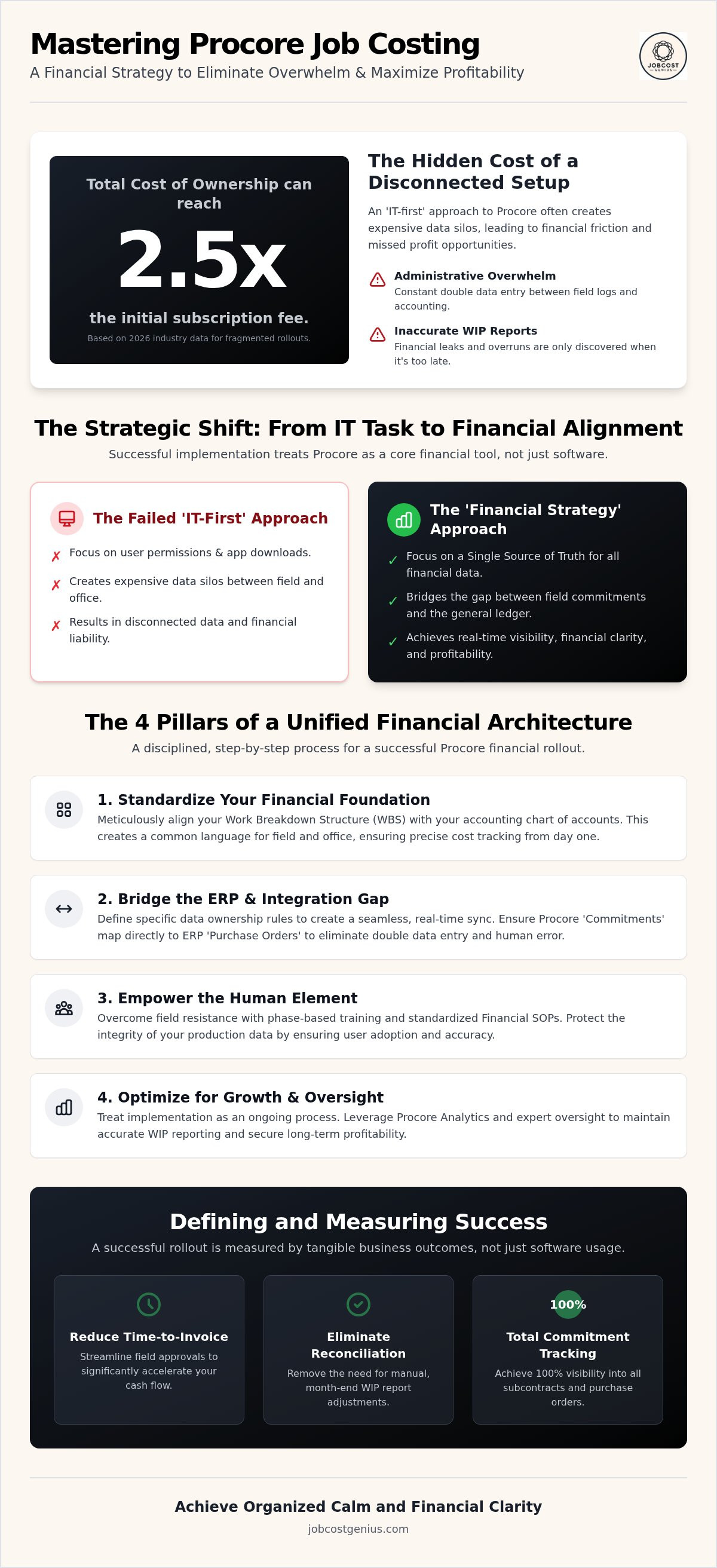
In 2026, the total cost of ownership for a Procore rollout often reaches 2.5 times the initial subscription fee due to fragmented implementation and integration gaps. You've likely experienced the administrative overwhelm of double data entry between your field logs and accounting software. This friction often stems from an incomplete procore job costing setup that fails to bridge the gap between production and the general ledger. It's frustrating when inaccurate WIP reports emerge. You deserve organized calm and financial clarity rather than a mountain of manual spreadsheets.
This guide provides a disciplined framework to align field production with office financial oversight. Mastering this strategic rollout ensures real-time visibility into your job costs and creates a seamless sync between field commitments and the balance sheet. We will examine the latest 2026 Work Breakdown Structure (WBS) standards, the impact of the One Big Beautiful Bill Act on equipment depreciation, and the methodical steps required to build a unified financial architecture that serves your entire organization.
Key Takeaways
- Shift your implementation focus from a basic software installation to a strategic financial alignment that eliminates data silos between the field and the back office.
- Establish a robust procore job costing setup by mapping your Work Breakdown Structure (WBS) directly to your accounting chart of accounts for precise tracking.
- Define specific data ownership rules for your ERP integration to ensure a seamless, real-time sync between field commitments and the general ledger.
- Utilize phase-based training and standardized Financial SOPs to overcome field resistance and protect the integrity of your production data.
- Treat implementation as an ongoing process by leveraging Procore Analytics and expert oversight to maintain accurate WIP reporting and long-term profitability.
Procore Implementation as a Financial Strategy: Why the 'IT-First' Approach Fails
Most construction firms approach software implementation as a series of technical hurdles. They focus on user permissions, mobile app downloads, and login credentials. This IT-first approach almost always fails to deliver financial clarity. In 2026, industry leaders recognize that a robust procore job costing setup is a strategic financial alignment rather than a technical one. If your project managers and bookkeepers are looking at different numbers, you don't have a system; you have a liability. Data silos are expensive. They lead to inaccurate WIP reports and missed profit opportunities that only surface when it's too late to pivot.
The move toward a Single Source of Truth model is no longer optional for firms scaling their annual volume. By establishing a unified framework, you ensure that every dollar committed in the field is immediately visible to the office. This transition requires a disciplined expert who understands the unique complexities of construction finance better than a general software consultant. You shouldn't wait for a project to fail before realizing your data is disconnected. A proactive procore job costing setup allows you to identify financial leaks in real-time. This is the difference between surviving a project and mastering your profitability.
The Field-to-Office Data Gap
Identifying where financial information gets lost is the first step toward stability. Data often vanishes in the transition from field-issued change orders to the back-office ERP. Without a unified Work Breakdown Structure, your team is essentially speaking two different languages. Procore Financials serves as the essential bridge, ensuring that every field commitment is captured and reflected in your real-time reporting. This level of integration protects your profit margins by catching overruns before they compound. It transforms administrative overwhelm into organized calm.
Defining Success Metrics for Your Rollout
You must set clear financial KPIs before the first training session. Success isn't just about using the software; it's about measurable business outcomes. Focus on these specific targets to ensure your Procore Financials Integration provides a return on investment:
- Reducing time-to-invoice: Streamline field approvals to accelerate your cash flow.
- Eliminating reconciliation: Remove the need for month-end WIP report manual adjustments.
- Total commitment tracking: Achieve 100% visibility for all subcontracts and purchase orders within the platform.
When you achieve these metrics, you gain the professional confidence that comes from knowing your numbers are accurate. JobCost Genius acts as your strategic partner in this process, ensuring your data sync functions as a reliable engine for growth.
Standardizing Your Financial Foundation: Cost Codes and WBS
WBS is the foundational hierarchy for all project financial data. A successful procore job costing setup requires more than just importing a list of codes. It demands a meticulous alignment between your field production activities and your office accounting categories. Many contractors fall into the 'Too Much Detail' trap by creating hundreds of CSI cost codes that project managers find impossible to track accurately on a mobile device. This creates a friction point where field teams stop using the tool. You need enough granularity to identify budget leaks but enough simplicity to ensure field compliance. Striking this balance is the hallmark of a disciplined, expert-led implementation.
Mapping Procore to your General Ledger (GL) is where financial stability is built. When Procore 'Commitments' sync perfectly with ERP 'Purchase Orders', you eliminate the risk of double data entry and human error. This process must follow established Contract Cost Principles and Procedures to ensure compliance and audit readiness. You also need a clear strategy for handling indirect costs and labor burden within the platform. If these aren't accounted for in your setup, your job cost reports will always look better than your bank balance. Consistent naming conventions across all active projects are the final piece of this foundational puzzle, providing the meticulousness required for enterprise-level oversight.
Work Breakdown Structure (WBS) Best Practices
In 2026, Procore's updated WBS terminology allows for greater flexibility in portfolio-level reporting. Utilizing sub-jobs and cost types is essential for multi-phase commercial projects where distinct tracking of buildings or floors is required. This structure ensures that your data supports accurate WIP reporting for construction companies. By organizing your financial data this way, you move from administrative overwhelm to a state of financial clarity. If you're struggling to align these systems, our Procore Financials Integration service provides the expert bookkeeping oversight necessary to ensure your sync actually works.
Bridging the ERP Gap: Best Practices for Financial Integrations
Achieving a seamless procore job costing setup requires a clear understanding of your ERP's limitations. Whether you utilize QuickBooks Online, Sage 300 CRE, or Acumatica, the integration is rarely a simple "plug and play" scenario. Success depends on the "Golden Rule" of data entry: you must determine which system owns each specific data point. Generally, Procore should own the commitments and change events, while your ERP remains the system of record for payments and the general ledger. This clear distinction prevents the administrative overwhelm of chasing conflicting numbers across different platforms.
Managing the ERP Integrations (ERPI) tool is a daily task, not a monthly one. In 2026, even with advanced sync capabilities, manual oversight remains essential. Without regular review, "ghost" costs can haunt your ledger. These discrepancies occur when a commitment is modified in Procore but fails to update in the ERP due to a sync error or a mapping conflict. A disciplined expert ensures these errors are resolved immediately, maintaining the foundational strength of your financial reporting and ensuring your procore job costing setup stays accurate.
Managing Commitments and Direct Costs
Automating the flow of subcontracts and direct costs is the primary goal of a successful integration. By setting "Approved" status triggers, you ensure that only verified financial data migrates to your accounting software. This automation is a core benefit of Procore financials integration services. It eliminates the risk of double entry and ensures your office team works with the same production data as your project managers, fostering a state of financial clarity.
Handling Change Orders and Prime Contracts
Change orders and prime contracts require specific attention to maintain real-time visibility. Change events should be captured in the field as they happen. This ensures they hit the budget before they become formal commitments. This proactive approach prevents budget surprises and protects your margins. Additionally, syncing prime contract billings, specifically AIA G702/703 forms, directly with accounts receivable reduces your time-to-invoice. We also recommend standardized retention tracking within the Procore-ERP ecosystem. This ensures that withheld funds are accurately reflected on both the job cost report and the balance sheet, providing a true picture of your project's financial health.
The Human Element: Training Workflows for Data Accuracy
Software is only as effective as the people operating it. Many firms fail by overwhelming staff with every module on day one. A phase-based training approach allows your team to master the basics of the procore job costing setup before moving to complex financials. This methodical rollout builds professional confidence and prevents burnout. You must establish clear Financial SOPs for both Project Managers and Superintendents. These documents act as a playbook, defining exactly when and how data enters the system to maintain a state of financial clarity.
Every successful implementation requires a "Procore Champion." This individual acts as a disciplined guide, maintaining data hygiene across all active projects. They serve as the internal expert who resolves technical friction before it becomes a financial bottleneck. This role is central to leading the weekly "Field-to-Office" financial review meeting. This meeting isn't a casual status update; it's a strategic audit where project managers and accountants verify that costs are hitting the correct codes. It ensures that the production data from the field aligns perfectly with the expectations of the back office.
Field Team Accountability
Superintendents are your front line for data accuracy. They must be trained to code daily logs and delivery tickets with precision. Timely field data is the lifeblood of effective construction bookkeeping services. If a delivery ticket isn't coded correctly on-site, the office team spends hours on forensic accounting later. Simplify the mobile experience to encourage high adoption. When the procore job costing setup feels like a tool rather than a burden, field teams are more likely to provide the granular data you need for accurate reporting.
The Office Review Cycle
Data shouldn't flow into your ERP without a safety net. Your bookkeeping team must audit Procore entries before any export occurs. This standardized approval workflow for vendor invoices and pay apps prevents errors from reaching the general ledger. It transforms the feeling of administrative overwhelm into organized calm. Develop a feedback loop that functions as a continuous improvement mechanism. When the office identifies a recurring coding error, they must communicate it back to the field immediately. This constant refinement ensures long-term accuracy and builds foundational strength. If you need help establishing these workflows, our Procore Financials Integration experts can design a custom training roadmap for your team.
Optimizing for Growth: Ongoing Oversight and Procore Management
A successful rollout is a foundation for continuous improvement, not a final destination. Many contractors treat their procore job costing setup as a one-time technical task, but the most profitable firms view it as an ongoing management process. As you scale from your initial Starter Plan projects to more complex, high-volume Premium Plan contracts, your financial architecture must adapt. This evolution requires moving beyond basic data entry to leveraging Procore Analytics for deep insights into your long-term profitability trends. This level of oversight ensures your infrastructure supports your growth rather than hindering it.
During this period of expansion, the value of outsourced bookkeeping for construction firms becomes evident. An expert partner provides the meticulousness required to maintain a clean ledger while your team focuses on project delivery. This partnership transforms the administrative overwhelm of software management into a state of organized calm. It allows you to trust the data driving your business decisions and ensures your growth remains sustainable.
Quarterly Financial Audits
Maintaining foundational strength requires regular maintenance. Conduct quarterly audits of your cost code usage to prune unnecessary complexity that may have crept into your system over time. Reviewing user permissions is equally critical to maintain strict internal financial controls and protect sensitive data. In 2026, you must also ensure your setup remains compliant with the latest labor burden and payroll standards. These audits prevent 'data drift' and keep your reporting accurate. A disciplined audit schedule is the hallmark of a seasoned industry veteran who values efficiency and foundational strength.
Partnering for Procore Financial Success
JobCost Genius acts as your strategic guide, managing the complex 'Financials' tab so you can focus on building. We specialize in ensuring your procore job costing setup produces WIP reports that are 'Bank-Ready' and accurate. Our expert oversight bridges the gap between field production and office reporting, providing the financial clarity needed for sustainable scaling. Software alone won't fix bad data, but a disciplined bookkeeping partner will. If you're ready to fix your integration and gain real-time visibility into your costs, Contact JobCost Genius today.
Mastering the Future of Construction Financial Management
True operational success isn't defined by software adoption; it's defined by architectural alignment. You've learned that a unified Work Breakdown Structure and disciplined training workflows are the only ways to eliminate expensive data silos. By transitioning from an IT-first approach to a financial-first strategy, you protect your profit margins and gain real-time visibility into every project phase. This shift transforms administrative overwhelm into organized calm, allowing your leadership team to make decisions based on verified production data rather than intuition.
Achieving a flawless procore job costing setup requires more than just technical knowledge. It demands the meticulousness of a seasoned industry veteran who understands the unique complexities of construction finance. As Procore-to-Accounting integration specialists, JobCost Genius provides the nationwide financial oversight necessary to ensure your field production and office reporting stay perfectly in sync. Streamline your field-to-office sync with specialized construction bookkeeping experts from JobCost Genius today. Your journey toward financial clarity and sustainable growth starts with a strategic commitment to data integrity.
Frequently Asked Questions
How long does a typical Procore Financials implementation take?
A standard rollout typically spans three to six months depending on your company's annual construction volume and the complexity of your existing ERP. The technical procore job costing setup can be completed quickly; however; aligning your historical data and training staff takes deliberate effort. Rushing this process often leads to data silos. A methodical approach ensures your financial foundation remains stable as you transition from legacy spreadsheets to a unified platform.
Can Procore replace my existing accounting software like QuickBooks?
No, Procore is not a replacement for your general ledger software like QuickBooks or Sage. It functions as a project management and financials tool that must sync with your accounting system to be effective. While Procore manages commitments, change events, and job costs, your ERP remains the system of record for taxes, payroll, and corporate financial statements. The goal is a seamless integration where both systems share a single source of truth.
What are the most common mistakes during Procore implementation?
The most frequent error is treating implementation as a technical IT task rather than a financial strategy. Many firms also create overly complex cost codes that discourage field adoption. Failing to establish a clear "Golden Rule" for data ownership between Procore and the ERP often results in double data entry. You must also avoid rolling out every tool at once. A phase-based approach allows your team to master foundational job costing first.
Do I need a consultant to help with Procore Financials setup?
Expert oversight is highly recommended because software alone cannot fix poor data entry or broken workflows. A specialized partner ensures your procore job costing setup aligns with industry-specific accounting standards. JobCost Genius provides the disciplined guidance needed to bridge the gap between field production and office reporting. This partnership transforms administrative overwhelm into financial clarity, ensuring your integration provides a tangible return on investment through accurate, real-time reporting.
How does Procore help with WIP reporting accuracy?
Procore improves WIP accuracy by capturing cost commitments and change events in the field as they occur. When integrated correctly, these updates flow directly into your budget, providing a real-time view of your percentage of completion. This eliminates the need for month-end manual reconciliations and prevents "ghost" costs from skewing your numbers. Accurate WIP reporting allows you to identify overbillings and underbillings early, protecting your project margins and cash flow.
Is Procore Financials worth the cost for small to mid-sized contractors?
For contractors scaling beyond $10M in annual volume, the efficiency gains typically outweigh the subscription and implementation fees. The total cost of ownership in the first year is often two to 2.5 times the subscription price, but the reduction in manual errors and double entry provides significant long-term value. Using a Starter or Growth plan alongside expert bookkeeping oversight ensures that your investment translates into better project control and increased profitability.
How do I handle labor burden and payroll in Procore?
Labor burden is managed by establishing specific cost types in your WBS and syncing timesheet data from the field. You must apply burden rates, including taxes, benefits, and insurance, to your raw labor costs to see your true job costs. JobCost Genius specializes in payroll management and can help you configure these rates accurately within the platform. This ensures that your labor budget reflects the total cost of your workforce, not just hourly wages.
What is the best way to train field staff on Procore Financials?
The most effective method is a phase-based approach supported by clear Financial SOPs. Start by training a "Procore Champion" who can provide on-site support to superintendents and project managers. Focus on simplifying the mobile experience to encourage high adoption rates for daily logs and delivery tickets. Regular "Field-to-Office" review meetings reinforce the importance of data hygiene and help correct recurring coding errors before they impact your general ledger.


