

Why does a project that looks profitable on the job site often result in a disappearing bottom line by the end of the fiscal year? It's a frustrating reality for many firms facing the 2026 economic climate, where input prices for nonresidential construction have risen 8.4% and energy costs have surged. Most contractors struggle with a construction company overhead analysis that relies on guesswork rather than granular data. You aren't alone if you find it difficult to distinguish between direct job costs and the persistent weight of business expenses like the $130,000 annual salary for a project manager or rising office rents.
You deserve to know exactly where every dollar goes so you can bid with absolute confidence. This guide provides a specialized framework to help you master the art of tracking and allocating indirect costs to protect your profit margins. We'll examine the true cost of doing business in today's market, from insurance premiums to software subscriptions. By the end of this analysis, you'll have the financial clarity needed to build more accurate bidding templates and support the sustainable scaling of your firm.
Key Takeaways
- Perform a rigorous construction company overhead analysis to distinguish between job-specific costs and the indirect expenses that erode your bottom line.
- Categorize your expenses into fixed and variable overhead to understand how scaling your contract volume impacts your total business costs.
- Identify the most accurate allocation method for your trade, whether you rely on the percentage method or the direct labor hour method for labor-heavy firms.
- Implement a five-step financial feedback loop that starts with clean data reconciliation and isolates often-misclassified indirect labor costs.
- Leverage specialized support and Procore financials integration to bridge the data gap between the field and the office for real-time clarity.
What is Construction Company Overhead Analysis?
Construction company overhead analysis is the systematic review of indirect costs that you cannot bill directly to a specific project. While standard job costing tracks the labor, materials, and equipment consumed on a job site, overhead analysis focuses on the expenses that keep your business running behind the scenes. Construction overhead is the total cost of business existence regardless of project volume.
Many contractors treat overhead as a static percentage added to a bid without regular verification. This approach is risky. Unanalyzed overhead often acts as a hidden profit eater, eroding 5-10% of annual margins because the actual costs of administration, insurance, and facilities are higher than the estimated rates. Mastering construction cost terminology is the first step toward identifying where your money is leaking and reclaiming those lost points.
The Goal: Moving Beyond the "Guess-and-Check" Method
The primary objective of this analysis is to establish a verified baseline for accurate markup and margin targets. You shouldn't have to guess if your markup is sufficient to cover your office staff or rent. By isolating indirect costs, you can identify specific inefficiencies in your administrative or shop operations that are dragging down your net profit. This ensures every bid you submit contributes its fair share to company solvency, protecting your firm from the "profitless volume" trap where you're busy but not making money.
Why Generalist Bookkeeping Fails This Analysis
Generalist bookkeepers often lack the industry-specific knowledge required for a deep construction company overhead analysis. They frequently miscategorize labor burden, which includes payroll taxes, workers' comp, and benefits, as general overhead instead of allocating it as a direct project cost. This common error inflates your overhead rate and makes your individual jobs look more profitable on paper than they are in reality.
Specialized accounts like "Shop Expense" or "Small Tools" require a nuanced understanding of how field operations interact with the back office. A generalist might miss these distinctions, leading to skewed reports that don't reflect your true operational costs. Understanding the difference between a Construction Bookkeeper vs Generalist: Why It Matters is essential for any firm looking to scale. When your data is categorized correctly from the start, your overhead analysis becomes a strategic tool for growth rather than a source of administrative overwhelm.
Categorizing Costs: Fixed vs. Variable Construction Overhead
Effective construction company overhead analysis requires a disciplined approach to categorization. You must distinguish between costs that remain static and those that fluctuate with your project volume. The legal definition of overhead costs provides a baseline for this, citing items like general office salaries and insurance as standard components. Misclassifying these expenses leads to inaccurate bidding and eroded margins that are difficult to recover once a contract is signed.
Fixed Indirect Costs: The Foundation
Fixed overhead represents the foundational cost of your firm's existence. These expenses remain constant regardless of whether you're running at 50% or 100% capacity. In 2026, typical monthly office rent and utilities for a mid-sized firm range between $2,900 and $7,500. Other fixed costs include executive salaries for non-field staff and professional fees for legal or specialized bookkeeping support. Because these costs are predictable, they form the bedrock of your annual budget and must be covered before you can claim a single dollar of net profit.
Variable Indirect Costs: The Scaling Factor
Variable indirect costs scale alongside your business activity but aren't billable to a single contract. Marketing and lead generation expenses, which currently average between $500 and $2,500 monthly, fall into this category as you ramp up efforts to fill your pipeline. Software subscriptions for platforms like Procore or Sage also scale as you add more users or increase project volume. Training, safety certifications, and recruitment fees are similarly variable; they increase during periods of growth but can be dialed back when the market cools.
Some expenses inhabit a gray area that complicates your reporting. Vehicle fleets and small tool depreciation are primary examples. If a truck is used across multiple sites in a single day, it's often more practical to treat its maintenance and depreciation as overhead rather than trying to split fuel costs by the hour for each job. However, if these aren't tracked carefully, they can balloon into an unmanaged expense that quietly kills your profit. You must decide on a consistent policy for these costs to ensure your data remains comparable month over month.
Clean data is impossible without a specialized construction chart of accounts. Using a generalist ledger often results in "dumping ground" categories that obscure your true financial health. To gain total control over these numbers, consider exploring specialized bookkeeping plans designed for the unique needs of the trade. Managing these details allows you to stay in the field while your back office provides the data needed to scale with absolute confidence.
Overhead Allocation Methods: How to Distribute the Weight
Allocating indirect costs is where the theoretical work of a construction company overhead analysis meets the practical reality of bidding. You must decide how to distribute the weight of your office and shop expenses across your projects so that each job remains profitable. The best method is the one you can consistently track without creating administrative gridlock.
The Percentage of Direct Costs Method
This approach is the most common due to its simplicity. You calculate an "Overhead Multiplier" for 2026 by dividing your total annual overhead by your total annual direct costs. If your overhead is $200,000 and your direct costs are $2,000,000, your multiplier is 10%. Applying this flat rate to every bid is straightforward, but it has limitations. It can penalize high-material jobs unfairly. A project with expensive specialty finishes will carry a higher overhead burden than a labor-intensive job of the same complexity, even if the administrative effort is identical.
The Direct Labor Hour Method
Labor-heavy trades often find more accuracy in the direct labor hour method. Your overhead expenses, such as safety training and project management salaries (which range between $109,000 and $130,000 in 2026), are usually driven by the number of people you manage rather than the cost of the lumber they install. By dividing total overhead by total estimated labor hours, you arrive at an hourly overhead rate. Adding this to your burdened labor rate ensures your bids are resilient against material price volatility.
Activity-Based Costing (ABC)
Complex, multi-division firms may require the precision of Activity-Based Costing. This method assigns overhead to specific activities, such as the number of permits processed or the volume of equipment maintenance required. While ABC offers a high level of accuracy, it requires sophisticated tracking systems to be effective. Most growing firms find that a refined labor-hour method or a hybrid approach offers the best balance of accuracy and efficiency for a standard construction company overhead analysis.
The Eichleay Formula for Government Contracts
If your firm handles federal or government projects, you may encounter the Eichleay formula. This specialized calculation remains the industry standard for substantiating overhead recovery during project delays. Because these claims are highly scrutinized, they require meticulous WIP reporting to prove that your office expenses continued even when the field work stopped. Surviving an audit for a delay claim is nearly impossible without specialized financial oversight that understands the nuances of federal regulations and contract law.
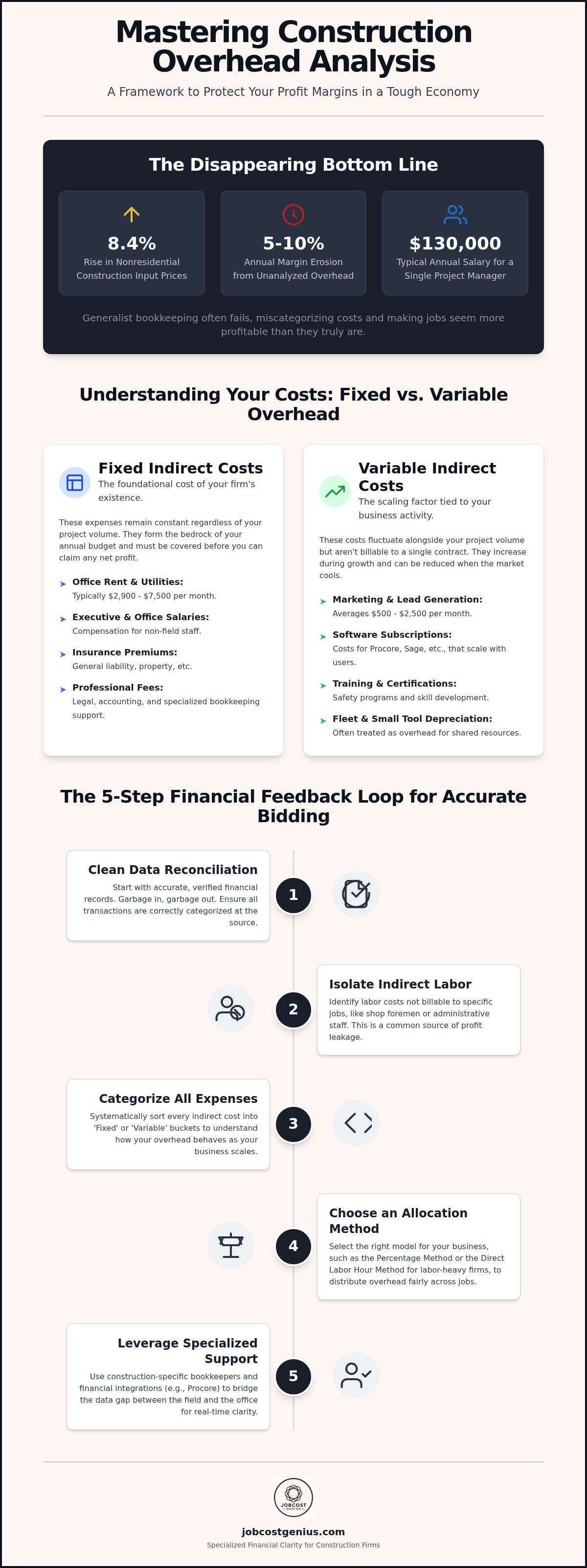
Performing the Analysis: A 5-Step Feedback Loop
A reliable construction company overhead analysis isn't a "set it and forget it" task. In a volatile 2026 market, waiting until year-end to review your numbers is a recipe for disaster. You need a dynamic feedback loop that turns financial data into actionable bidding intelligence. This five-step process ensures your office expenses never outpace your project revenue.
- Step 1: Clean the data. Reconcile all bank and credit accounts. You can't analyze what you haven't verified; bad data leads to bad bids.
- Step 2: Isolate indirect labor. This is the most common misclassification. Ensure project managers and estimators aren't buried in general overhead if their time can be attributed to specific job costs.
- Step 3: Compare actual vs. recovered overhead. Look at the total overhead spent versus what you actually billed out to clients through your markup.
- Step 4: Adjust the Burn Rate. Your "Overhead Burn Rate" changes with the seasons. Account for 2026 realities, such as the 70% surge in energy prices that impacts utility and fuel costs.
- Step 5: Update bidding templates. If your actual overhead is 12% but your templates still use 8%, you're losing money on every contract you sign.
Comparing Budget vs. Actual (BVA)
Analyzing why office expenses exceeded your quarterly forecast is vital for maintaining a healthy bottom line. Monthly financial statements help you identify "scope creep" within your administrative operations before it becomes a systemic issue. Effective cash flow management allows you to time large overhead purchases, such as new software seats or yard maintenance, when your project cycles are most liquid. This level of oversight transforms your back office from a cost center into a strategic asset.
The Role of WIP in Overhead Recovery
Work-in-Progress (WIP) reports are your early warning system for overhead recovery. They allow you to see if specific projects are "under-contributing" to your business costs in real time. Identifying these profit gaps while a job is still active gives you the chance to course-correct. If you find your billings aren't keeping pace with your actual output, fixing overbilling on WIP reports can serve as a critical recovery tactic. Protecting your margins requires knowing exactly how much overhead each project has absorbed at any given moment.
To stop the guesswork and start managing by the numbers, consider a Growth Plan that puts professional financial analysis at your fingertips.
Streamlining Overhead Analysis with Specialized Support
Software like QuickBooks serves as a reliable ledger, but it rarely provides the depth needed for a sophisticated construction company overhead analysis. Tools alone cannot interpret why your shop expenses are rising or if your indirect labor is being recovered correctly. You need a system that connects site activity directly to your financial reports. The Procore financials integration bridges this field-to-office gap, ensuring that project data flows seamlessly into your accounting software. JobCost Genius takes this raw data and transforms it into actionable overhead insights, allowing you to focus on production while we handle the meticulous reporting.
As your firm grows, your overhead complexity increases. You might start with our Starter Plan for essential bookkeeping, but as you add more project managers and equipment, transitioning to a Growth Plan provides the deeper analysis required to maintain your margins. Managing these transitions smoothly is the difference between a firm that scales and one that stalls due to administrative overwhelm.
Automating the Data Flow
Manual data entry is a primary source of financial leakage. By automating the data flow in AP/AR management, you reduce the human errors that skew your overhead calculations. We ensure your labor burden is automatically calculated during payroll cycles, including taxes and workers' comp. This prevents these costs from accidentally ending up in a general overhead bucket where they obscure your true job profitability. Recurring monthly bookkeeping provides the real-time analysis you need to catch cost spikes before they erode your quarterly profit.
Expert Oversight vs. In-House Overhead
Hiring a full-time in-house controller is a significant overhead expense itself, often costing six figures annually. Outsourcing to specialized professionals provides the same level of disciplined expert guidance at a fraction of that cost. This strategic partnership ensures your financial statements are always audit-ready and compliant. You gain the peace of mind that comes from knowing your numbers are accurate and your business infrastructure is foundational for growth. Accuracy in your construction company overhead analysis isn't just about compliance; it's about having the professional confidence to bid on larger, more complex projects.
Ready to find your hidden costs? Get a Financial Health Checkup from JobCost Genius.
Build Your Foundation for Sustainable Growth
Mastering a construction company overhead analysis is more than an administrative chore; it's a strategic necessity for protecting your bottom line in a volatile market. By accurately categorizing fixed and variable costs and implementing a disciplined feedback loop, you transform your back office into a profit-protecting engine. You won't have to wonder if your bids are high enough to cover your office staff or rising utility costs. Instead, you can operate with the organized calm that comes from total financial clarity.
JobCost Genius provides the specialized construction-only expertise you need to scale with confidence. With over 20 years of industry experience and national service, we understand the unique complexities of labor burden and WIP reporting. Our transparent tiered pricing starts at $800/month, ensuring you have a plan that fits your current stage of growth. Get the financial clarity your business deserves with JobCost Genius. It's time to build your firm on a foundation of precision and professional strength.
Frequently Asked Questions
How often should a construction company perform an overhead analysis?
A construction company should perform an overhead analysis at least quarterly, though monthly reviews are ideal in the current 2026 economic environment. With energy prices surging nearly 70% and interest rates remaining high, waiting for an annual review is too slow. Monthly analysis allows you to adjust your "Overhead Burn Rate" in real time. This ensures your bidding templates remain accurate as market conditions shift, protecting your profit margins from unexpected administrative cost spikes.
What is a "normal" overhead percentage for a general contractor in 2026?
Typical overhead for residential construction ranges from 8% to 12% as of early 2026. However, this varies based on your specific trade and volume. With input prices for nonresidential construction rising 8.4% year-over-year, your "normal" might shift. It's vital to calculate your own rate rather than relying on industry averages. A precise construction company overhead analysis will reveal your firm's specific baseline, ensuring you don't under-bid in a high-inflation environment.
Is labor burden considered overhead or a direct job cost?
Labor burden should be treated as a direct job cost rather than overhead. This includes payroll taxes, workers' comp, and benefits directly tied to field employees. Misclassifying these as overhead inflates your overhead rate and makes individual projects appear more profitable than they actually are. By correctly allocating labor burden to specific jobs, you gain a clearer understanding of your true gross profit and a more accurate foundation for your company-wide financial reporting.
Can I use a general bookkeeper for my construction overhead analysis?
Using a general bookkeeper is often insufficient for a specialized construction company overhead analysis. Generalists frequently lack an understanding of industry-specific accounts like "Shop Expense" or the nuances of labor burden allocation. They may miss the "Field-to-Office" data gaps that lead to inaccurate reporting. A specialized expert understands the unique complexities of the trade, ensuring your financial statements are audit-ready and providing the clarity needed to scale your firm effectively.
How do I include my overhead rate in my project bids?
You include your overhead rate in bids by applying an overhead multiplier to your total estimated direct costs. For example, if your verified overhead rate is 10%, you multiply your direct costs (labor, materials, equipment) by 1.10. Alternatively, labor-heavy trades may add an hourly overhead rate to their burdened labor rate. This ensures every contract contributes its fair share toward your business's existence costs, such as office rent and project management salaries.
What is the difference between indirect costs and overhead?
While often used interchangeably, indirect costs are expenses that support multiple projects but aren't tied to a specific one; overhead represents the total cost of business existence. For instance, a vehicle fleet used across several sites is an indirect cost. Office rent and executive salaries are pure overhead. Distinguishing between these allows for more granular allocation methods, helping you understand which parts of your operations are driving your business expenses the most.
How does overbilling on a WIP report affect my overhead analysis?
Overbilling on a WIP report can mask the fact that a project is under-contributing to your overhead recovery. If you've billed ahead of your actual progress, your job may appear more profitable on paper than it is in reality. This creates a false sense of security regarding your margins. A rigorous construction company overhead analysis uses verified WIP data to ensure that overhead is being recovered based on actual costs incurred, not just progress billings.
Will Procore integration help me track my overhead more accurately?
Procore financials integration significantly improves overhead tracking by automating the data flow between the field and the back office. This sync reduces manual entry errors in AP/AR management and ensures that site-driven expenses are captured in real time. By eliminating the data gap, you gain immediate visibility into how project activity impacts your total business costs. This automation allows you to focus on production while maintaining the meticulous financial oversight required for scaling.


