

Bondability is a byproduct of a disciplined back office, not just a year-end adjustment by your CPA. Many contractors believe that securing higher limits is simply a matter of having a long enough track record or a strong relationship with an agent. However, underwriters prioritize the "Three C's": Character, Capacity, and Capital. It's natural to feel overwhelmed by the complexity of GAAP-compliant reporting or the fear of a denial due to poor record-keeping. Preparing the right financial statements for surety bonds often feels like a high-stakes hurdle that drains both your time and your budget.
You don't have to face the underwriting process with uncertainty. This guide provides a clear roadmap to becoming bondable by outlining exactly which documents you need and how to prepare your back office for success. We'll break down the specific thresholds for CPA-reviewed statements, the critical role of WIP reporting, and how to transition from basic record-keeping to sophisticated, audit-ready oversight. You'll learn how to build a streamlined process for monthly reporting that transforms your financial clarity and positions your business to take on much larger projects.
Key Takeaways
- Understand how underwriters evaluate your business based on the "Three Cs" of Capital, Capacity, and Character to secure higher bonding limits.
- Identify the specific financial statements for surety bonds required at different project thresholds, ranging from internal compilations to CPA-reviewed reports.
- Learn how to standardize your Chart of Accounts and reconcile your WIP schedule monthly to eliminate year-end reporting stress and administrative overwhelm.
- Determine the level of CPA assurance your business needs based on your current project volume and long-term growth goals.
- Discover how enterprise-level support from a Growth or Premium Plan provides the proactive financial oversight needed to maintain a bondable back office.
The Role of Financial Statements in the Surety Underwriting Process
Surety bonds are fundamentally different from standard insurance policies. While insurance protects you against unforeseen losses, a surety bond acts as a three-party financial guarantee. To understand what a surety bond is, you must view it as a specialized line of credit. The surety company isn't just selling you a policy; they're co-signing your ability to perform on a contract. Because of this, the quality of your financial statements for surety bonds serves as your primary tool for negotiation. High-quality financials act as a professional resume for your firm, proving you have the stability to handle the risks of the job site.
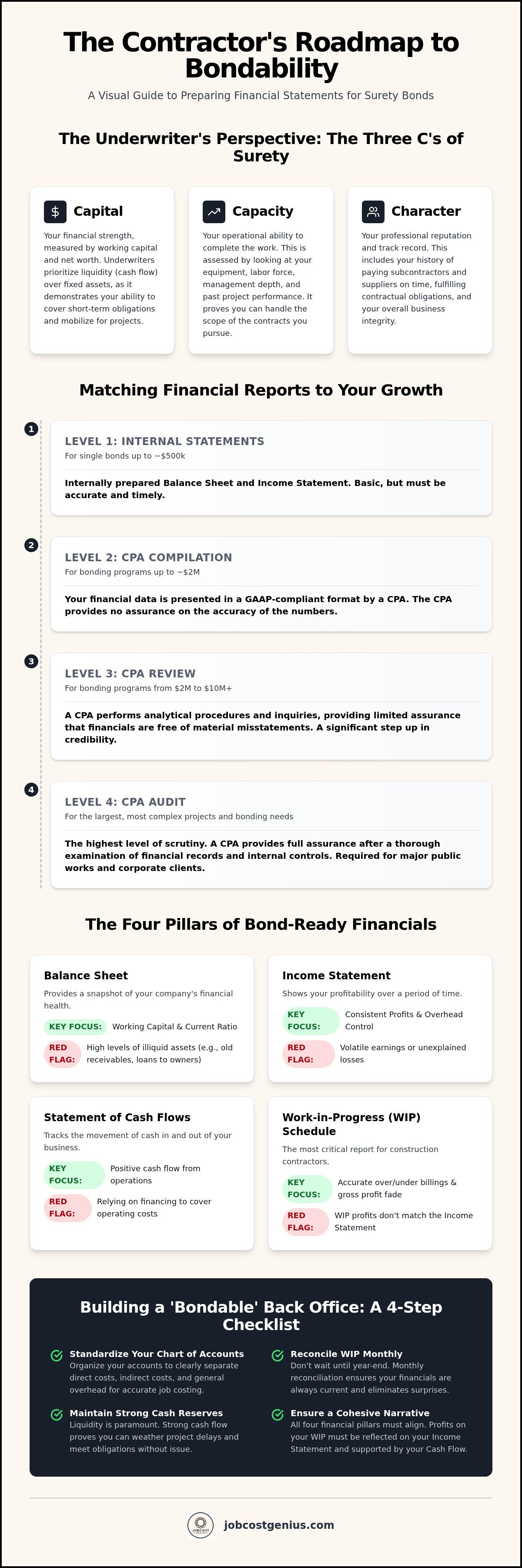
The underwriting process centers on the "Three Cs": Capital, Capacity, and Character. Capital refers to your financial strength, specifically your working capital and net worth. Capacity measures your ability to physically complete the work, looking at your equipment, labor force, and management depth. Character assesses your reputation and track record for paying subcontractors and suppliers. When these three elements are documented clearly, your bonding agent can advocate for the higher limits you need to grow.
Understanding the Surety's Perspective on Risk
Underwriters don't just look at the bottom line. They prioritize liquidity over total assets. A contractor might own millions in heavy equipment, but if they lack the cash flow to meet payroll during a project delay, the surety sees a high risk of default. Surety Underwriting is the process of verifying a contractor's financial and operational stability. They look at historical performance to gauge how you've managed overhead control and project profitability in the past. Consistent profits on your Income Statement signal that you're a safe bet for future projects.
Why Bonding Capacity is Your Growth Ceiling
Your bonding limit dictates the size and scope of the contracts you can pursue. If your back office isn't producing accurate financial statements for surety bonds, you'll likely hit a growth ceiling that stalls your company's progress. Limited capacity prevents you from bidding on lucrative public works or large-scale private developments that require performance and payment bonds. Maintaining a clean financial history provides a significant competitive advantage over firms with disorganized books. For those just starting to professionalize their reporting, the 2026 Construction Accounting Guide for Small Firms offers a foundational look at the bookkeeping standards required to build this trust with underwriters.
The Four Pillars: Essential Financial Statements for Surety Bonds
Underwriters don't look at your reports in isolation. They search for a cohesive narrative where the Balance Sheet, Income Statement, Statement of Cash Flows, and WIP Schedule align perfectly. If your WIP shows a project profit that doesn't manifest on your Income Statement, or if your cash flow doesn't support your reported equity, the surety will likely flag your file for closer scrutiny. Providing comprehensive financial statements for surety bonds is about proving that your back office is as disciplined as your field crew. For contractors seeking federal work, the SBA Surety Bond Guarantee Program offers a pathway to larger contracts, but the documentation requirements remain just as rigorous as private markets.
The Balance Sheet and Working Capital
Calculating your "Current Ratio" is just the start. Underwriters look at this number to ensure you have enough liquid capital to cover short-term obligations without halting operations. However, they often "haircut" or discount assets they deem illiquid. Loans to shareholders, aged receivables over 90 days, and inventory are frequently removed from the working capital calculation. Maintaining high levels of cash on hand is essential for project mobilization. You must also account for overbilling and underbilling. Overbilling represents a liability for work yet to be performed, while underbilling is an asset representing earned revenue not yet invoiced. If these aren't balanced, your reported equity may be misleading, which is why professional bookkeeping support is vital for maintaining accuracy.
The Work-in-Progress (WIP) Schedule
A standard Profit and Loss statement is insufficient for construction bonding because it fails to account for the timing of costs and billings. The WIP schedule is the specialized report that bridges this gap. It tracks the total contract price, estimated costs, and actual costs to date to determine "earned" revenue. A major weakness in many contractor's books is the failure to reconcile the WIP schedule to the General Ledger monthly. When these two systems don't "talk" to each other, it creates discrepancies that underwriters view as a lack of control. To master these mechanics, refer to our WIP Reporting for Construction: The Definitive 2026 Guide. Producing accurate financial statements for surety bonds requires this level of detail to ensure your earned revenue matches your actual project progress.
Compilation vs. Review vs. Audit: Choosing the Right Preparation Level
Choosing the right level of financial preparation is a strategic decision that directly impacts your bonding capacity. While internal reports might suffice for smaller projects, larger contracts require a higher degree of verification from a third party. The three primary levels of CPA-prepared financial statements for surety bonds include compilations, reviews, and audits. Each level offers a different degree of assurance to the underwriter regarding the accuracy and reliability of your data. A Compilation is the most basic level. The CPA takes your internal numbers and puts them into a standard format without performing any testing or verification. This provides no assurance. It's often acceptable for bonds between $750,000 and $2 million, but it won't be enough as you scale toward larger public works.
When Internal Statements Aren't Enough
Your QuickBooks printouts are a starting point, but they rarely meet the standards required for significant bonding lines. As of 2026, most surety companies require CPA-reviewed statements once a single bond exceeds $2 million or your aggregate program grows. Sureties trust third-party verification because it adds a layer of accountability that internal reporting lacks. Preparing for this transition can be stressful. JobCost Genius helps by organizing your raw data, reconciling accounts, and ensuring your financial statements for surety bonds are audit-ready. This makes the CPA's job faster and significantly lowers your professional fees.
The 'Review' – The Industry Standard for Growth
The financial review is the "gold standard" for mid-sized contractors. During a review, a CPA performs analytical procedures and makes inquiries to provide "limited assurance" that no material modifications are needed. They look closely at accruals, retention, and how you recognize revenue on your WIP. Moving to a Review level is a clear signal of business maturity. It shows underwriters that you're committed to transparency and have the infrastructure to support larger obligations. For contractors managing aggregate programs over $20 million, a full Audit becomes necessary. This involves extensive testing of transactions and physical inspections, representing the highest level of scrutiny in the industry.
How to Prepare Your Construction Financials for a Surety Audit
A successful audit starts with a disciplined back office. You can't expect a CPA to fix a year of messy bookkeeping in a few weeks without incurring massive fees. Preparing your financial statements for surety bonds requires a systematic approach to your data. Follow these five steps to ensure your books are audit-ready.
- Step 1: Standardize your Chart of Accounts. Use a construction-specific structure that separates direct job costs from general overhead.
- Step 2: Reconcile your WIP schedule to the General Ledger monthly. Discrepancies here are a major red flag for underwriters.
- Step 3: Clean up aging Accounts Receivable and Accounts Payable. Ensure your current assets are truly liquid.
- Step 4: Document your internal controls. Show that you have checks and balances for payroll and vendor payments.
- Step 5: Perform an overhead analysis. Accurate job costing depends on knowing your true burden rates.
Reconciling WIP to the General Ledger
Underwriters look for "profit fade" as a sign of poor project management or inaccurate estimating. Profit fade occurs when the projected profit at the start of a job steadily decreases as the project nears completion, and this pattern erodes underwriter trust in your reporting. If your WIP costs don't match your general ledger, it suggests your financial statements for surety bonds are unreliable. You must address overbilling (liabilities) and underbilling (assets) before the audit begins. Overbilling shows you've collected more cash than work performed, which represents a future obligation. Underbilling shows you've earned revenue you haven't yet invoiced. Both must be reconciled to ensure your equity is stated accurately.
Cleaning Up Aging AR and AP
Surety companies typically "zero out" or discount any accounts receivable older than 90 days when calculating your working capital. If you have old balances sitting on the books, they won't help your bonding capacity. Managing retention tracking is equally critical; ensure these funds are clearly identified so they don't get lost in your general AR. Implementing consistent construction cash flow management strategies helps you collect faster and keep your aging report clean. If your internal team is struggling to keep up with these reconciliations, our Growth Plan provides the professional oversight needed to maintain an audit-ready back office.
Building a 'Bondable' Back Office with JobCost Genius
Managing a construction company's finances shouldn't feel like a series of emergencies. Most contractors operate in a reactive state, scrambling every December to clean up books before a CPA review or audit. This approach is risky and often leads to missed opportunities for higher bonding limits. Transitioning to a proactive model ensures that your financial statements for surety bonds are always accurate and ready for inspection. JobCost Genius acts as your strategic guide, moving your back office from basic record-keeping to a state of organized, audit-ready clarity.
Tech Integration for Real-Time Underwriting
Data gaps between the field and the office often lead to the "profit fade" discussed earlier. Leveraging Procore Financials Integration Services creates a bridge that eliminates these discrepancies. When your project management software and accounting systems are in sync, you create a single source of truth. Automated data flow significantly reduces the risk of human error in your financial statements for surety bonds, providing your agent with real-time confidence in your liquidity and capacity. This level of technical sophistication signals to underwriters that your firm is a low-risk, high-discipline partner.
Continuous Support vs. One-Time Cleanup
Attempting an emergency cleanup right before an audit is significantly more expensive than maintaining monthly recurring bookkeeping. Our Growth Plan is designed to scale with your team, providing the specialized WIP Reporting and oversight needed as your bonding requirements increase. For contractors targeting massive projects or aggregate programs over $20 million, our Premium Plan offers the enterprise-level support required to navigate the most rigorous audits. We don't just fix past mistakes; we build the infrastructure for your future growth.
Steady financial management builds the character and capital that sureties demand. By integrating your field data and standardizing your reporting, you remove the administrative overwhelm that prevents you from bidding on larger contracts. Reach out to our team today for a financial health checkup to determine if your current back office is ready to support your next big project.
Secure Your Firm’s Future with Financial Clarity
Scaling your construction business requires more than just field expertise; it demands a back office capable of producing audit-ready data. By mastering the four pillars of reporting and reconciling your WIP monthly, you transform your financial statements for surety bonds from a burden into a strategic asset. You've seen how moving to a CPA-reviewed level of assurance can unlock the bonding capacity needed for larger public and private contracts. The transition from reactive year-end scrambles to proactive monthly oversight is the most reliable way to build trust with your underwriters and ensure long-term stability.
JobCost Genius acts as your strategic guide through every stage of business growth. As WIP Reporting Experts and Procore Financials Integration Partners, we provide the Specialized Construction Bookkeeping you need to stay organized and compliant. Don't let administrative overwhelm or poor record-keeping hold your business back from its full potential. Get Audit-Ready with JobCost Genius today and build the foundational strength your company deserves. You have the capacity to take on bigger projects; let’s make sure your books prove it.
Frequently Asked Questions
What is the difference between an internal and a CPA-prepared financial statement?
Internal statements are generated by your staff, while CPA-prepared financial statements for surety bonds involve an independent professional who organizes or verifies your data. Sureties trust CPA-prepared reports more because they follow GAAP standards and provide a level of assurance that internal reports lack. This third-party verification is often a mandatory requirement once you cross specific project value thresholds, such as the $2 million mark for a single bond.
How much bonding capacity can I get based on my financial statements?
Bonding capacity is typically calculated based on your working capital and net worth. Underwriters often use a multiplier, such as 10 to 20 times your liquid working capital, to determine your aggregate limit. For instance, $500,000 in verified working capital might support a $5 million to $10 million bonding program. This ratio depends heavily on your specific industry experience, project history, and the quality of your reporting.
Why does the surety company care about my WIP schedule?
The WIP schedule is the most accurate indicator of your current project performance and future profitability. It allows underwriters to see if you are overbilled or underbilled and identifies profit fade before it ruins your balance sheet. Without a reconciled WIP, a surety cannot verify if your reported income matches the actual progress of your active contracts. It is the bridge between your field operations and your financial reports.
What are the most common financial mistakes that lead to bond denial?
Common mistakes include failing to reconcile the WIP to the general ledger, carrying aged receivables over 90 days, and maintaining high debt-to-equity ratios. Additionally, inconsistent overhead allocation or a lack of internal controls can signal operational weakness to an underwriter. Disorganized financial statements for surety bonds often lead to denials because the surety cannot accurately assess the financial health or risk profile of your construction firm.
How often do I need to provide financial statements to my surety agent?
Most sureties require full financial packages annually, but they often request interim statements quarterly or semi-annually to monitor your progress. Large bonding programs may require monthly updates to track your aggregate capacity in real-time. Keeping your books current through a Growth Plan ensures you can provide these updates instantly. This proactive approach prevents administrative delays and ensures you are always ready to bid on new, lucrative opportunities.
Can I use QuickBooks for surety-level financial reporting?
QuickBooks is an excellent tool for daily bookkeeping, but it often requires specialized adjustments to meet rigorous surety standards. You must ensure you are using the percentage-of-completion method for revenue recognition rather than simple cash or accrual accounting. Integrating your books with Procore Financials Integration can help automate this process. This setup provides the high-level detail and accuracy that underwriters demand when evaluating your capacity for larger projects.
What does it mean when a surety 'discounts' my accounts receivable?
Sureties discount or haircut receivables they believe are at risk of non-payment to protect their own interests. This usually applies to any invoices older than 90 days or retention funds that haven't been clearly tracked and documented. When these assets are discounted, your calculated working capital decreases. This can directly lower your maximum bonding limit even if your total assets appear high on your internal balance sheet.
How long does the financial audit preparation process typically take?
Preparation time varies based on the current state of your books and back-office efficiency. If you maintain a disciplined system with monthly WIP Reporting, preparing for a CPA review or audit might only take two to three weeks. However, if your books require significant cleanup or reconciliation of past years, the process can drag on for several months. This delay can potentially cause you to miss critical bidding deadlines for large contracts.


