

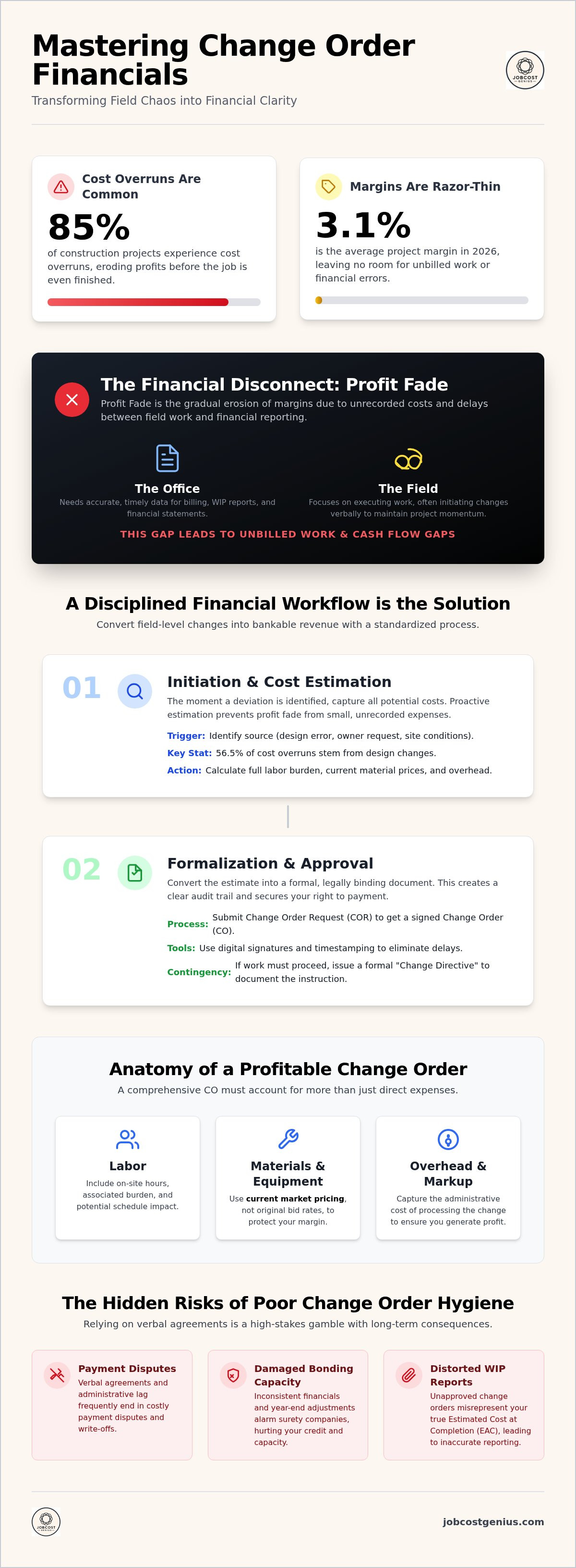
Did you know that 85% of construction projects experience cost overruns, while the average project margin in 2026 has tightened to just 3.1%? When margins are this thin, managing construction change orders financials isn't just an administrative task; it's a survival strategy. You've likely felt the sting of profit fade when unapproved work remains unbilled for months. It's frustrating to deliver high-quality work only to face disputes or cash flow gaps at the finish line.
We understand that bridging the gap between the field and the back office is a constant struggle. This guide provides a structured framework to help you synchronize field changes with financial reporting, ensuring every extra nail and hour is accounted for in real-time. You'll learn how to leverage new 2026 regulations, such as California's SB 440, to accelerate payment cycles and resolve disputes faster. We'll also cover how integrated WIP reporting protects your bonding capacity and keeps your audits clean. By the end of this article, you'll have the tools to transform field chaos into financial clarity and professional confidence.
Key Takeaways
- Identify the specific financial risks of change orders and learn how to prevent profit fade through proactive documentation and tracking.
- Implement a standardized communication loop between the field and the office to ensure all extra work is captured and billed promptly.
- Master the complexities of managing construction change orders financials by correctly recording pending work to avoid revenue distortion on your balance sheet.
- Adjust your Estimated Cost at Completion (EAC) accurately to maintain the integrity of your WIP reports and percentage of completion calculations.
- Streamline your financial oversight by moving from manual spreadsheets to automated systems and specialized software integrations.
The Financial Impact of Change Orders in Construction
Most contractors view a change order as a field adjustment or a simple response to unforeseen site conditions. From a financial standpoint, it's actually a formal amendment to the project's economic foundation. While a general overview of What is a Change Order? explains the basic mechanics of modifying a contract, managing construction change orders financials requires looking past the physical work to the general ledger. Every modification represents a shift in your resource allocation and your expected return on investment.
Mid-sized firms are particularly vulnerable to profit fade because their administrative overhead often lags behind field production. When you perform work without a signed order, you're essentially financing the owner's project interest-free. This creates a dangerous disconnect in your WIP reporting for construction companies. Costs are incurred immediately, but revenue recognition remains stagnant until the paperwork catches up. Profit fade is the gradual erosion of estimated margins due to unrecorded costs.
It's also vital to distinguish between scope creep and legitimate change orders. Scope creep is the silent killer; it's the "while you're here" request that seems small but consumes labor hours and equipment time. Legitimate change orders are documented, priced, and approved. Failing to draw a hard line between the two leads to a bloated cost-to-complete and a shrinking bottom line.
The Anatomy of a Change Order
A profitable change order accounts for more than just the direct expenses. It must be a comprehensive reconciliation of new project requirements. Consider these essential components:
- Labor: This includes not just the hours on-site, but the associated burden and potential impact on the overall schedule.
- Materials and Equipment: Use current market pricing rather than original bid rates to protect your margin.
- Overhead and Markup: The administrative cost of processing the change must be captured to ensure you're generating profit, not just trading dollars.
A centralized Change Order Log is the foundation of financial transparency. It allows the office to track the status of every request, ensuring that no cost falls through the cracks during the billing cycle.
Hidden Risks of Poor Change Order Hygiene
Relying on verbal agreements is a high-stakes gamble that frequently ends in payment disputes. This administrative lag does more than hurt your weekly cash flow; it threatens your long-term business health. Surety companies and banks demand consistency in your financial statements. If your reports show frequent adjustments or massive year-end write-downs due to unmanaged changes, your bonding capacity and credit lines will suffer. Financial clarity depends on a disciplined field-to-office communication loop.
A Step-by-Step Financial Workflow for Change Management
Establishing a standardized workflow is the only way to convert field-level changes into bankable revenue. Without a structured loop, communication between the job site and the accounting department inevitably breaks down. Managing construction change orders financials requires a sequence that begins the moment a deviation is identified. This process ensures that every cost is captured and validated before it impacts your bottom line. By following a disciplined path, you move from reactive scrambling to proactive financial management.
Step 1: Initiation and Cost Estimation
The process begins by identifying the trigger for the change. Design changes are a primary contributor to cost overruns, accounting for 56.5% of them according to industry data. Whether the issue stems from a design error, unforeseen site conditions, or a direct owner request, you must act quickly. Don't just estimate direct costs; you need to calculate the full labor burden and current material prices. Using historical data from similar projects helps ensure your estimate covers every variable. This accuracy prevents the profit fade that occurs when small, unrecorded expenses accumulate over the life of a project.
Step 2: Formalization and Approval
Once you have a solid estimate, you must move from a Change Order Request (COR) to a signed Change Order (CO). Digital signatures and timestamping are essential tools to eliminate delays and create a clear audit trail. If signatures are stalled but the project schedule requires work to proceed, use a formal "Change Directive" to document the instruction and your intent to claim costs. For those working on public or large-scale projects, adhering to Federal Change Order Regulations provides a clear legal framework for how these modifications should be handled and documented. A disciplined approach to managing construction change orders financials ensures that you aren't stuck with uncollectible receivables at the end of the job.
Step 3: Financial System Entry
The final step is the immediate entry of the approved change into your accounting system. You must update the Schedule of Values (SOV) to reflect the new contract sum and allocate every dollar to the correct job cost codes. This keeps your field data synced with the home office financials in real-time, which is vital for accurate percentage-of-completion reporting. It's much easier to maintain cash flow when your pay applications reflect the actual work performed. If you find this manual entry and reconciliation process overwhelming, you might consider how professional financial oversight can help automate these workflows for you.
Accounting for Change: Approved vs. Pending Orders
Getting a signature in the field is only half the battle. Managing construction change orders financials requires a disciplined approach to the general ledger that many firms overlook. If you track changes in the field but fail to record them correctly in your accounting system, your financial statements will provide a false sense of security. The goal is to create a clear distinction between work that is legally authorized and work that is still in negotiation.
The Revenue Recognition Dilemma
The core challenge lies in how you recognize revenue under GAAP standards, specifically ASC 606. You're often forced to choose between a conservative or aggressive reporting strategy. Aggressive firms might recognize revenue as soon as a change is "probable," but this risks significant reversals if a dispute arises later. On the other hand, being too conservative can hide the true value of work performed, making your project look less profitable than it actually is.
Pending change orders should typically remain in job costs but not in recognized revenue. This practice ensures your expenses are captured in real-time while preventing "phantom profit" from inflating your balance sheet. The danger of recognizing revenue before a change is legally approved is that it distorts your debt-to-equity ratio. This can lead to difficult conversations with sureties or lenders when those unapproved amounts are eventually contested or written off.
Managing the Change Order Log
A well-maintained Change Order Log serves as the primary bridge between project management and the accounting department. It's not just a list; it's a strategic tool for construction cash flow management. By categorizing every request as estimated, quoted, or approved, you gain a granular view of your project's financial trajectory. This visibility allows you to predict future cash inflows with much higher accuracy.
Reconciling this log with your general ledger every month is a non-negotiable task for financial clarity. You must ensure that the "Approved" column matches the current contract sum in your accounting software exactly. Even verbal change orders must be tracked internally. While you won't bill for them yet, recording the estimated costs against the job ensures your "Cost to Complete" remains accurate. This level of meticulousness transforms your financial reporting from a historical record into a forward-looking management tool.
Maintaining Accuracy: Updating WIP Reports and Pay Apps
Managing construction change orders financials requires constant vigilance over your Work in Progress (WIP) report. Every change, whether approved or pending, alters the project’s trajectory. If you don't update your "Total Estimated Cost at Completion" (EAC) immediately, your percentage of completion (POC) calculation will be fundamentally flawed. This isn't just a paperwork issue; it’s a reporting failure that can hide significant losses until it’s too late to recover them. Accurate reporting ensures that your financial statements reflect the reality of the job site, not an outdated bid.
The WIP Report Adjustment
An accurate WIP report is the heartbeat of a construction firm. When you incur costs for a change order that hasn't been formally added to the contract sum, you create an "underbilled" position. Your costs go up, but your revenue remains stagnant, which artificially lowers your reported margin. Conversely, if you bill for an approved change but haven't updated the estimated costs to perform that work, you appear "overbilled." This creates a false sense of cash surplus that can lead to poor spending decisions. Detailed WIP reporting for contractors is the only way to reveal these hidden project losses before they become permanent profit fade.
Syncing with Payment Applications
Consistency between your internal job cost reports and your external payment applications is vital for maintaining owner trust. Most commercial projects utilize the AIA G702 and G703 forms, which require a clear breakdown of the original contract sum and all subsequent modifications. Automating the update of your Schedule of Values (SOV) is the best way to avoid common math errors that lead to rejected pay apps and delayed payments.
You must also account for retention on change order work. For projects subject to the 2026 retention cap of 5%, failing to adjust your billing calculations can lead to significant cash flow gaps. Precision in these documents ensures that your approval and payment cycles remain as fast as possible. If your current process feels like a constant battle between field notes and accounting software, you can get expert help with your WIP reporting to ensure your change orders never compromise your financial integrity.
Scaling Your Financial Oversight with JobCost Genius
Managing construction change orders financials shouldn't feel like a monthly crisis. For many growing firms, the leap from manual spreadsheets to automated systems is the difference between sustainable growth and sudden profit fade. JobCost Genius provides the specialized oversight needed to ensure that every field adjustment is reflected accurately in your general ledger. We act as your strategic guide, transforming administrative overwhelm into a state of organized calm and financial clarity.
Our approach is fundamentally construction-first. We understand the high-stakes nature of the industry and the unique complexities of job costing. By leveraging Procore financials integration services, we bridge the gap between field updates and office records. This seamless data flow ensures that your project managers can focus on production while your financial team maintains a real-time view of project profitability.
From Field Data to Financial Clarity
The administrative burden on project managers is often the primary cause of delayed change order processing. When PMs are forced to navigate complex accounting entries, mistakes happen and documentation lags. Our team reduces this burden by handling the heavy lifting of financial reconciliation. We eliminate "end-of-month" surprises by providing a CEO-level dashboard for multi-project oversight. This visibility allows you to identify underperforming jobs and unapproved changes before they compromise your cash flow. You gain the confidence to make data-driven decisions based on accurate, real-time figures.
Scalable Plans for Growing Firms
We recognize that every construction company has different needs based on their project volume and team size. Our service tiers are designed to grow with you, ensuring you always have the right level of support. Consider our available options:
- Starter Plan: Ideal for firms needing to establish essential financial hygiene and basic change order tracking.
- Growth Plan: Designed for companies looking to refine their WIP reporting and project cost controls.
- Premium Plan: Provides comprehensive support for firms with complex tech stacks and advanced integration needs.
Specialized construction bookkeeping is an investment in your company’s foundational strength, not just a line-item cost. Our services start at $800 per month, providing you with access to founders who have over 20 years of industry experience. This expertise ensures that your change orders never fall through the cracks of your financial statements. By professionalizing your financial management, you protect your margins, improve your bonding capacity, and position your business for long-term success.
Protecting Your Profitability Through Financial Discipline
Mastering the transition from a field change to a ledger entry is essential for any contractor looking to scale. By standardizing your workflow and distinguishing between approved and pending work, you eliminate the uncertainty that leads to profit fade. Accurate WIP reporting and timely payment applications ensure your business maintains the cash flow needed to take on larger projects. Managing construction change orders financials effectively transforms your back office from a reactive cost center into a strategic asset. These systems protect your bonding capacity and ensure your financial audits remain clean as you grow.
You don't have to navigate these complexities alone. JobCost Genius provides construction-specific bookkeeping starting at $800 per month. Our founders bring over 20 years of industry experience to every partnership, offering expert WIP and Procore integration support. We help you move from administrative overwhelm to total financial clarity. Stop losing profit to unmanaged change orders; explore JobCost Genius financial services today. With the right systems and expert guidance in place, your business can achieve the professional stability and long-term growth it deserves.
Frequently Asked Questions
How do change orders affect a contractor’s WIP report?
Change orders alter the two primary variables in a WIP report: the total contract price and the total estimated cost at completion. When a change is approved, both figures increase, which shifts the percentage of completion. If costs are incurred before the contract price is updated, it creates an underbilled situation. This mismatch can hide project losses or artificially deflate your reported margins until the financials are reconciled.
What is the best way to track unapproved change orders?
The most effective method is maintaining a centralized Change Order Log that categorizes items by status, such as "Pending," "Quoted," or "Verbal." This log should be reviewed during monthly financial meetings to ensure that estimated costs are captured even if revenue isn't yet recognized. Tracking these items separately prevents them from distorting your general ledger while ensuring project managers remain aware of potential margin erosion from unapproved work.
Can I bill for a change order before it is officially signed?
Typically, you cannot include a change order on a formal pay application until it is fully executed by all parties. Billing for unsigned work often leads to rejected applications and delayed cash flow. However, some contracts allow for billing under a "Construction Change Directive" if the owner has authorized the work to proceed. Always verify specific contract language and local regulations, such as California's SB 440, before submitting these costs.
How does a change order impact the percentage of completion calculation?
Change orders impact the percentage of completion (POC) by modifying the total estimated costs for the project. Since POC is calculated as actual costs to date divided by total estimated costs, adding a change order increases the denominator. This can cause the POC to drop temporarily if the contract value isn't updated simultaneously. Managing construction change orders financials requires ensuring that both costs and revenue are adjusted in the same reporting period to maintain accuracy.
What is a reasonable markup for a construction change order?
A reasonable markup typically ranges between 10% and 15% for combined overhead and profit, though this is often governed by the prime contract. Some agreements specify lower percentages for subcontractor work versus self-performed work. It's vital to account for the administrative burden of processing the change. If your contract doesn't specify a rate, ensure your markup covers the true cost of project disruption and additional coordination.
How do I handle a change order that reduces the project scope?
A deductive change order reduces the total contract sum and the total estimated costs. Financially, this requires adjusting your WIP report to reflect a lower revenue ceiling. You must also account for any "sunk costs" or non-refundable materials already purchased for the removed scope. Properly documenting these credits is essential for maintaining a clean audit trail and ensuring the final pay application matches the owner's records.
Why do change orders often lead to underbilling on WIP reports?
Underbilling occurs when a contractor recognizes the costs of extra work on the general ledger but hasn't yet met the contractual requirements to bill for it. This is common when managing construction change orders financials because field production often moves faster than the formal approval process. The resulting "costs in excess of billings" on your balance sheet can negatively impact your debt-to-equity ratio and concern your bonding agent if left unmanaged.
How can Procore integration help with change order management?
Procore integration streamlines change order management by creating a direct link between field-generated Change Order Requests and the home office accounting system. This automation eliminates double entry and ensures that project managers and bookkeepers are looking at the same data. It allows for real-time updates to the Schedule of Values and WIP reports, providing the financial clarity needed to prevent profit fade and maintain steady cash flow throughout the project.


