

Balancing your bank accounts won't rescue your business if your project records are fundamentally broken. Standard reconciliations routinely fail in construction because they treat progress billings as immediate income rather than earned revenue tied to actual job costs. When your bank balance looks healthy but your profit and loss statement shows red ink, or when a general bookkeeper misclassifies retainage and untracked change orders, the confusion is paralyzing. It puts your bonding capacity, banking relationships, and tax compliance directly at risk. To fix messy construction books, you can't rely on retail accounting methods; you must rebuild your job costs from the ground up.
You shouldn't have to guess whether an active project is actually turning a profit or suffering from silent margin fade. In this guide, you'll discover how to diagnose accounting errors, rebuild job cost records, and restore financial clarity to your construction business. We'll walk through a proven roadmap to untangle project subledgers, reconcile your work-in-progress position, and build the disciplined reporting required to scale profitably.
Key Takeaways
- Discover why generic bookkeeping practices fail in contracting by misinterpreting progress billings and obscuring direct project costs within general overhead.
- Follow a structured financial roadmap to fix messy construction books, isolating project costs, clearing suspense balances, and verifying core liabilities.
- Learn how accurate Work-in-Progress (WIP) reporting calculates true earned revenue, separating operating profit from cash liabilities like overbillings.
- Implement disciplined field-to-office workflows and strict change order controls to prevent margin fade and maintain audit-ready records.
Warning Signs Your Construction Books Are in Trouble
Financial distress in construction rarely arrives without warning. It creeps in through administrative shortcuts, delayed paperwork, and generic bookkeeping assumptions. You might receive unexpected intent-to-lien notices from material suppliers while your accounts payable aging report claims you are current. Similarly, your accounts receivable ledger might display hundreds of thousands of dollars in past-due billings, yet half that balance represents retainage you cannot legally collect until final project sign-off. Recognizing these structural red flags early allows you to fix messy construction books before administrative errors destroy your commercial credit or bonding capacity.
Cash Balance Versus Profit and Loss Discrepancies
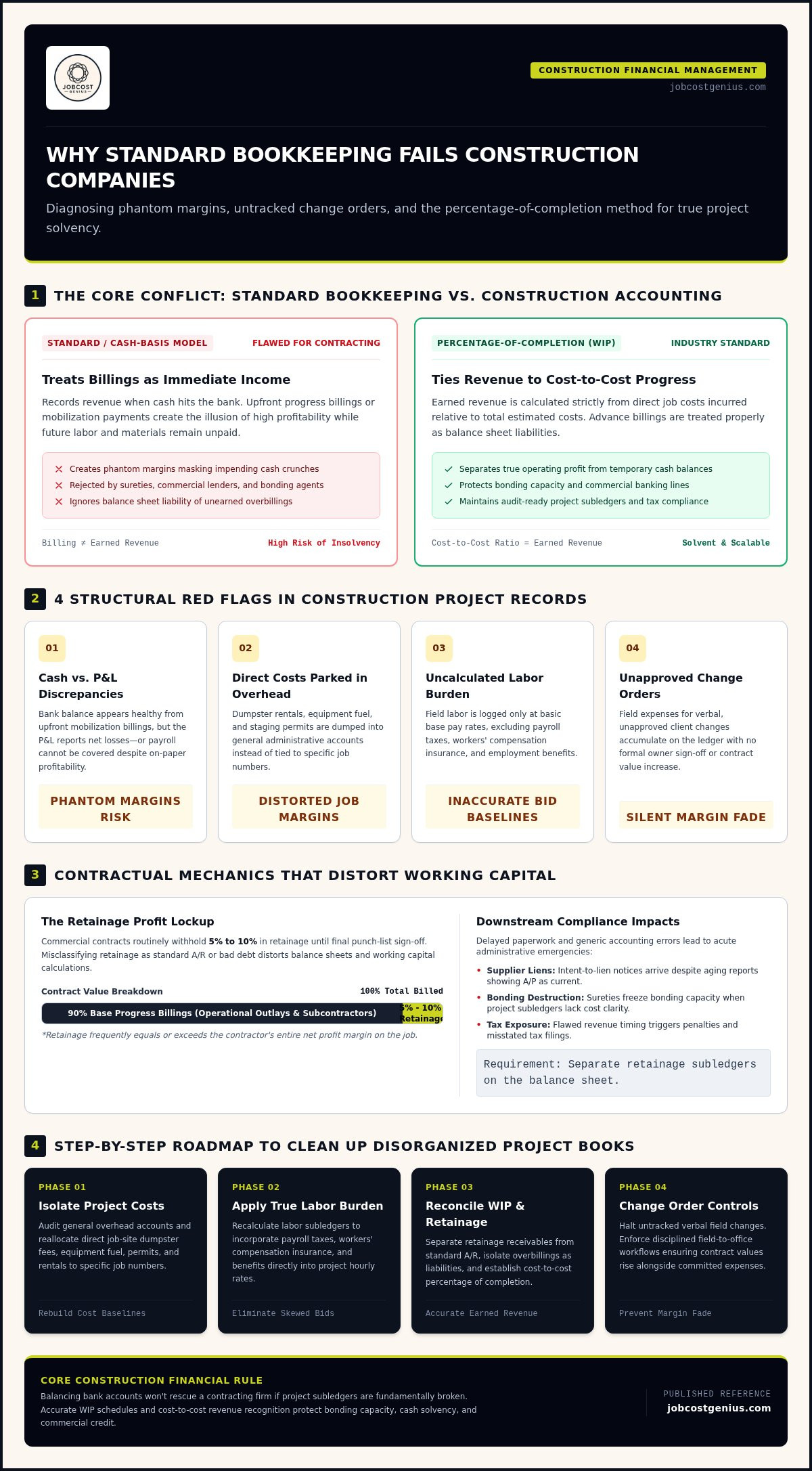
A profitable income statement means little if your operating bank account cannot cover Friday's payroll. This dangerous disconnect happens when off-the-shelf bookkeeping systems record upfront progress billings as immediate earned income. When you bill ahead on an initial mobilization or site prep phase, you hold temporary cash, not profit. Under the percentage-of-completion method, advance billings represent a balance sheet liability; that money belongs to upcoming trade contractors and suppliers. Treating unearned billings as realized profit produces phantom margins, masking an impending cash crunch until project costs suddenly come due.
Unassigned Costs and Distorted Job Margins
Direct project costs easily slip through the cracks when busy field crews bypass standard cost codes. When financial tracking breaks down, books quickly show distinct symptoms:
- Job-site dumpster rentals, equipment fuel, and staging permits get parked in generic overhead accounts instead of tied to specific job numbers.
- Field labor hours get logged at basic hourly rates without calculating true labor burden, including payroll taxes, workers' compensation, and benefits.
- Field expenses for verbal, unapproved change orders accumulate on the ledger with no corresponding increase in contract value.
Dumping direct job expenses into general overhead artificially inflates your individual job margins. Estimators then use these skewed historical numbers to bid upcoming work. You end up winning contracts based on inaccurate cost baselines, locking your business into compounding margin fade before breaking ground.
Why Standard Bookkeeping Methods Fail Construction Companies
Standard business bookkeeping works well for retail stores and professional agencies where sales and deliveries occur almost simultaneously. Construction operates under entirely different rules. Projects stretch across quarters or years, and cash outlays occur long before milestone payments arrive. While following foundational financial practices outlined in the SBA guide to managing business finances is essential for basic compliance, generalist bookkeeping fails to track how project-level events impact company-wide solvency. If you try to fix messy construction books using standard off-the-shelf templates, you treat surface symptoms instead of the root operational problems.
The Limits of Cash-Basis Accounting in Construction
Cash-basis accounting records revenue when money hits your bank and logs expenses only when checks clear. In long-duration contracting, this creates a dangerous financial illusion. Upfront mobilization payments create the appearance of a banner month, even when impending labor and materials will consume every dollar. Sureties and commercial lenders reject cash-basis numbers because they mask project bleeding until substantial completion. Accurate financial control demands structured WIP reporting for construction companies, ensuring earned revenue ties strictly to the cost-to-cost percentage of completion rather than the timing of your bank deposits.
Retainage, Change Orders, and Billing Complexities
Contractual mechanics quickly overwhelm generic accounting setups. Typical commercial contracts withhold 5% to 10% in retainage until punch-list completion, often locking up an entire job's net profit margin. General bookkeepers frequently mispost retainage as bad debt or forget to separate it on the balance sheet, distorting working capital calculations.
Change orders introduce additional financial volatility:
- Executing field change orders without formal owner sign-off commits labor costs without legally increasing contract value.
- Progress billings that outpace completed site work create substantial overbillings, which are unearned liabilities rather than recognized revenue.
- Unbilled work leaves you financing project owners out of your operating capital.
Failing to track these variables in real time forces contractors into reactive triage. Partnering with a specialist at JobCost Genius gives you the project-level job costing workflows needed to protect your margins before errors compound.
A Step-by-Step Roadmap to Clean Up Disorganized Project Books
Remediating historical accounting records requires a systematic sequence. If you attempt to calculate project margins before validating baseline bank balances, your reports will collapse under bad data. To fix messy construction books permanently, establish a firm historical cut-off date and work outward through your financial structure. Follow this five-step sequence:
- Step one: Reconcile all primary operating accounts, credit cards, and equipment notes against third-party statements to eliminate unrecorded transfers and suspense balances.
- Step two: Audit the chart of accounts to establish clear boundaries between direct project costs and general operating overhead.
- Step three: Review all open and recently closed jobs to reallocate miscoded material receipts, equipment rentals, and trade contractor invoices.
- Step four: Audit accounts receivable by isolating retainage balances and matching billed amounts directly against owner payment certificates.
- Step five: Reconstruct a comprehensive work-in-progress schedule to establish accurate earned revenue across every active project.
Rebuilding the Construction Chart of Accounts
General ledgers fail when direct job costs get commingled with operating overhead. Rebuilding your structure requires separating direct contract costs, indirect project expenses, and general and administrative expenses into dedicated parent tiers. Standardize your phase codes using CSI MasterFormat cost codes to align field estimating directly with accounting entries. If you need a complete breakdown of structural account tiers, reference the foundational principles in our 2026 construction accounting guide for small firms.
Subcontractor and Vendor Ledger Cleanup
Accounts payable cleanup prevents severe legal and cash exposure. Match pending vendor invoices against original purchase orders and formal subcontract agreements. Purge duplicate entries and isolate disputed change orders that lack signed authorization. Collect missing Form W-9s and enforce lien waiver tracking for all disbursements. Releasing funds without current certificates of insurance or unconditional lien waivers leaves your business vulnerable to third-party claims.
Labor Burden and Payroll Recalibration
Booking raw wages to active jobs severely understates true labor costs. Recalibrate your payroll by calculating actual labor burden, factoring in employer taxes, workers' compensation rates, health benefits, and union dues. Reallocate these burdened payroll expenses across active contracts based on certified field timesheets. Accurate labor burden allocation ensures that historical job performance reflects true project resource consumption.
Restoring Accuracy to WIP Schedules and Financial Reports
True financial clarity returns only when your general ledger reconciles directly with an active Work-in-Progress (WIP) schedule. When you fix messy construction books, balancing bank feeds is merely the starting line. True financial control requires calculating earned revenue across every open contract. Earned revenue represents the percentage of total estimated costs incurred to date multiplied by the revised contract value. Comparing this figure against cumulative progress billings exposes critical operational balances that standard accounting software overlooks.
Reconciling project schedules against your balance sheet reveals two critical adjustments:
- Overbillings (Billings in Excess of Costs): A current liability capturing advance billings that must fund future job costs, preventing you from mistaking upfront cash for operating profit.
- Underbillings (Costs in Excess of Billings): A current asset identifying unbilled site work that is actively draining your operational cash reserves.
Posting monthly journal entries for these amounts aligns your profit statement with site progress, eliminating erratic revenue spikes.
Uncovering True Project Margins
A Work-in-Progress schedule serves as the ultimate safeguard against margin fade by tracking real-time cost variations against projected contract profits. Comparing original contract estimates against actual projected completion expenditures exposes exactly where labor overruns or supply price spikes took root. It highlights creeping scope changes that eroded gross margins across past billing cycles, empowering project managers to enforce signed change orders before completion.
Preparing Books for Surety Bonding and Banking Reviews
Surety underwriters and commercial loan officers evaluate contractor balance sheets with extreme scrutiny. They look for disciplined reporting and routinely penalize working capital calculations when they spot large unexplained miscellaneous expense allocations or erratic underbillings. Establishing disciplined month-end closing workflows demonstrates operational maturity and protects your aggregate bonding line. To gain complete visibility into project performance and protect your banking relationships, you can access dedicated WIP reporting through JobCost Genius.
Building Sustainable Accounting Systems to Prevent Future Mess
Cleaning up historical records provides immediate relief, but cleanup without workflow reform is temporary. Many contractors fix messy construction books only to find themselves untangling the exact same discrepancies six months later. Preventing recurring administrative chaos requires structured operational protocols and software connections that eliminate manual data entry. When field operations and back-office accounting operate in sync, project records stay clean by default.
Field-to-Office Data Synchronization
Paper timesheets and physical fuel receipts dropped into glove compartments guarantee reporting delays. Moving past administrative disorganization requires capturing field data digitally at the job site:
- Eliminate paper timecards by adopting digital tracking that logs crew hours against specific cost codes in real time.
- Route trade contractor invoices and material delivery slips directly into accounts payable queues for project manager approval before processing.
- Enforce strict subcontract change order controls, requiring signed owner authorizations before committing field resources.
Connecting your project management software through Procore Financials Integration bridges the operational divide. It synchronizes cost commitments, contracts, and job costs between field supervisors and your accounting ledger, keeping budgets accurate without double entry.
Selecting the Right Ongoing Accounting Support
Relying on an in-house generalist bookkeeper often reintroduces retail habits that derail construction tracking. General bookkeepers rarely understand retainage mechanics, labor burden allocations, or overbilling calculations. Engaging specialized outsourced bookkeeping for construction firms delivers specialized industry expertise without the overhead of managing internal personnel.
Tailored options such as the Starter Plan or Growth Plan give growing contractors dedicated job cost tracking, accounts payable workflows, and disciplined monthly closing cadences. A structured monthly close locks completed periods, balances job subledgers, and ensures you never have to fix messy construction books under high-stakes tax or audit pressure again.
Take Command of Your Construction Accounting
Regaining control over your financial records transforms your business from reactive cash triage to disciplined, strategic growth. When you fix messy construction books, you do far more than organize historical transactions. You actively protect your bonding capacity, satisfy commercial lenders, and eliminate the threat of silent margin fade. Reconciling your general ledger with an accurate Work-in-Progress schedule ensures you always understand your true earned revenue, overbillings, and project profitability well before job closeout.
You don't have to navigate complex progress billings, unbilled change orders, or subledger cleanups alone. JobCost Genius specializes exclusively in construction accounting workflows, accurate WIP reporting, and field-to-office alignment through Procore Financials Integration. With clear financial data, you can bid competitively and run active jobs with total confidence. Take the first step toward lasting operational calm today. Schedule a Construction Bookkeeping Assessment with JobCost Genius and build the structured financial foundation your business deserves.
Frequently Asked Questions
How do I know if my construction company's books are actually broken?
Your books are broken if your balance sheet carries negative liabilities, unassigned suspense balances, or uncleared transactions dating back months. Another immediate sign is when your job profitability reports don't tie out to your total general ledger expenses. If you can't tell which projects generated profit last quarter without manually reviewing bank statements, your system is compromised. These accounting blind spots prevent reliable bidding and leave you vulnerable to unexpected cash shortfalls.
Why can't my regular tax CPA clean up my ongoing construction bookkeeping?
Tax CPAs focus on annual compliance and reducing tax liabilities, not day-to-day job cost tracking. They usually work with summarized historical data once a year, while ongoing construction bookkeeping requires daily cost coding, labor burden calculations, and monthly progress billing management. JobCost Genius focuses strictly on operational construction accounting and WIP schedules rather than income tax filing. This specialized focus ensures your books remain accurate throughout the construction lifecycle.
How long does a typical construction book cleanup take for a contractor?
A thorough cleanup typically takes anywhere from a few weeks to a couple of months depending on transaction volume and record condition. Straightening out a few months of unassigned expenses moves quickly, whereas reconstructing multi-year contract schedules, disputed subcontracts, and unbilled change orders takes longer. When you need to fix messy construction books, establishing a realistic historical cut-off date accelerates the forensic audit and restores verified reporting much faster.
What documents are required to start untangling historical job cost records?
You'll need signed owner contracts, approved change orders, historical AIA billing applications, and complete vendor invoices. Additionally, gather bank and credit card statements, loan amortization schedules, payroll summary reports, and active certificate of insurance records. Having open subcontracts and purchase orders ready allows specialists to reconcile committed costs against real-time ledger entries. Organizing these operational records upfront ensures that cost allocations tie cleanly back to specific job codes.
What is the difference between overbilling and underbilling on messy books?
Overbilling occurs when your cumulative billings exceed the actual earned revenue recognized on a job, creating a balance sheet liability for future work you still owe. Underbilling happens when earned revenue outpaces what you've invoiced, representing an unbilled asset that strains working capital. Disorganized books often ignore these clearing accounts completely. Properly tracking both balances reveals whether your cash flow is artificially inflated or if you are unintentionally financing project owners.
Can messy construction books be fixed without switching our accounting software?
Yes, most cleanup engagements resolve core data errors directly within your existing accounting software. Disorganization usually stems from poor cost code mapping, neglected reconciliations, and missing WIP adjustments rather than the software platform itself. However, to fix messy construction books permanently, you may need to integrate specialized tools. Connecting your existing general ledger with platforms like Procore Financials Integration streamlines field data capture and prevents errors from recurring in future periods.
How does clean construction bookkeeping improve our surety bonding capacity?
Surety underwriters calculate bonding limits using adjusted working capital, routinely multiplying verified working capital by ten to fifteen times to set aggregate capacity. When your records contain unverified accounts receivable, missing retainage accounts, or erratic profit fade, underwriters aggressively discount your balance sheet. Clean, GAAP-compliant statements supported by consistent WIP schedules prove financial control, giving underwriters the confidence to extend higher single-project and aggregate bonding lines. Similarly, for contractors and real estate investors seeking project or property financing, organized books make all the difference when working with mortgage brokers like LoansByJB (The Nuhome Team) who navigate complex, investor-focused loan scenarios.


