

Why does your Profit and Loss statement show a healthy gain while your bank account feels dangerously empty? It's a common frustration for construction leaders who realize, often too late, that a traditional P&L only tells you where you've been. In an industry where the average general contractor waits 83 days to collect cash, relying on lagging data is a recipe for disaster. Effective WIP reporting for contractors serves as the ultimate truth-teller; it exposes hidden losses before they compromise your bonding capacity or drain your working capital.
You deserve a financial infrastructure that provides organized calm instead of administrative overwhelm. This guide will help you master the mechanics of Work in Progress schedules to eliminate financial surprises and ensure your projects actually generate profit. We'll explore how to identify profit fade early, manage the delicate balance of overbillings and underbillings, and leverage tools like Procore Financials to gain real-time visibility. By the end, you'll have a clear roadmap to higher net profit margins and stronger, more predictable relationships with your surety and bank.
Key Takeaways
- Identify the disconnect between standard accrual reporting and project reality. This prevents the profit illusion that often traps growing firms.
- Master the cost-to-cost method to calculate earned revenue with precision. Precise calculations ensure your balance sheet remains accurate and compliant.
- Interpret overbillings and underbillings as critical indicators of operational health. These metrics serve as early warning signs for your project's cash flow.
- Implement a standardized framework for WIP reporting for contractors. Linking field labor and material costs to financial oversight builds a foundation for long-term stability.
- Leverage specialized construction bookkeeping to eliminate administrative overwhelm. Proactive management secures the bonding capacity required for large-scale growth.
The Construction Profit Illusion: Why Your P&L Statement Often Lies
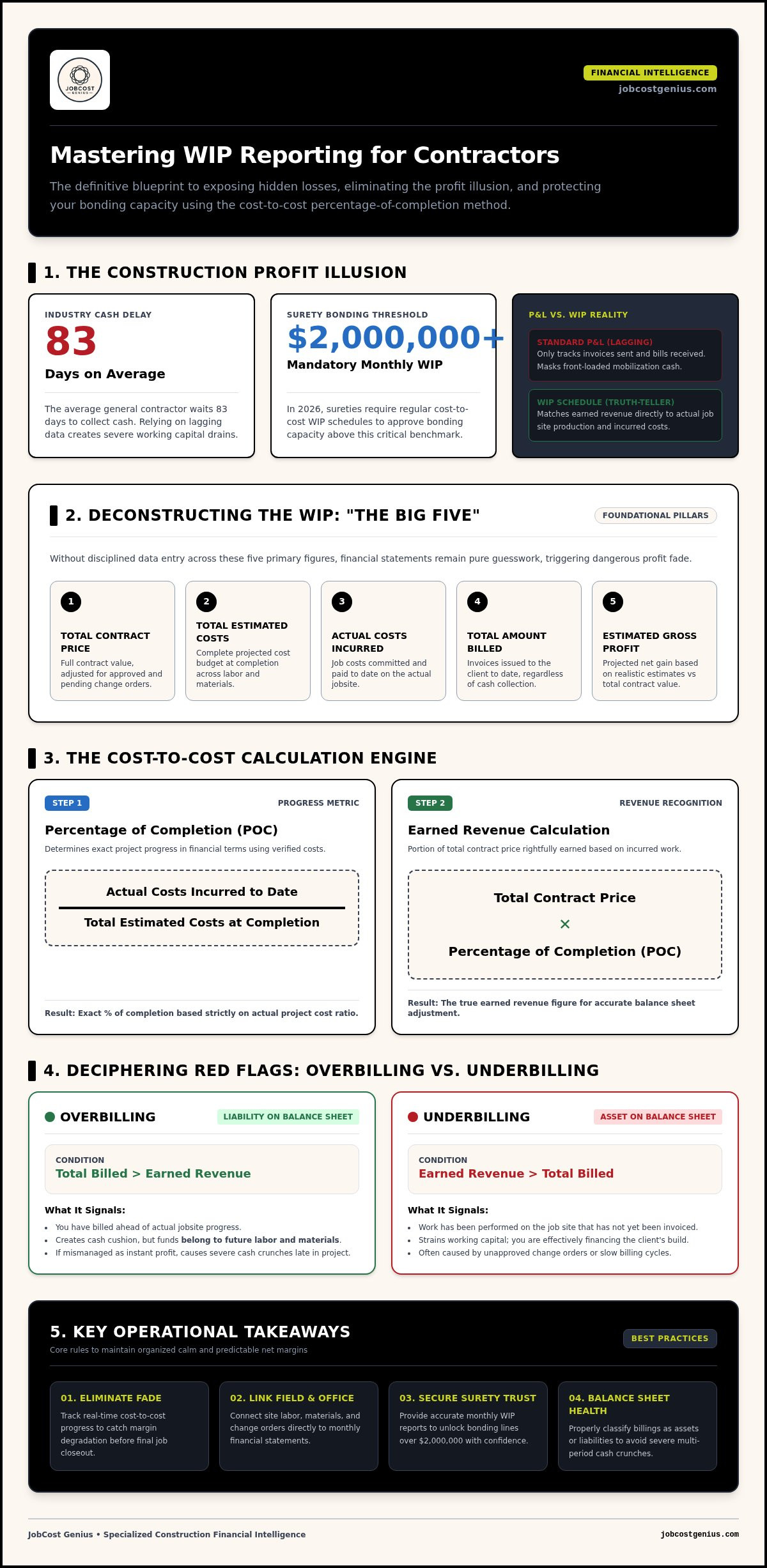
Cash in the bank is a deceptive metric for construction profitability. Many contractors look at a high bank balance or a positive Profit and Loss (P&L) statement and assume their projects are thriving. This is often an illusion. A standard P&L only tracks invoices sent and bills received; it doesn't account for the actual stage of production on the job site. If you've front-loaded your billings or received a large mobilization payment, your financial statements will show a paper profit that hasn't been earned yet. This disconnect leads to sudden cash crunches when those funds are needed to finish the work later in the project lifecycle.
WIP reporting for contractors acts as the essential "truth-teller" in this scenario. A Work in Progress (WIP) report is a specialized financial tool that tracks the earned revenue of a project based on its actual progress. By utilizing the percentage-of-completion method, the report matches recognized revenue with the costs incurred to date. This process transforms administrative overwhelm into financial clarity. It ensures that your books reflect project reality rather than just your billing cycle. Without a WIP adjustment, you are essentially managing your business based on a lagging and often inaccurate snapshot of your financial health.
The Gap Between Field Reality and Office Accounting
Traditional accounting methods often fail to capture the nuances of the job site. Project delays, unapproved change orders, and front-loaded billing schedules create a massive gap between what the office sees and what is happening in the field. Generalist bookkeepers often miss these details because they lack industry-specific expertise. They may treat a large deposit as immediate income rather than a liability that must fund future labor and materials. For many owners, mastering construction accounting for small firms starts with recognizing that general accounting software alone isn't enough to manage complex, multi-period contracts. You need a system that links field data directly to your financial oversight.
Who Needs a WIP Report?
A robust WIP process is a requirement for any contractor looking to scale. External stakeholders, particularly surety companies, view the WIP schedule as a non-negotiable document. In 2026, most sureties mandate monthly cost-to-cost WIP schedules for any contractor seeking bonding capacity above $2,000,000. Lenders also rely on these reports to ensure that lines of credit are supported by earned assets rather than overbilled liabilities. Internally, the WIP report serves as a predictive engine. It allows project managers to identify "profit fade" early, providing the visibility needed to adjust course before a project concludes with a surprise loss.
Deconstructing the WIP Report: Essential Components for Financial Accuracy
A reliable WIP schedule is built on five core data points: total contract price, total estimated costs, actual costs incurred to date, total amount billed, and estimated gross profit. These figures provide the foundation for every calculation that follows. Without accuracy in these "Big Five," your financial statements remain guesswork. WIP reporting for contractors requires a disciplined approach to data entry to ensure that the office reflects the physical reality of the job site.
The most critical calculation in this process is the Percentage of Completion (POC). Most industry experts utilize the cost-to-cost method, which determines progress by dividing actual costs incurred to date by the total estimated costs at completion. This ratio tells you exactly how far along the project is in financial terms. Once you have the POC, you can determine your Earned Revenue by multiplying the Total Estimated Revenue by the Percentage of Completion. Earned Revenue is the portion of the contract price a contractor has rightfully earned based on costs incurred to date.
Contract Value and Estimated Costs
Your WIP is only as good as your estimates. If your total contract value doesn't account for pending change orders, your revenue recognition will be skewed. Outdated values lead to "profit fade," where margins appear high early on but collapse as the project nears completion. Avoid the temptation to "plug" numbers to make a project look healthier than it is. Real-time WIP reporting for construction companies integrates directly with your master budget, ensuring that every budget adjustment is captured immediately. This level of detail is what separates a professional operation from one struggling with administrative overwhelm.
Actual Costs and Committed Costs
Tracking direct labor and materials is the baseline, but true financial accuracy requires looking at committed costs. This includes open purchase orders and subcontracts that haven't been invoiced yet but represent future obligations. Failing to account for these commitments can lead to a false sense of liquidity. Additionally, your WIP should reflect a proper allocation of indirect costs and overhead to ensure project-level profitability is realistic. For guidance on standardized cost allocation, the IRS Construction Industry Audit Technique Guide provides a framework for how federal auditors evaluate long-term contract accounting. Maintaining this level of meticulousness is easier when you have professional financial oversight to manage the heavy lifting of data integration.
Overbilling vs. Underbilling: Identifying Red Flags in Your Projects
Every construction project exists in a state of either being ahead or behind on billing. Overbilling, classified as a contract liability, occurs when you bill for more work than you've physically completed. It provides an immediate cash influx, acting like an interest-free loan from the project owner. However, this cash is deceptive. Underbilling, or a contract asset, indicates you've performed work but haven't yet invoiced for it. This is a primary driver for the 74% of construction firms reporting moderate to severe cash flow problems. Effective WIP reporting for contractors requires you to look past the bank balance to see the true obligations attached to every dollar.
Spotting "profit fade" is the most critical function of a consistent WIP schedule analysis. When a project starts with a 15% estimated margin but slips to 10% by the time it reaches 80% completion, you have a systemic issue. This erosion often stems from unbilled change orders or estimated costs that didn't account for field realities. Underwriters and banks monitor these variances closely; contractors who keep monthly margin fluctuations within 5% typically secure much higher bonding limits and lower collateral requirements.
The Risks of Sustained Underbilling
Sustained underbilling is an involuntary financing facility for the project owner. It depletes your working capital, which is lethal for a firm with only a 20-day cash liquidity cushion. Bonding agents view chronic underbilling as a sign of poor management or disputed work. If your reports show high contract assets, you likely have a breakdown in field-to-office communication. You can start fixing underbilling on WIP reports by mandating weekly field reports and ensuring change orders are signed before the work begins. Accurate WIP reporting for contractors ensures these assets are converted to cash as quickly as possible.
The Trap of Excessive Overbilling
Overbilling is structurally necessary to finance mobilization, but it creates a psychological trap. It's tempting to use overbilled cash from a new job to cover shortfalls on a finishing project. This "cash flow borrowing" creates a liquidity spiral that leads to insolvency if new project acquisition slows down. Excessive overbilling often masks underlying losses until the final 10% of a project. At that stage, a massive cash crunch occurs because there is no remaining billing to cover the final costs. Maintaining disciplined construction cash flow management means treating overbilled funds as a project reserve, not general overhead capital.
Implementing a Robust WIP Process: From Field Data to Financial Oversight
Implementing effective WIP reporting for contractors requires a structured transition from raw field data to financial oversight. It's not enough to simply record costs; you must have a disciplined workflow that captures the physical reality of every job site. This process transforms your accounting from a historical record into a predictive management tool that identifies risks before they impact your cash reserves.
The process begins with five foundational steps:
- Step 1: Establish a standardized Chart of Accounts specifically designed for construction and ASC 606 compliance.
- Step 2: Implement rigorous job costing for every labor hour and material purchase to eliminate "plug" numbers.
- Step 3: Sync field reports with the accounting office weekly to maintain data freshness.
- Step 4: Review the WIP report with Project Managers to validate the "Estimated Cost at Completion," which is the front line against profit fade.
- Step 5: Adjust the General Ledger to match WIP findings through formal overbilling and underbilling entries that reflect your true contract assets and liabilities.
Field-to-Office Data Synchronization
Automating the flow of information is the most effective way to reduce the "messy middle" of data collection. Many firms struggle with a 30-day lag between field commitments and financial reviews; this renders reports obsolete before they're even printed. Leveraging Procore financials integration services bridges this gap. It allows labor and material costs to flow seamlessly into your accounting system. Training field staff is equally vital. When foremen understand that accurate daily logs directly impact the company's bonding capacity, the quality of data improves significantly.
Frequency and Review Cycles
Monthly WIP reporting is the absolute minimum standard for any contractor targeting sustainable growth. In 2026, sureties require these monthly schedules to maintain aggregate program limits above $2,000,000. However, a report is only useful if it's analyzed with a critical eye. Conduct a monthly WIP review meeting where Project Managers must defend their estimated costs at completion. This drives accountability and ensures that the "truth" of the project is visible to leadership in time to make adjustments. If your current reporting feels like a lagging indicator rather than a management tool, it's time to upgrade your infrastructure. You can optimize your project reporting today with specialized financial oversight tailored to your specific trade and project volume.
Scaling with Confidence: How Specialized WIP Reporting Fuels Construction Growth
Scaling a construction business requires more than just a larger backlog of contracts; it demands a financial infrastructure capable of supporting increased complexity. Aggressive growth without real-time visibility is a primary cause of business failure in this industry. WIP reporting for contractors provides the necessary guardrails for safe expansion. It allows you to commit to larger projects with the confidence that your working capital is protected and your margins are accurately projected.
Maintaining this level of meticulousness often exceeds the capacity of an in-house administrative team. Generalist bookkeepers frequently lack the technical depth required to manage the nuances of percentage-of-completion accounting or complex labor allocations. This is where specialized outsourced bookkeeping for construction firms becomes a strategic advantage. By partnering with experts who understand the "truth-teller" nature of the WIP report, you transition from administrative overwhelm to a state of organized financial calm.
JobCost Genius acts as this strategic partner, offering a tiered framework designed to grow with your firm. Our Starter Plan provides the foundational tracking needed for emerging contractors, while our Premium Plan offers advanced financial oversight and Procore Financials integration for high-volume builders. This scalability ensures that your reporting capabilities never become a bottleneck for your operational ambitions.
Building Bonding Capacity and Bankability
Your bonding capacity is directly linked to the quality of your financial reporting. In 2026, sureties have moved away from relationship-based underwriting, instead mandating monthly WIP schedules reconciled to the general ledger. A professional financial package, complete with accurate cost-to-cost WIP data, signals to bonding agents and banks that you are a disciplined, low-risk operator. When your aggregate bonding limit is typically benchmarked at 10 times your net working capital, clean reporting isn't just about compliance; it's about unlocking the credit needed to win larger federal and private contracts.
Taking the Next Step Toward Financial Clarity
Evaluate your current reporting honestly. Is it a true WIP that accounts for earned revenue and project liabilities, or is it simply a list of costs? If you're relying on a generalist who misses the nuances of construction-specific revenue recognition, your growth is at risk. Transitioning to a specialized construction bookkeeper ensures that every labor hour and material purchase is reflected in your project's health. It's time to stop guessing and start leading with data. If you're ready to see the truth in your numbers, explore our WIP reporting and bookkeeping services and build your firm on a foundation of professional clarity. WIP reporting for contractors is the most powerful tool in your management arsenal; use it to scale with absolute confidence.
Master Your Financial Future with Accurate WIP Data
Relying on a standard Profit and Loss statement is a risk your business cannot afford. True financial clarity requires moving beyond bank balances to understand the physical reality of your projects. By implementing disciplined WIP reporting for contractors, you transform administrative overwhelm into organized calm. You gain the ability to spot profit fade early, manage overbillings as a project reserve, and build the bankability required for aggressive scaling.
JobCost Genius provides the specialized oversight needed to navigate these complexities. With over 20 years of industry experience, our team acts as a strategic guide for builders nationwide. We are specialized Procore and Buildertrend integration experts, ensuring your field data flows seamlessly into tiered subscription plans designed for your growth stage. Whether you're stabilizing your cash flow or expanding your bonding capacity, our infrastructure supports your long-term success.
Don't let hidden losses dictate your firm's future. Take control of your margins and lead with data-driven confidence. Get a Financial Health Checkup and Professional WIP Reporting today to secure the financial foundation your hard work deserves. Your next level of growth starts with seeing the truth in your numbers.
Frequently Asked Questions
How often should a contractor run a WIP report?
Monthly is the industry standard for established firms. However, high-growth contractors should review these schedules weekly to catch margin erosion early. In 2026, most surety companies mandate a monthly cost-to-cost schedule for any aggregate bonding program exceeding $2,000,000. Running reports frequently ensures that your financial statements reflect the physical progress of the job site rather than just your billing cycle.
What is the difference between a WIP report and a Job Cost report?
A job cost report is a management tool that compares actual costs against the original budget to track field efficiency. In contrast, a WIP report is a financial oversight tool used to adjust your Profit and Loss statement for revenue recognition. While job costing tells you how much you spent, WIP reporting for contractors tells you how much of that spending actually translates into earned profit under GAAP standards.
Can I generate a WIP report in QuickBooks Online?
QuickBooks Online lacks a native, automated WIP schedule capable of calculating percentage of completion. You must manually calculate overbillings and underbillings in a spreadsheet and then enter adjusting journal entries into the General Ledger. For a more reliable workflow, many firms use a Procore Financials Integration to sync field data directly with their accounting software. This automation reduces administrative overwhelm and eliminates the risk of manual entry errors.
Why do bonding companies require a WIP schedule?
Sureties use the WIP schedule to evaluate your historical margin consistency and the health of your current backlog. They are specifically looking for "profit fade," which occurs when margins slip as a project nears completion. A clean report demonstrates that you have a disciplined process for estimating and job costing. Accurate reporting builds the trust necessary to secure higher aggregate bonding limits and lower collateral requirements.
How do I handle change orders on my WIP report?
You should only include approved, signed change orders in your total revised contract value. Including pending or verbal changes on your WIP report artificially inflates your earned revenue and creates inaccurate financial statements. If you incur costs for work that hasn't been formally approved, those costs will show up as underbillings. This acts as a red flag for lenders, as it indicates you are financing the owner's project.
What is the most common mistake in WIP accounting?
The most frequent error is "plugging" the estimated cost at completion to match the original budget. Project managers often fail to update their estimates to reflect field delays or material price increases. This practice masks underlying losses until the final 10% of the project, leading to a sudden and lethal cash crunch. Successful firms mandate a rigorous monthly review of every project's estimated final cost to maintain accuracy.
How does percentage of completion affect my taxes?
Under Internal Revenue Code Section 460, construction contractors with average annual gross receipts exceeding $32 million in 2026 must use the Percentage of Completion Method for tax reporting. This matches your tax liability to the earned revenue recognized on your WIP schedule. Smaller contractors under this threshold may qualify for exempt methods, but using PCM for internal management remains the best practice for maintaining financial clarity and predictable cash flow.
What happens if my estimated costs at completion are wrong?
Inaccurate estimates lead to either profit fade or profit gain, both of which damage your financial credibility. If your estimated costs at completion are too low, you'll recognize "phantom profit" early and face a massive shortfall at job closeout. Consistently missing your estimates signals poor project management to your bank and surety. Using specialized WIP reporting for contractors helps you refine your estimating process by providing a historical record of margin performance.


