

A perfectly balanced balance sheet can still bankrupt a growing contractor. If your bank accounts reconcile every month yet your cash flow feels like guesswork, you aren't imagining the problem. Traditional accounting records historical data, but field operations move in real time. In the debate between a generalist bookkeeper vs construction specialist, the difference comes down to whether your team merely logs transactions or actively protects project profitability.
You already know the frustration of watching a standard P&L display artificial profit spikes one month and phantom losses the next. When unbilled change orders, retainage, and labor burden slip through the cracks, your bonding capacity and operating cash take the hit. You need financial statements that reflect true job-level margins and satisfy surety underwriters.
In this guide, you'll discover why standard bookkeeping fails trade contractors and how specialized financial controls safeguard your margins. We will examine the operational pitfalls of standard reporting, explore Work-in-Progress (WIP) management, and show you how to connect your back-office accounting directly with field project software.
Key Takeaways
- Understand why traditional overhead categorization conceals job-level bleeding, and learn how committed cost tracking protects project margins.
- Examine daily back-office workflows to see how choosing a generalist bookkeeper vs construction specialist impacts your bonding capacity and cash flow.
- Discover how specialized management of AIA progress billing and retainage prevents multi-month payment delays.
- Learn the evaluation criteria for testing accounting candidates on percentage-of-completion rules and field integrations like Procore.
- Follow a structured framework to restructure your construction chart of accounts and establish clean baseline balances.
Why Standard Bookkeeping Fails the Construction Business Model
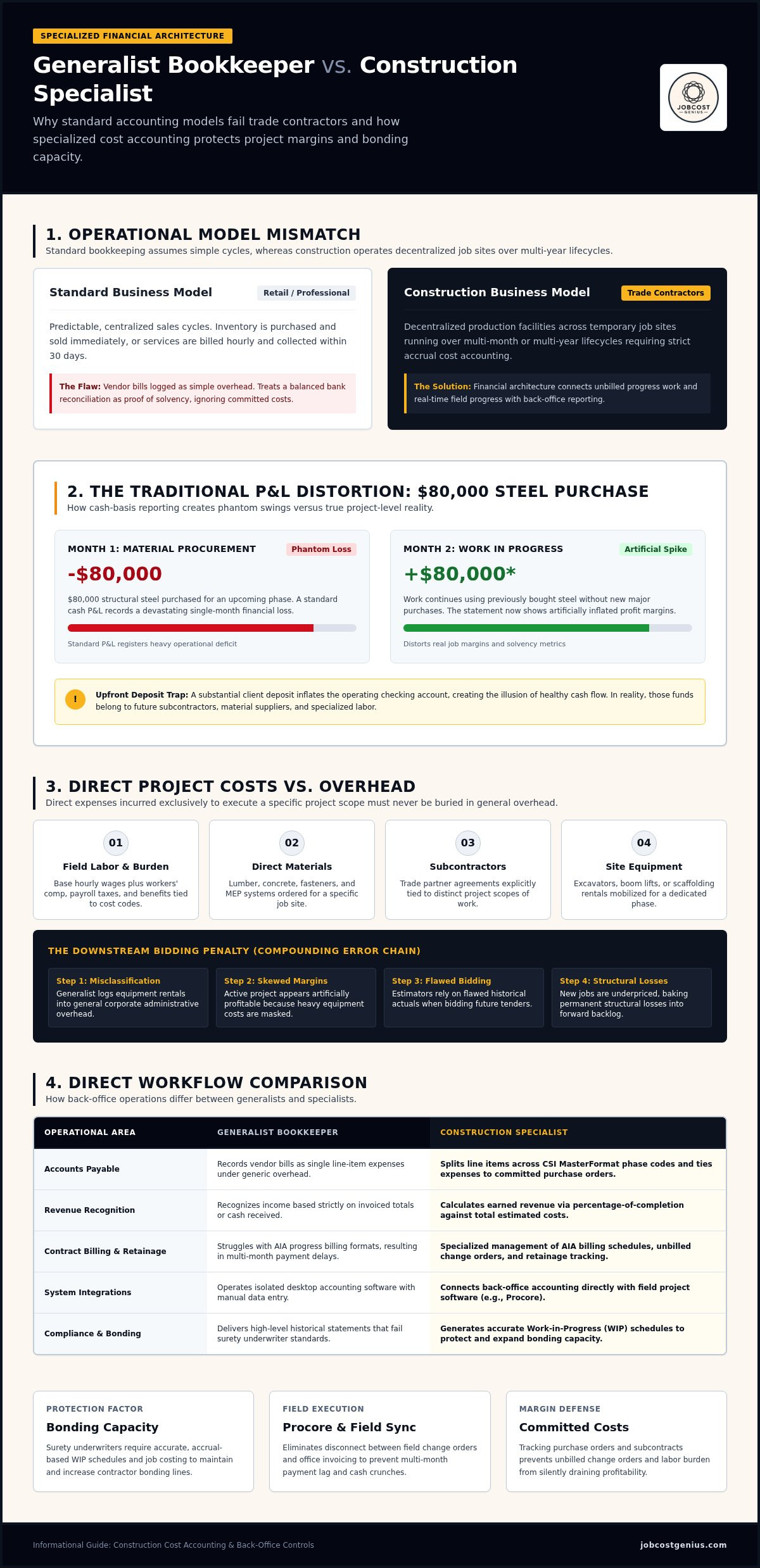
Standard bookkeeping models assume a predictable sales cycle. Retailers buy inventory and sell it immediately. Professional service firms bill hourly rates and collect payment within 30 days. Construction companies, by contrast, run decentralized production facilities across temporary job sites over multi-month or multi-year lifecycles. Treating vendor invoices as simple overhead rather than committed project costs leaves leadership blind to true job margins.
Cash-basis accounting exacerbates this blindness. A substantial upfront client deposit inflates the operating checking account, creating the illusion of healthy cash flow. That money belongs to future subcontractors, material suppliers, and specialized labor. A balanced bank reconciliation shows only that cleared transactions match the bank statement; it does not confirm business solvency. Contractors need strict accrual accounting founded on robust cost accounting principles to measure real operational health. This distinction illustrates the core dilemma when weighing a generalist bookkeeper vs construction specialist.
The Flaw of Traditional Profit and Loss Statements
Traditional profit and loss statements distort project performance. When you purchase $80,000 in structural steel for an upcoming phase, a standard cash P&L records a devastating financial loss for that single month. The following month, as work continues without major material purchases, the statement shows artificial, inflated profit margins.
Standard charts of accounts cannot track multi-phase project lifecycles or align unbilled progress work with incurred field costs. As outlined in the 2026 Construction Accounting Guide for Small Firms, your financial architecture must connect real-time field progress with back-office reporting to eliminate phantom profit swings.
Direct Costs vs Indirect Overhead Misallocations
Accurate job costing demands a rigorous division between direct production expenses and indirect company overhead. Direct costs represent expenses incurred exclusively to execute a specific project scope:
- Field Labor and Burden: Base hourly wages plus workers' comp, payroll taxes, and benefits assigned directly to project cost codes.
- Direct Materials: Lumber, concrete, fasteners, and MEP systems ordered for a specific job site.
- Subcontractor Commitments: Trade partner agreements tied to distinct scopes of work.
- Site-Specific Equipment: Excavator, boom lift, or scaffolding rentals mobilized for a dedicated phase.
Generalist bookkeepers routinely misclassify field equipment rentals into generic corporate overhead accounts. When heavy machinery costs disappear into general administrative expenses, your active project margins look artificially profitable. This error triggers a compounding downstream penalty. Estimators rely on skewed historical actuals to bid future tenders, underpricing upcoming jobs and baking structural losses into your forward backlog. Choosing between a generalist bookkeeper vs construction specialist determines whether your historical data protects your bidding or quietly drains your margins.
Generalist vs Construction Specialist: The Direct Workflow Comparison
Generalist bookkeepers and construction specialists operate on entirely different planes. A generalist reconciles accounts, records historical bills, and delivers high-level statements after the month ends. A construction specialist manages job costs in real time, turning accounting into an operational compass. Because contracting requires managing complex production lifecycles, industry authorities recognize contractor finance as a specialized discipline that standard office workflows cannot handle.
| Operational Area | Generalist Bookkeeper | Construction Specialist |
|---|---|---|
| Accounts Payable | Records vendor bills as single line-item expenses under generic overhead. | Splits line items across CSI MasterFormat phase codes and ties expenses to committed purchase orders. |
| Revenue Recognition | Recognizes income based on invoiced totals or cash received. | Calculates earned revenue via percentage-of-completion against total estimated costs. |
| WIP Management | Does not calculate or reconcile overbillings and underbillings. | Maintains an active monthly WIP schedule to adjust balance sheet contract liabilities and assets. |
| Payroll Tracking | Applies gross payroll wages to a single broad salary expense account. | Allocates fully burdened labor rates, certified payroll compliance, and workers' comp to specific jobs. |
| Lien & Retainage | Treats retainage as overdue AR; collects no conditional or unconditional waivers. | Segregates retainage receivable/payable accounts and matches lien waivers to disbursements. |
When assessing a generalist bookkeeper vs construction specialist, the divergence shows up daily in your operational data. If you want back-office workflows that actually protect job profitability, you can explore specialized support from JobCost Genius.
Job Costing and Cost Code Architecture
A generalist records an invoice to "Job Supplies." A specialist assigns that cost to specific CSI MasterFormat codes, such as 03-30-00 for Cast-in-Place Concrete. Granular tracking exposes margin slippage while crews are still on site. If concrete placement exceeds estimated labor hours by 15%, field managers can adjust production before the project finishes at a loss.
WIP Schedules and Percentage of Completion Accounting
Work-in-Progress reporting governs accurate financial reporting for mid-sized trade contractors. Under percentage-of-completion accounting, earned revenue equals actual costs incurred divided by total estimated costs, multiplied by total contract value. Overbillings represent unearned cash that sits as a liability on your balance sheet, not immediate profit. For detailed reconciliation procedures, review our WIP Reporting Definitive Guide.
Labor Burden and Prevailing Wage Nuances
Direct payroll goes far beyond base hourly pay. Labor burden must capture employer payroll taxes, state unemployment, general liability allocations, and trade-specific workers' comp rates. On public works, Davis-Bacon regulations mandate certified payroll submissions tied to strict wage classifications. Our Prevailing Wage Payroll Guide outlines how structured payroll systems prevent catastrophic audit penalties.
Complex Contract Billing: Why General Bookkeepers Struggle
Commercial construction doesn't operate on standard 30-day net invoicing. Billing is an intricate, contractual procedure bound by architectural milestones, stored material validations, and owner approval cycles. When accounting teams lack industry background, they treat complex contracts like simple retail billings. In the comparison between a generalist bookkeeper vs construction specialist, billing execution represents the quickest point of operational failure.
Improperly formatted payment requests create immediate friction. A minor documentation error can halt cash flow across an entire job site, delaying payroll and leaving trade subcontractors unpaid.
AIA G702 and G703 Payment Applications
Institutional and commercial owners mandate standardized billing, typically using the AIA G702 (Application and Certificate for Payment) and G703 (Continuation Sheet). The G703 requires a meticulous breakdown of the Schedule of Values, matching completed work percentages, stored materials, and approved change orders across dozens of phase codes.
Generalist bookkeepers struggle here because these forms demand exact mathematical continuity from one pay application to the next. If a bookkeeper miscalculates retainage deductions or bills against an unapproved change order, the project architect rejects the entire packet. A single rejected application restarts the approval timeline, turning a standard 30-day collection cycle into a 60-day cash crunch.
Retainage Tracking and Lien Waiver Compliance
Commercial contracts routinely withhold 5% to 10% of earned billings as retainage until final project closeout. Because net profit margins on commercial jobs frequently hover near those same percentages, your retainage receivable often equals the entire net profit of the job.
A generalist bookkeeper treats retainage as standard accounts receivable, which distorts short-term liquidity reports by displaying money you cannot collect for another six to twelve months. A construction specialist isolates retainage into distinct asset and liability accounts, providing a realistic assessment of working capital. Specialists also enforce strict lien waiver controls:
- Conditional Waivers on Progress Billings: Transmitted with pay apps to protect owner interests while preserving lien rights until funds clear.
- Unconditional Waivers upon Payment: Collected from lower-tier suppliers and subcontractors before releasing subsequent disbursements.
Without synchronized retainage and lien waiver workflows, contractors face devastating mechanics' liens, double payment liabilities, and damaged reputations with project owners.
How to Vet a Construction Bookkeeper: The Evaluation Framework
Hiring the wrong financial partner creates expensive back-office cleanup later. General software certifications show basic software proficiency, but they don't prove a candidate understands job costing, contract liabilities, or field production workflows. When weighing a generalist bookkeeper vs construction specialist, use a structured five-step framework to verify their practical capabilities before granting access to your books:
- 1. Percentage-of-Completion Mastery: Confirm they know how to calculate earned revenue and adjust for overbillings and underbillings.
- 2. Construction Stack Experience: Validate hands-on proficiency with trade platforms and ERP software rather than generic office tools.
- 3. Compliance Administration: Verify their workflow for collecting Certificates of Insurance (COIs), tiered lien waivers, and W-9s before approving subcontractor payouts.
- 4. Monthly Reporting Samples: Request blinded sample deliverables showing itemized WIP schedules, committed cost reports, and phase-level job profitability statements.
- 5. Underwriter Presentation: Ensure they can compile clean, GAAP-compliant balance sheets that satisfy commercial surety underwriters and banking officers.
Essential Technical Interview Questions
Targeted interview prompts quickly separate standard bookkeepers from true industry veterans. Start by asking how they account for substantial unbilled change orders when calculating earned revenue at month end. If they cannot describe the relationship between revised contract values and unapproved owner adjustments, they won't produce an accurate WIP schedule.
Next, ask them to explain how overbillings affect working capital. A generalist often views front-loaded billings as surplus operating cash. A qualified specialist immediately recognizes overbilling as a balance sheet liability that represents future work owed without incoming revenue.
Construction Tech Stack and Integration Capabilities
Manual data entry creates operational lag and expensive transcription errors. A capable specialist connects back-office ledgers with your field operations to maintain real-time job cost visibility. For example, our team leverages dedicated Procore Financials Integration Services to synchronize purchase orders, subcontracts, and change directives directly with accounting records without double handling.
Avoid bookkeepers who insist on manually rekeying paper tickets or spreadsheet logs into QuickBooks. If your back office operates on disconnected systems, partner with JobCost Genius to install automated, construction-ready financial controls.
Modernizing Your Back Office: Transitioning to Specialized Support
Upgrading your financial infrastructure requires more than swapping accounting software. It demands a systematic overhaul of your financial foundation. In the evaluation of a generalist bookkeeper vs construction specialist, the transition process itself exposes past blind spots. Establishing structured financial controls unlocks higher bonding capacity, improves credit terms with commercial lenders, and provides the clarity needed to scale sustainably.
Contractors can access enterprise-level financial controls without taking on executive payroll overhead through specialized Outsourced Bookkeeping for Construction models.
The Historical Data Cleanup and Restructuring Phase
Transitioning begins with a forensic audit of legacy records. Specialists review historical ledgers to extract direct job expenses buried in generic overhead accounts. Active project balances are reconciled against signed contracts and change orders to establish a verified baseline for ongoing WIP schedules.
During this phase, phase codes across estimating, field management, and accounting are aligned into a standardized construction chart of accounts. This synchronization ensures that every dollar spent in the field maps directly to its intended budget line item.
Scalable Subscription Tiers for Growing Contractors
Growing trade contractors require adaptable back-office infrastructure. Choosing between a generalist bookkeeper vs construction specialist no longer forces you to hire an expensive, full-time in-house financial team. JobCost Genius provides dedicated national support through tiered monthly subscription plans designed for distinct operational stages:
- Starter Plan: Designed for early-stage contractors who need foundational job cost tracking, clean reconciliations, and accurate monthly reporting.
- Growth Plan: Built for expanding businesses requiring active WIP reporting, labor burden tracking, and full-service payroll management.
- Premium Plan: Engineered for established firms needing advanced reporting, multi-tier compliance management, and direct Procore Financials integrations.
Clean data transforms back-office accounting from a stressful compliance chore into a strategic growth engine. For businesses looking beyond day-to-day entries to high-level outsourced controller support or advisory oversight, consulting firms like SD Mayer help align broader corporate accounting strategies with operational needs. With structured job costing and reliable WIP reporting, you can approach surety underwriters, commercial lenders, and project owners with total financial confidence.
Running an expanding trade business with basic accounting forces you to fly blind. Standard statements conceal project bleeding, distort working capital, and trigger payment application rejections. In the final assessment of a generalist bookkeeper vs construction specialist, the decision comes down to operational control versus financial guesswork. Specialized management protects your job margins, strengthens lender relationships, and secures your bonding capacity.
Founded by professionals with over 20 years of construction finance experience, JobCost Genius provides dedicated nationwide support. From specialized Work-in-Progress (WIP) reporting and granular cost code tracking to direct Procore Financials integrations, we ensure your back office reflects real site conditions.
Stop letting unbilled costs and administrative bottlenecks eat into your net profit. Schedule a Construction Financial Consultation with JobCost Genius to establish an accounting foundation that scales with your backlog.
Frequently Asked Questions
Why can’t my generalist bookkeeper manage construction accounting using standard software?
Standard accounting software is engineered for retail transactions and generic overhead tracking, not decentralized production lifecycles. Generalist bookkeepers typically treat invoices as static administrative expenses rather than committed project costs mapped against phase codes. Without specialized workflows for retainage, burdened labor rates, and contractual change orders, standard software setups produce distorted reports that hide field-level margin erosion until a job is already finished.
What is the biggest financial risk of using a generalist bookkeeper for construction?
The biggest danger is unrecognized project margin fade masked by cash flow timing. Generalists often log upfront client deposits as immediate income, creating phantom profits while unbilled vendor costs and retainage accumulate off the balance sheet. In the debate between a generalist bookkeeper vs construction specialist, choosing a generalist leaves you vulnerable to sudden cash crunches, underpriced project estimates, and bonding capacity reductions.
How does Work-in-Progress (WIP) reporting change monthly financial statements?
A Work-in-Progress schedule aligns billed revenue with actual production costs using percentage-of-completion accounting. Instead of showing artificial profit spikes when large invoices clear, WIP reporting reallocates revenue into overbillings or underbillings on the balance sheet. Overbillings reflect unearned revenue owed to the project, while underbillings capture earned work you haven't billed yet. This adjustment ensures your monthly P&L accurately reflects real operational margins.
Does a specialized construction bookkeeper handle my annual income tax return filing?
No, dedicated construction bookkeepers specialize in operational accounting, job costing, and managerial reporting rather than income tax filings. Firms like JobCost Genius deliver reconciled Work-in-Progress schedules, clean balance sheets, and accurate year-end ledgers directly to your external CPA. This separation ensures your tax preparer receives pristine, audit-ready data without spending costly accounting hours fixing basic job-cost misallocations.
What software platforms should a dedicated construction bookkeeping specialist understand?
A true specialist understands both accounting ledgers and construction-specific operations software. They should possess hands-on expertise in general ledger systems like QuickBooks Online and Sage, paired with project platforms like Procore, Foundation, and Buildertrend. Beyond software entry, they must know how to map CSI MasterFormat cost codes, process AIA billing schedules, and route digital lien waivers through automated workflows.
How does specialized construction bookkeeping help contractors secure larger surety bonds?
Surety underwriters base bonding programs on balance sheet strength, verifiable working capital, and historical gross margin consistency. When weighing a generalist bookkeeper vs construction specialist, underwriters heavily favor the specialist. A specialist provides accurate WIP schedules that eliminate underbilling surprises and prove internal job-cost discipline. Transparent financial packages reassure bond producers that your backlog will remain profitable and properly capitalized.
Can an outsourced construction specialist integrate directly with field management tools like Procore?
Yes, modern construction specialists actively integrate project management platforms directly with back-office accounting ledgers. Specialists configure Procore Financials integrations to synchronize purchase orders, subcontractor commitments, and change directives in real time. This two-way communication eliminates duplicate data entry, reduces field-to-office communication delays, and ensures project managers and financial controllers work from the exact same cost figures.


