

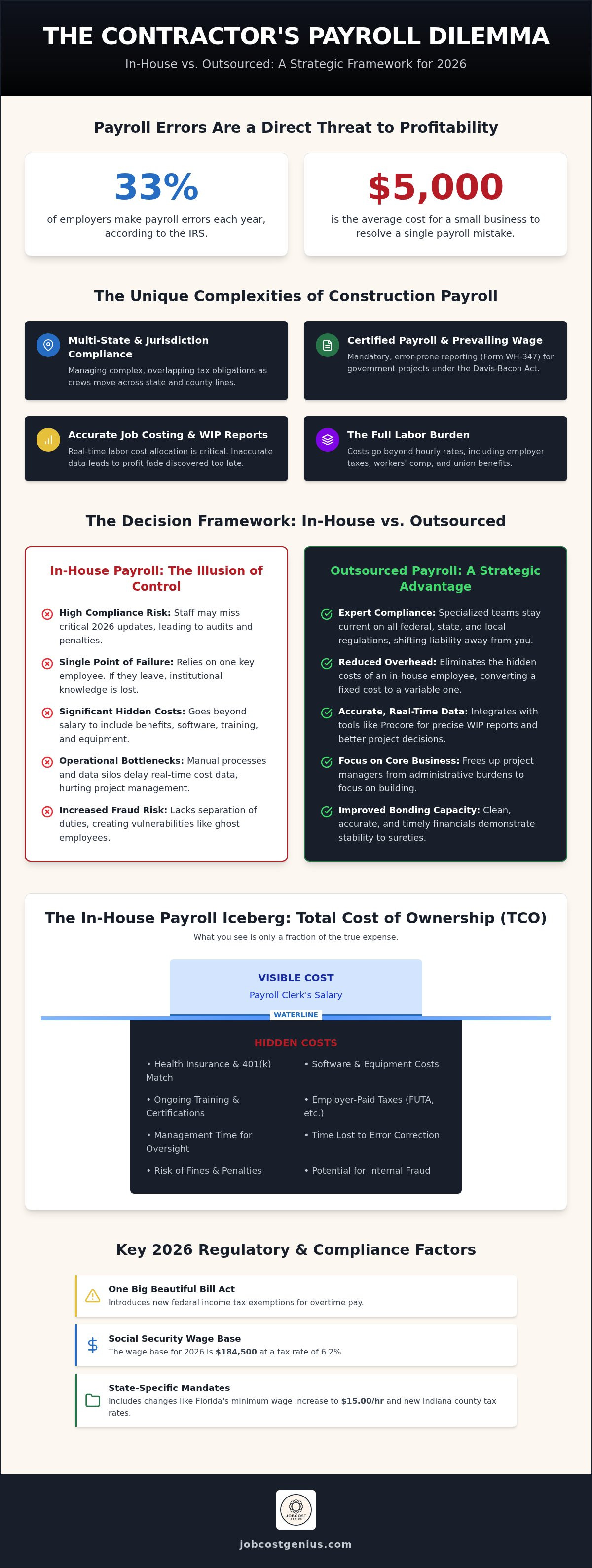
The IRS reports that 33% of employers make payroll errors each year, with the average small business mistake costing up to $5,000 to resolve. In the high-stakes world of contracting, these errors aren't just administrative nuisances; they're direct threats to your bonding capacity and project margins. Deciding between in-house vs outsourced construction payroll is a pivotal choice that dictates whether you spend your weekends wrestling with certified payroll reports or reviewing accurate WIP data. You've likely felt the overwhelm of tracking multi-rate labor or the anxiety of a potential DOL audit when prevailing wage laws shift.
We understand that your payroll needs to be a project management tool, not a back-office burden. This guide provides the framework to evaluate your specific compliance, job costing, and technical requirements for 2026. You'll learn how to navigate the newest regulations, such as the One Big Beautiful Bill Act's federal income tax exemptions for overtime, while ensuring your labor burden is perfectly reflected in your financials. We'll compare internal staffing against specialized services to help you achieve 100% compliance and reduced overhead.
Key Takeaways
- Evaluate the decision between in-house vs outsourced construction payroll by analyzing your specific needs for certified reporting and multi-state compliance.
- Navigate the 2026 regulatory environment, including federal tax exemptions for overtime introduced by the One Big Beautiful Bill Act.
- Learn how specialized payroll management improves the accuracy of your WIP reports by capturing the full labor burden in real time.
- Calculate the true Total Cost of Ownership (TCO) of your payroll process by including hidden expenses like administrative overhead and audit risks.
- Identify the technical criteria for selecting a payroll partner, focusing on critical integrations with industry tools like Procore Financials.
The Unique Complexity of Construction Payroll in 2026
Construction labor management is fundamentally different from the static models used in retail or corporate sectors. A standard payroll process usually involves fixed locations and predictable tax withholdings. In contrast, contractors often manage crews across multiple states and jurisdictions simultaneously. This mobility creates a complex web of tax obligations. For instance, 2026 has seen specific income tax rate changes in several Indiana counties and a scheduled minimum wage increase in Florida to $15.00 per hour. Managing these variables internally is a primary driver in the debate over in-house vs outsourced construction payroll.
Beyond simple check-cutting, payroll data serves as the foundation for WIP reporting for construction companies. If labor costs aren't allocated to the correct job codes in real time, your Work in Progress reports become historical artifacts rather than active management tools. Inaccurate data entry leads to profit fade that isn't discovered until a project is nearly complete. When you factor in union requirements and multi-state filings, the administrative load often exceeds the capacity of generalist bookkeeping staff.
Certified Payroll and Prevailing Wage Demands
Federal contracts exceeding $2,000 fall under the Davis-Bacon Act, requiring rigorous prevailing wage compliance. Certified payroll is a mandatory compliance document for government-funded projects. Manually generating Form WH-347 is a frequent cause of clerical burnout for internal staff. A single oversight in reporting can trigger Department of Labor audits or result in the suspension of project payments. This administrative burden is why many firms choose to shift the responsibility to specialized experts who understand the nuances of prevailing wage laws.
The Labor Burden: Beyond the Hourly Rate
Successful contractors look past the gross hourly rate to understand their true costs. An accurate construction labor burden calculation must include employer-paid taxes, workers' compensation insurance, and union benefits. For 2026, the Social Security tax remains 6.2% on a wage base of $184,500, while FUTA applies to the first $7,000 of earnings. Neglecting these costs when bidding leads to projects that look profitable on paper but drain cash in reality. Specialized payroll management ensures every dollar of labor burden is tracked against specific tasks, protecting your bottom line from missed expenses.
In-House Construction Payroll: The Illusion of Control
Contractors often prioritize direct control over their financial data. They believe keeping a clerk in the office ensures faster answers and better security. However, this perceived control often masks significant vulnerabilities in the in-house vs outsourced construction payroll debate. When you rely on a single internal employee to manage complex union codes and prevailing wage rates, you create a single point of failure. If that person leaves, they take years of institutional knowledge with them, leaving your firm exposed to massive compliance gaps.
Hidden costs extend far beyond a base salary. You're paying for health insurance, 401(k) matches, office equipment, and constant training. General bookkeeping tools frequently fail to handle the nuances of construction, such as multi-rate labor or certified reporting. This forces staff to use manual workarounds in spreadsheets, which are prone to human error. For a broader look at how these dynamics play out across various industries, consult this Payroll Outsourcing: The Ultimate Guide.
The Compliance Risk Factor
Staying compliant in 2026 requires constant vigilance. The Social Security wage base has risen to $184,500, and the One Big Beautiful Bill Act has fundamentally changed how overtime is taxed. A generalist clerk might miss these updates, leading to penalties that far outweigh the cost of professional services. Internal processing also increases the risk of internal fraud, such as ghost employees or timecard padding. Small firms often lack the separation of duties required to prevent these financial leaks effectively.
Operational Bottlenecks
Manual payroll creates a Friday Afternoon Rush that pulls project managers away from the job site. They spend hours chasing down illegible paper timecards or correcting coding errors. In-house payroll often creates data silos between the field and the office. This lack of integration means your project managers don't see real-time labor costs until it's too late to adjust. If you feel buried by these administrative hurdles, exploring a managed payroll solution can restore your focus to the field.
Outsourced Construction Payroll: A Strategic Advantage
Shifting from internal processing to a specialized partner transforms payroll from a reactive chore into a proactive management tool. It moves the burden of 2026 tax law compliance from your office staff to a team of industry experts. While an internal clerk may struggle to track the $184,500 Social Security wage base or the nuances of the One Big Beautiful Bill Act, a dedicated service handles these updates automatically. This transition mitigates the "single point of failure" risk discussed earlier, ensuring your operations remain stable even if your internal team changes.
Scalability is a primary benefit for growing firms. Construction is seasonal. Your administrative overhead shouldn't fluctuate wildly just because your field crew grows during peak project months. An outsourced model allows you to handle 50 employees as easily as 15 without hiring additional office staff. This efficiency is a core component of modern Accounting for Construction Companies, where firms prioritize lean operations and foundational strength.
Data security is another critical factor. Specialized providers maintain enterprise-grade security protocols and disaster recovery plans that local servers often lack. Your sensitive labor data is protected by encryption and redundant backups, ensuring business continuity regardless of local hardware failures or cyber threats. Deciding on in-house vs outsourced construction payroll often comes down to this level of professional stability.
Expertise in Construction-Specific Reporting
Government-funded projects require meticulous documentation. Specialized partners automate the generation of WH-347 forms, ensuring every hour is coded correctly according to Davis-Bacon requirements. This automation extends to union fringes and apprenticeship tracking, which are notoriously difficult to manage in general bookkeeping software. Utilizing prevailing wage payroll processing for contractors removes the manual burden of multi-rate calculations. It reduces audit anxiety by ensuring your filings are 100% compliant before they're submitted.
Field-to-Office Data Synchronization
Modern outsourcing thrives on technical integration. By connecting your payroll service with Procore financials integration services, you eliminate the need for manual data entry. Field timecards flow directly into your accounting system, creating a single source of truth for labor costs. This real-time synchronization allows project managers to see accurate job costing data immediately. It prevents the data silos that typically plague in-house systems, giving you the financial clarity needed to protect your project margins.
Total Cost of Ownership (TCO): A Comparison Framework
Comparing in-house vs outsourced construction payroll requires looking beyond the monthly invoice. Direct costs like software subscriptions and base salaries are easy to track. However, the indirect costs often sink a contractor's budget. When project managers spend hours resolving timecard disputes or correcting labor codes, they aren't managing the job site. This inefficiency creates a massive opportunity cost. Your team's expertise is best used in production and safety, not administrative data entry. Every hour spent on clerical work is an hour lost to project execution.
Professional services also provide a critical "audit buffer." If the Department of Labor or the IRS requests records, you have an industry expert ready to defend your filings immediately. This reduces the risk of the $5,000 average error correction cost often faced by small businesses. With the IRS reporting that 33% of employers make payroll errors annually, the financial value of professional accuracy cannot be overstated. A specialized partner ensures your labor burden is calculated correctly from the start, protecting your project margins from hidden leaks.
Calculating the Internal Payroll Price Tag
Internal administration involves more than just a clerk's hourly wage. You must factor in the cost of continuing education to stay current with 2026 tax changes, such as the $184,500 Social Security wage base and federal contractor minimum wage requirements. These complexities demand constant training that takes staff away from their core duties. Consider these five hidden costs of in-house payroll:
- Employer-paid taxes and benefits for internal administrative staff.
- Office space, hardware, and furniture overhead for each employee.
- Software maintenance fees and annual subscription renewals.
- Time spent by owners or executives reviewing manual reports for errors.
- Professional development and compliance training hours required for 2026 regulations.
The Value of Accuracy in Bonding
Clean payroll records directly impact your financial standing and future growth. Sureties look for meticulous labor tracking and financial transparency when evaluating your bonding capacity. Accurate data is also essential for reclaiming retention payments, as it proves compliance with all project labor requirements and prevailing wage laws. Bond companies prioritize contractors with outsourced bookkeeping for construction firms. This professional oversight signals to sureties that your business is stable, organized, and carries minimal compliance risk. To see how specialized management can stabilize your overhead and improve your financial profile, explore our tiered payroll plans.
Making the Switch: How to Transition to Managed Payroll
Transitioning to a managed model is a strategic shift that requires more than just signing a new contract. It involves a systematic audit of your current processes to identify where data silos exist. As you evaluate in-house vs outsourced construction payroll, look for gaps in how timecards move from the field to your ledger. This audit reveals the true administrative burden and sets the baseline for your new technology stack. Successful transitions prioritize field-to-office efficiency, ensuring that every hour logged on a job site flows directly into your financial reporting without manual intervention.
Selecting a partner who understands construction accounting for small firms is the most critical step. Generalist payroll companies often struggle with the multi-jurisdictional tax filings and union tracking common in the industry. Your partner must act as a disciplined guide, helping you move from administrative overwhelm to a state of financial clarity and foundational strength. Clear communication with your field crew is also essential; explain how the new system simplifies their time-tracking and ensures 100% accuracy in their paychecks.
Selecting a Construction-Specific Partner
Ask potential providers about their specific experience with industry tools like Procore Financials. A generalist provider won't understand how payroll data impacts your bonding capacity or WIP reports. Verify that they can handle automated certified reporting and that they offer tiered plans that scale as your workforce grows. While comparing in-house vs outsourced construction payroll options, prioritize firms that offer specialized formatting for construction-specific billing. You need a partner who understands that payroll is a project management tool, not just a back-office task.
The JobCost Genius Approach to Payroll
JobCost Genius brings over 20 years of industry experience to your back office. Our team specializes in managing the technical complexities of labor compliance, from Davis-Bacon requirements to real-time labor burden tracking. We offer structured solutions, including our Starter Plan for smaller operations and our Growth and Premium plans for contractors scaling their teams. We focus on Procore Financials Integration to ensure your field data and office records are always in sync. This approach eliminates the "Friday Afternoon Rush" and provides you with accurate WIP reporting. To move your firm toward financial clarity and organized calm, Contact JobCost Genius for a tailored payroll management plan today.
Stabilize Your Overhead with Specialized Management
The decision between in-house vs outsourced construction payroll ultimately determines your firm's operational agility and long-term stability. Internal processing often hides significant costs and compliance risks that can threaten your project margins and bonding capacity. Moving to a specialized model isn't just about outsourcing a task; it's about gaining the financial clarity required to scale your business with confidence. By prioritizing accurate labor burden tracking and seamless field-to-office synchronization, you ensure every WIP report reflects your true financial position.
JobCost Genius provides the expert-led support you need to eliminate administrative overwhelm. With over 20 years of construction finance expertise, our team understands the meticulous requirements of certified payroll and multi-state filings. We offer tiered plans designed for scaling contractors and ensure seamless Procore and WIP integration for your existing infrastructure. Don't let back-office burdens stall your production or lead to audit anxiety. Get a Specialized Payroll Strategy from JobCost Genius and secure your firm's foundational strength today. Your path to organized calm starts with a partner who understands the high-stakes nature of your industry.
Frequently Asked Questions
Is outsourced payroll more secure than in-house payroll for construction?
Outsourced payroll is generally more secure due to enterprise level encryption and redundant cloud backups. In-house systems often rely on local servers that lack professional disaster recovery protocols. These internal setups are also more susceptible to internal fraud because they often lack a proper separation of duties. By moving to a professional service, you protect sensitive employee data and ensure your business remains operational regardless of local hardware failures or cyber threats.
Can an outsourced payroll service handle union fringe benefits?
Specialized providers handle union fringe benefits by automating complex calculations for various trade codes. They track apprenticeship hours and benefit tiers that change frequently. This automation removes the manual burden from your office staff and ensures your union reports are accurate and submitted on time. It's a critical component of managing labor compliance in the construction industry, where manual errors can lead to expensive grievances or project delays.
How does outsourcing payroll affect my WIP reporting accuracy?
Outsourcing payroll significantly improves WIP reporting accuracy by capturing the full labor burden in real time. When you evaluate in-house vs outsourced construction payroll, you'll find that manual systems often miss employer paid taxes and insurance costs. Professional management ensures every dollar of labor expense is allocated to the correct job code. This gives you a true picture of project profitability, allowing you to identify profit fade before it impacts your bottom line.
What happens if there is an error in a certified payroll report?
Errors in certified payroll reports can lead to Department of Labor audits and the suspension of project payments. If an oversight occurs, a specialized partner provides the documentation and expertise needed to correct the filing quickly. They act as a buffer between your firm and regulatory agencies. Having a professional defend your records reduces the likelihood of paying the $5,000 average error correction cost reported by many small businesses.
Do I still need a bookkeeper if I outsource my payroll?
You don't necessarily need a separate internal bookkeeper if you select a partner like JobCost Genius. We offer tiered plans, such as our Growth and Premium options, which combine bookkeeping with payroll management. This unified approach ensures your financial statements and labor records are always in sync. It transforms your back office from a source of administrative overwhelm into a disciplined engine of financial clarity and foundational strength for your growing firm.
Can outsourced payroll integrate with Procore or Buildertrend?
Professional payroll services integrate seamlessly with industry tools like Procore or Buildertrend. JobCost Genius focuses specifically on Procore Financials Integration to bridge the data gap between the field and the office. This synchronization allows timecards to flow directly into your accounting system without manual data entry. It creates a single source of truth for your labor costs, ensuring your project managers have access to real time financial data for better decision making.
Is it better to use a general payroll provider or a construction specialist?
A construction specialist is superior because they understand industry specific requirements like Davis-Bacon and multi-state tax filings. General providers often lack the technical knowledge to handle complex labor laws or WIP integration. When choosing between in-house vs outsourced construction payroll, a specialist ensures your firm stays compliant with 2026 regulations, such as the One Big Beautiful Bill Act. They provide the industry specific formatting required for construction billing that generalists simply can't offer.
How long does it take to transition from in-house to outsourced payroll?
A typical transition takes between 30 and 60 days to ensure a smooth handover. This period involves a thorough audit of your current payroll process to identify gaps and set up your new technology stack. We also focus on communicating the change to your field crew and office staff to ensure everyone understands the new workflow. This deliberate pace builds trust and reinforces the reliability of your new financial infrastructure.


