

Is your bank balance actually yours, or are you just holding onto cash that belongs to your subcontractors and the IRS? It's a common trap in this industry. You see a healthy account and assume your projects are thriving, only to realize later that overbilling and uncollected retention have created a massive cash flow gap. Performing a regular construction financial health checkup is the only way to ensure you aren't just moving money around while your true margins erode. If you've ever felt that your Profit and Loss statement is lying to you, you aren't alone.
This 2026 checklist provides the framework you need to audit your project profitability using industry-specific benchmarks that generalist accountants frequently overlook. We'll help you move past the administrative overwhelm and gain total financial clarity. You'll learn how to identify hidden profit leaks and calculate a precise labor burden across every job site. This guide covers everything from the essentials of Work in Progress (WIP) reporting to the sophisticated data needed for confident bidding. By the end, you'll have a reliable system to ensure your historical data finally matches your bank reality.
Key Takeaways
- Understand why a standard P&L often hides the truth and how a dedicated construction financial health checkup identifies operational leaks before they impact your bottom line.
- Master the mechanics of Work in Progress (WIP) reporting to distinguish between actual profit and temporary cash flow generated by overbilling.
- Compare your firm's performance against specific industry benchmarks for gross margins and current ratios to identify areas for competitive improvement.
- Implement a rapid 15-minute audit process to reconcile accounts and flag aging retention before it creates a significant cash flow crisis.
- Discover how transitioning from DIY bookkeeping to specialized tiered plans can provide the expert oversight needed for sustainable business scaling.
What is a Construction Financial Health Checkup?
A construction financial health checkup is a systematic diagnostic of your firm’s fiscal stability. It moves beyond the basic tax compliance of a standard audit to focus on operational efficiency and project-level performance. While a general accountant looks at what you owe the government, this checkup looks at what you owe your vendors, your employees, and your future self. It bridges the gap between your field operations and your back office.
Many contractors fall into the trap of trusting a standard Profit and Loss (P&L) statement. This report can often show a healthy profit even while the company is dangerously close to running out of cash. This paradox occurs when you use deposits from new jobs to pay for the costs of old ones. A professional construction financial health checkup identifies these profit leaks by looking at the timing of your revenue. It introduces the concept of project-first accounting, where every job is managed as its own financial entity. This methodology is a core component of professional Construction Management Overview, ensuring that costs are tracked exactly where they are incurred.
Why Generalist Bookkeeping Fails Contractors
Generalist bookkeepers typically rely on cash-basis reporting. This works for retail businesses, but it's fundamentally mismatched for the long-term nature of construction projects. They often treat overbillings as pure revenue. In reality, overbilling is a liability; it's money you've collected for work you haven't yet performed. If you don't track these figures accurately, you'll spend your future project costs on today's overhead. You can explore the specific risks of this approach in our comparison of a Construction Bookkeeper vs Generalist: Why It Matters.
The Consequences of Skipping Your Financial Checkup
Failing to conduct regular checkups leaves your business vulnerable to several high-stakes risks. Without a clear framework, you may experience:
- Profit Fade: This is the gradual erosion of your estimated margins as a project progresses. Without a checkup, you won't notice the fade until the job is finished and the money is gone.
- Bonding and Financing Barriers: Banks and surety companies require high levels of financial transparency. If your books are messy, you won't secure the bonding needed for larger, more profitable contracts.
- Unexpected Tax Liabilities: Inaccurate revenue recognition leads to surprises at year-end. You might find yourself owing taxes on profit that was actually just cash flow from unearned billings.
The 4 Core Metrics of a Healthy Construction Firm
A thorough construction financial health checkup requires more than just glancing at your bank balance. You need specific financial health indicators that accurately reflect the volatility of the job site. While a generalist might focus on simple overhead, a construction expert looks at how project-level data impacts company-wide stability. These metrics tell you if your business is truly growing or just surviving on cash from the next deposit.
Underbilling and overbilling are two of the most misunderstood metrics in the industry. Underbilling occurs when you've done more work than you've invoiced, which means you're financing the owner’s project with your own cash. Overbilling might feel like a win because your bank account is full, but it's actually a liability for work you haven't performed yet. Balancing these is critical for long-term survival.
WIP Reporting: The Heart of the Audit
Work in Progress (WIP) reports bridge the gap between field progress and office billing. They provide a clear view of whether you're ahead or behind on every job. Consistent underbilling across your portfolio is a major red flag. It suggests that your billing cycle is lagging behind your production, which can lead to a sudden cash crunch. For a deeper look at these mechanics, review our WIP Reporting for Construction: The Definitive 2026 Guide.
True Labor Cost vs. Paycheck Amounts
Your firm's health depends on knowing your fully burdened labor rate. Most contractors underestimate this because they only look at gross wages. Labor burden is the total cost of employment beyond gross wages. This includes payroll taxes, health benefits, workers' comp, and even vehicle overhead. If you don't account for these, your bids will be too low to sustain your business. Understanding these costs is easier when you have a partner like JobCost Genius helping you track the data.
Finally, you must track Days Sales Outstanding (DSO). This metric measures how fast you turn invoices into cash. In an industry where retention can tie up 10% of your revenue for months, you can't afford to let standard invoices sit unpaid. High DSO numbers often signal a breakdown in your collection process or a dispute on the job site that needs immediate attention. Tracking this monthly ensures your cash flow remains predictable.
Benchmarking: How Does Your Business Compare?
Benchmarking is the diagnostic phase of your construction financial health checkup. Comparing your firm to a generic local business is a mistake. Construction involves high overhead, delayed payments, and significant risk profiles that standard accounting models don't capture. You need industry-specific data to determine if your margins are sustainable or if you're slowly losing ground to your competitors.
Your current ratio measures your ability to pay short-term debts using your current assets. For builders, a ratio between 1.2 and 1.5 is generally considered healthy. If this number drops below 1.0, you're technically insolvent in the short term. Conversely, a ratio that is too high might indicate that you aren't reinvesting your cash efficiently into growth or equipment. It's about finding a balance that ensures liquidity without sacrificing expansion.
We also look at "Months in Backlog" to gauge future stability. This metric predicts how long your current contracts will cover your overhead if you don't sign a single new deal. A healthy firm typically maintains a pipeline of 6 to 12 months. Without this visibility, you're bidding out of desperation rather than strategy. Reliable backlog data allows you to pass on low-margin work and wait for the right opportunities.
Gross Margin Benchmarks by Trade
Margins vary wildly across the industry. General contractors often operate on thinner gross margins, typically between 10% and 15%, because they manage large volumes of pass-through costs. Specialty trades like electrical or plumbing require higher margins, often 25% to 35%, to sustain specialized labor and equipment. A 10% margin might be a sign of efficiency for a GC, but it's a death sentence for a subcontractor with high labor burden. Reviewing your historical job costs is the only way to set accurate internal benchmarks for future bids.
The Debt-to-Equity Ratio in Construction
Debt is a tool for scaling, but too much leverage will freeze your bonding capacity. Surety companies look for a balanced debt-to-equity ratio to ensure you can weather a project delay or a slow payment cycle. If your ratio climbs too high, you'll find it nearly impossible to secure the bonds required for larger contracts. You must also analyze your balance sheet for hidden liabilities. This includes unrecorded retention or "pay-when-paid" clauses that haven't been properly tracked. Identifying these gaps ensures your financial position is as strong as it looks on paper.
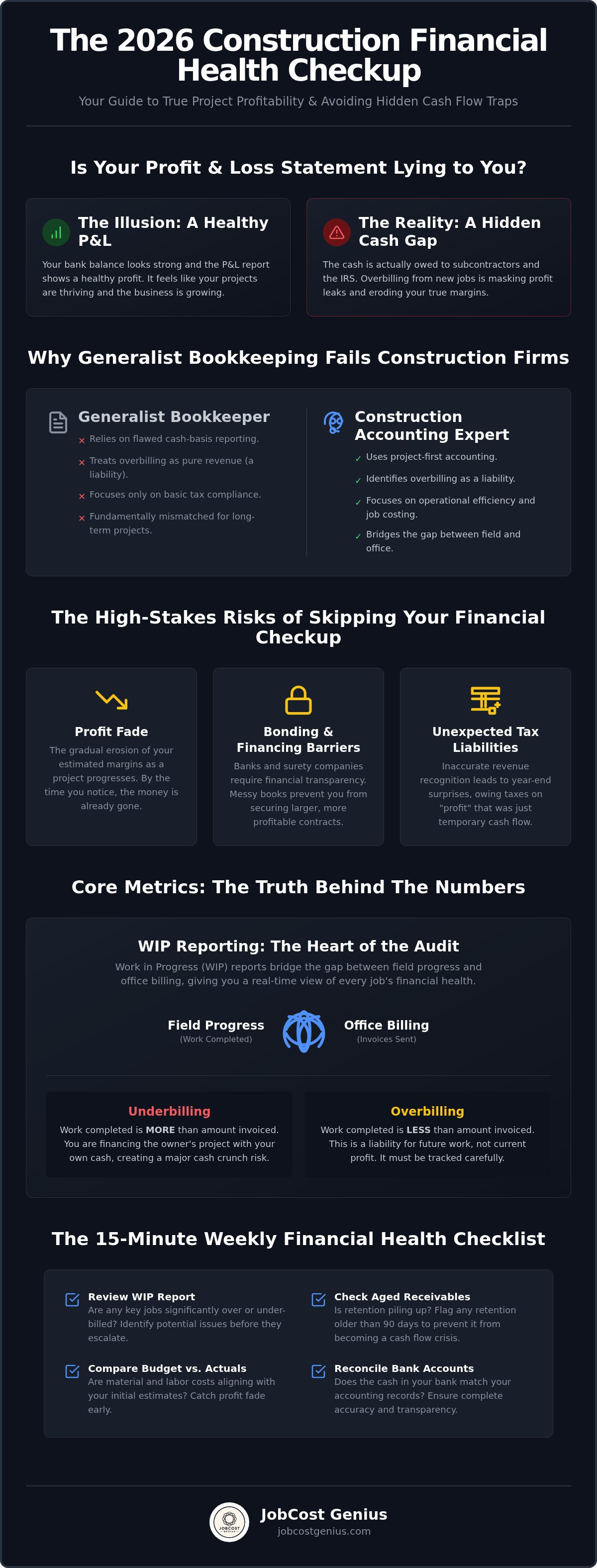
The 15-Minute Construction Financial Health Checklist
Maintaining a profitable firm requires consistent oversight. You don't need hours of deep analysis every day to stay on track. A 15-minute construction financial health checkup can reveal critical issues before they compromise your operations. This rapid audit ensures your data is current and your cash flow is protected. Follow these five steps to verify your firm's standing.
- Step 1: Reconcile Accounts. Ensure all bank and credit card accounts are reconciled through the previous week. If your data is 30 days old, you're making decisions based on ancient history.
- Step 2: Audit Retention. Review your Accounts Receivable aging report. Specifically, look for any retention older than 60 days. Uncollected retention is your profit sitting in someone else's bank account.
- Step 3: Cost Comparison. Select your top three active projects. Compare actual costs incurred to date against your original estimates. Significant variances suggest a breakdown in field production or estimating accuracy.
- Step 4: Overbilling Reality Check. Check your WIP for overbillings. Compare that total liability to your current cash in the bank. If your overbillings exceed your available cash, you're spending money you haven't earned yet.
- Step 5: Change Order Verification. Verify that every change order currently in progress is signed and reflected in the contract total. Work performed without a signature is a primary cause of profit fade.
Weekly vs. Monthly Health Tasks
Effective management requires different levels of scrutiny at different intervals. Weekly "pulse checks" should focus on immediate cash balances and payroll obligations. Monthly "annual physicals" involve a deeper overhead analysis and a full review of your debt-to-equity ratio. Establishing a culture of financial transparency between your project managers and the accounting team ensures that field data flows accurately into your reports. For more detailed tactics, see our guide on Construction Cash Flow Management: Strategies for Sustainable Growth in 2026.
Spotting Red Flags Before They Become Crises
Identifying a red flag early is the difference between a minor adjustment and a business failure. If your cash on hand is lower than your overbillings liability, you're at risk of a "cash crunch" when the project ends. Similarly, if a project’s "cost to complete" suddenly exceeds the remaining budget, you need an immediate intervention. Always verify vendor lien waivers before issuing final payments to prevent double-payment risks. If these steps feel overwhelming, JobCost Genius can provide the expert oversight needed to keep your books clean and your projects profitable.
Scaling with Confidence: Implementing Expert Oversight
Scaling a construction firm requires more than just winning bigger contracts. It demands a sophisticated financial infrastructure that grows alongside your project list. Many contractors start with DIY bookkeeping or a generalist service. These options quickly become liabilities as complexity increases. A professional construction financial health checkup isn't just a one-time event; it's a recurring necessity for firms that want to remain profitable. Transitioning to a specialized service allows you to focus on production while experts manage the technical nuances of job costing and labor compliance.
JobCost Genius offers tiered support to match your firm's specific stage of growth. Our Starter, Growth, and Premium plans begin at $800 per month, providing a scalable path for firms nationwide. This structure ensures you have access to industry veterans with over 20 years of experience without the overhead of an internal department. By delegating these tasks, you replace administrative overwhelm with organized calm and financial clarity. You gain a strategic partner who understands the high stakes of the building industry.
Field-to-Office Sync with Procore Financials
Bridging the data gap between the job site and the accounting office is the only way to eliminate profit fade. When field teams and office staff work from different numbers, errors are inevitable. We provide Procore Financials Integration Services to create a single source of truth for your organization. This integration ensures that every dollar spent in the field is instantly reflected in your financial reports. It allows for real-time adjustments before margins shrink, ensuring your project data is always current and actionable.
The Value of Monthly WIP Reporting
Relying on a year-end review is a reactive strategy that leads to tax-season panic. Monthly oversight through specialized WIP reporting identifies underbillings and cash flow gaps as they happen. This proactive approach ensures your books are always audit-ready. It provides the transparency required by banks and bonding agents to secure your next big contract. You gain the confidence to bid on larger jobs because you know exactly what your historical data supports. It's time to stop guessing about your true margins. You can schedule a consultation with JobCost Genius to stabilize your financials and secure your firm's future.
Securing Your Firm’s Financial Foundation
True financial stability in the construction industry isn't found in your bank balance; it's found in the accuracy of your project data. By implementing a regular construction financial health checkup, you protect your firm from profit fade and uncollected retention. You've now seen how to audit your labor burden and reconcile overbillings against your actual cash reserves. These steps move you beyond the administrative overwhelm of messy books and into a state of financial clarity.
You don't have to manage these technical complexities alone. JobCost Genius provides specialized, construction-only expertise to ensure your firm remains audit-ready and profitable at every stage of growth. Our team members are experts in Procore and Sage 300 CRE integrations, and we include specialized WIP reporting in our monthly services. It's time to build your business on a foundation of foundational strength and meticulous reporting. Get a Professional Financial Health Checkup with JobCost Genius today. Take the first step toward organized growth and sustainable success.
Frequently Asked Questions
How often should a construction company perform a financial health checkup?
Monthly is the industry standard for a comprehensive review. Weekly pulse checks on cash balances and payroll are necessary for immediate stability; however, a full construction financial health checkup should happen at the close of every month. This frequency allows you to identify underbillings or profit fade before they become irreversible. It ensures that your project managers and accounting team stay aligned on actual field progress throughout the year.
What is the most important financial metric for a general contractor?
Work in Progress (WIP) accuracy is the most critical metric. It tells you if your projects are truly profitable or if you're just using cash from one job to fund another. For a general contractor, monitoring overbillings and underbillings within the WIP report is essential. This data provides a clear view of your earned revenue versus your actual billings, which is a foundational indicator of your firm's long-term stability.
Why does my bank balance not match my profit and loss statement?
This discrepancy occurs because a Profit and Loss statement records revenue when it's earned, while your bank balance reflects actual cash movement. In construction, you might have a high bank balance due to overbilling for work not yet performed. Conversely, your P&L might show profit while your cash is tied up in uncollected retention. A construction financial health checkup reconciles these timing differences to show your true financial standing.
Can a general bookkeeper handle construction financial health audits?
Generalist bookkeepers often lack the specialized knowledge required for complex construction accounting. They typically don't understand the nuances of WIP reporting, labor burden calculations, or retention tracking. Construction requires a project-first approach that generalists miss. Without industry-specific expertise, a generalist might misclassify overbillings as revenue. This leads to inaccurate reporting and unexpected tax liabilities at the end of the year that can cripple your cash flow.
What are the red flags of poor financial health in a construction firm?
Common red flags include consistently low cash reserves despite high billings and a growing list of aging accounts receivable. If your overbillings liability is higher than your available cash, you're in a dangerous position. Other warning signs include frequent profit fade where margins shrink as a project nears completion. Seeing these indicators early allows for strategic adjustments before they escalate into a full-scale cash flow crisis for your firm.
How does WIP reporting help with a financial health checkup?
WIP reporting acts as the bridge between your field operations and your financial statements. It allows you to see the percentage of completion for every project and compare it to your billings. This visibility is the only way to accurately recognize revenue and identify jobs that are underperforming. It provides the data necessary to adjust your bidding strategies based on actual historical performance rather than relying on optimistic estimates.
Is it possible to automate my construction financial health monitoring?
You can automate much of the data flow by integrating your field management software with your accounting system. Using tools like Procore Financials Integration ensures that field costs are updated in real-time. While technology handles the data entry, you still need expert oversight to interpret the reports correctly. Automation reduces manual errors but works best when paired with a professional review to ensure your benchmarks remain accurate and achievable.
What is a healthy debt-to-equity ratio for a growing construction business?
A ratio between 1.0 and 2.0 is generally considered healthy for growing construction firms. This balance shows that you're using leverage to scale while maintaining enough equity to satisfy bonding companies. If your ratio exceeds 3.0, you may find it difficult to secure the necessary insurance or financing for larger projects. Maintaining a disciplined ratio ensures you have the foundational strength to weather industry downturns or unexpected project delays.


