

What if the reason you're feeling stretched isn't a lack of work, but a lack of visibility into the work you already have? Determining exactly when to hire a bookkeeper for a construction business is rarely about hitting a specific revenue milestone; it's about the moment your project complexity outpaces your ability to track every dollar in real time.
You likely started your firm to build, not to spend your nights reconciling unorganized receipts or stressing over labor burden calculations. It's exhausting to manage a full pipeline while still feeling anxious about cash flow or waiting until a job is finished to see if it was actually profitable. You deserve the same precision in your financial data that you demand on your job sites.
This 2026 guide will help you identify the exact moment your construction firm needs professional financial oversight to protect project margins and scale with confidence. We'll show you how to move from administrative overwhelm to a state of organized calm and financial clarity.
We'll examine the critical triggers for hiring, from the need for accurate WIP reports for bonding to the benefits of software integrations. By the end, you'll know how to reclaim your time so you can focus on bidding and site management.
Key Takeaways
- Understand why construction bookkeeping requires more than just a general ledger; it’s about mastering project-based job costing and retention.
- Learn the critical indicators of when to hire a bookkeeper for a construction business, especially if you don't have real-time WIP visibility.
- Evaluate the true costs of in-house staff versus specialized partners to ensure your financial oversight scales efficiently with your project volume.
- Identify essential partner qualifications, such as expertise in percentage-of-completion accounting and seamless Procore or Sage integrations.
- Transition from administrative overwhelm to organized calm by choosing a service model that protects your margins as your pipeline grows.
Beyond Data Entry: Why Construction Bookkeeping is a Different Beast
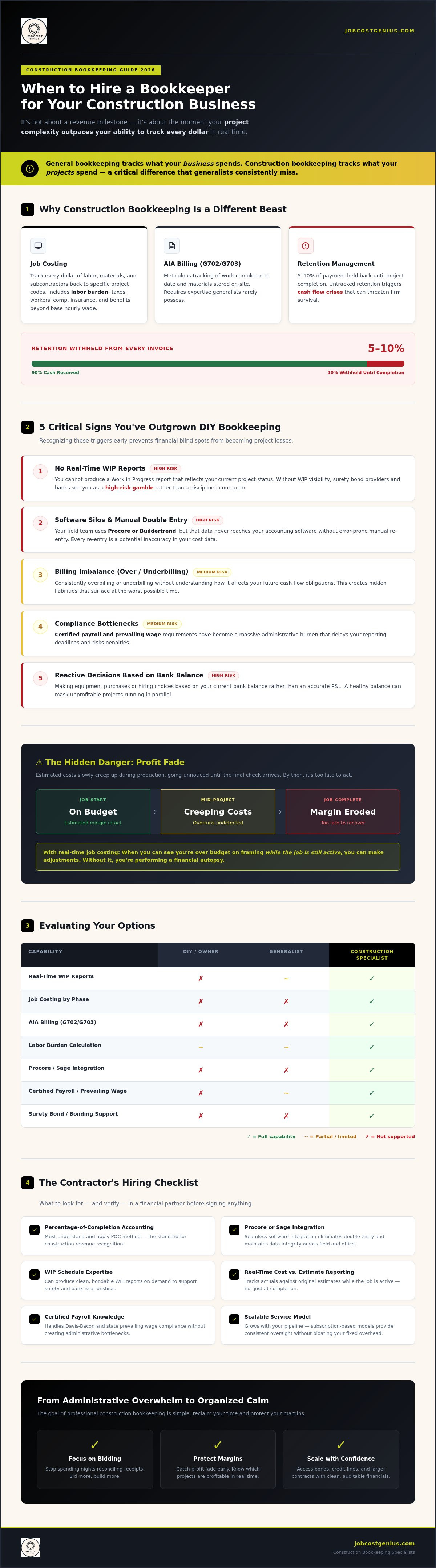
General bookkeeping tracks what your business spends. Construction bookkeeping tracks what your projects spend. This distinction is why generalist bookkeepers often fail contractors. A standard ledger shows you have money in the bank, but it won't tell you if Project A is quietly subsidizing the losses of Project B. Understanding when to hire a bookkeeper for a construction business usually starts when you realize your bank balance doesn't reflect your actual project health.
Specialized oversight identifies "profit fade" before it erodes your margins. This happens when estimated costs slowly creep up during production, often going unnoticed until the final check arrives. Beyond internal health, clean financial data is your ticket to growth. Surety bond providers and banks require sophisticated reporting to approve the credit lines you need for larger contracts. Without project-specific data, you appear as a high-risk gamble rather than a disciplined professional. Professional oversight ensures your financial statements mirror the quality of your physical builds.
The Complexity of Job Costing
Tracking every dollar spent on labor, materials, and subcontractors back to specific project codes is non-negotiable for scaling firms. Generalists often struggle with the calculation of labor burden, which includes taxes, workers' compensation, insurance, and benefits far beyond the base hourly wage. If your burden rates are inaccurate, your bids are essentially guesswork. Equipment allocation presents another hurdle; if you don't track the cost of owning and operating your fleet against specific jobs, your overhead will quietly eat your profits. Job costing is the heartbeat of contractor profitability.
To maintain accuracy, you must categorize expenses by cost type and phase. This level of detail allows you to compare actual costs against your original estimates in real time. When you can see that you're over budget on framing while the job is still active, you can make adjustments. Without this data, you're simply performing a financial autopsy after the project is over.
AIA Billing and Retention Management
Commercial contractors face the unique administrative weight of G702 and G703 forms. These AIA billing documents require meticulous tracking of work completed to date and materials stored on-site. Managing retention is equally critical. With 5-10% of your payment often held back until the project is 100% complete, your cash flow can become a crisis if not tracked properly. A pro ensures your billing stays ahead of your costs. Knowing when to hire a bookkeeper for a construction business means recognizing that you can no longer afford to finance an owner's project with your own working capital.
5 Critical Signs Your Construction Firm Has Outgrown DIY Bookkeeping
Knowing when to hire a bookkeeper for a construction business isn't just about how many hours you spend on spreadsheets; it's about the quality of the data driving your firm's growth. If your current administrative process feels like a constant scramble, you've likely hit a ceiling that DIY methods cannot break. Recognizing these five signs will help you pivot before financial blind spots turn into project losses.
- No Real-Time WIP: You cannot produce a Work in Progress report that reflects your current project status.
- Software Silos: Your field team uses Procore or Buildertrend, but that data never reaches your accounting software without manual double entry.
- Billing Imbalance: You are consistently overbilling or underbilling without understanding how it affects your future cash flow obligations.
- Compliance Bottlenecks: Certified payroll and prevailing wage requirements have become a massive administrative burden that delays your reporting.
- Reactive Decisions: You make equipment purchases or hiring choices based on your current bank balance rather than an accurate P&L statement.
If these bottlenecks sound familiar, transitioning to a professional subscription model can provide the organized calm needed to focus on your next big bid. Specialized oversight ensures that your financial infrastructure is as solid as your physical builds.
Project Profitability Blindness
Cash-basis thinking is a dangerous trap in a high-overhead industry. If you only look at the cash in your account, you might feel successful while actually losing money on every job. Knowing your profit at the end of a project is too late to save the margin. You need to identify the gap between field reports and office financials while the crew is still on-site. This visibility allows you to address labor overruns or material waste before they become permanent losses on your balance sheet.
The WIP Report Stress Test
Your WIP report is more than an internal tool; it's a statement of credibility to external stakeholders. Surety bond providers and banks view a clean WIP as a sign of a disciplined, low-risk operation. If you cannot provide these reports on demand, you'll find it nearly impossible to secure the bonding capacity required for larger commercial contracts. It's also vital to remember that overbillings can mask a failing business by providing temporary cash that hides underlying project losses. To master this metric, read our WIP Reporting for Construction: The Definitive 2026 Guide.
Evaluating Your Options: In-House vs. Generalist vs. Construction Specialist
Choosing the right financial partner is a strategic decision that impacts your firm's scalability. Determining when to hire a bookkeeper for a construction business involves weighing three paths: hiring in-house, using a generalist freelancer, or partnering with a construction specialist. Each option carries distinct risks that go far beyond the monthly fee.
The True Cost of a Generalist
Generalist virtual assistants often lack the industry context needed to manage a contractor’s complex chart of accounts. They often miss the nuances of sales tax on materials or improperly handle sub-contractor 1099s. These errors lead to expensive corrections and potential penalties during tax season. Miscategorized transactions create "lying" financial statements that show profit where there is actually a loss. This misinformation makes it impossible to bid accurately on future work. Specialist services like JobCost Genius bridge the field-to-office gap by ensuring data from your project management tools flows accurately into your books. For a deeper look at these differences, see Construction Bookkeeper vs Generalist: Why It Matters.
In-House vs. Outsourced Specialization
Hiring a competent in-house professional often requires a salary between $50k and $70k. When you add benefits, payroll taxes, and office equipment, the true cost is significantly higher. For many growing firms, this is a heavy overhead burden that isn't yet justified by the project volume. An in-house hire also represents a single point of failure. If they leave or take a vacation, your financial visibility stops immediately. You're left managing the books yourself or hiring a temporary replacement who doesn't know your history.
An outsourced specialist provides a team of experts for a predictable monthly investment. This model offers redundant oversight and deep expertise in the construction tech stack, including Procore and Sage 300 CRE integrations. You gain the benefits of a full accounting department without the recruitment and training costs. This approach allows you to scale your financial support as your project pipeline expands. To explore how this model supports your growth, review our Outsourced Bookkeeping for Construction: 2026 Guide.
The Contractor’s Hiring Checklist: What to Look for in a Financial Partner
Identifying when to hire a bookkeeper for a construction business is the first step; the second is ensuring your chosen partner possesses the specialized technical skills your firm requires. A generalist might understand debits and credits, but construction requires a deeper mastery of project-based accounting. Your financial partner must be a strategic asset that understands the unique rhythms of the job site as well as the balance sheet.
Use this checklist to evaluate potential partners during your discovery process:
- Percentage-of-Completion Expertise: Do they understand how to recognize revenue based on project progress rather than just cash received?
- Job-Level Reporting: Can they provide monthly financial statements that break down profitability by individual project codes?
- Proactive Billing Analysis: Are they trained to identify overbillings and underbillings before they create a cash flow crisis?
- Compliance Knowledge: Do they have experience managing the complexities of certified payroll and prevailing wage requirements?
If you're ready to move beyond basic data entry, explore our tiered subscription plans designed specifically for growing contractors. Having an expert team ensures your financial infrastructure scales alongside your project volume.
Software Stack Compatibility
A modern construction bookkeeper must be as comfortable with your tech stack as they are with a spreadsheet. Manual data entry between your field tools and your accounting software is a massive red flag for inefficiency and human error. You need a partner who can bridge the gap between platforms like Buildertrend or Sage and your core financials. Our Procore Financials Integration Services exemplify the automated, real-time visibility that sophisticated firms require in 2026. If your bookkeeper cannot navigate these ERP systems, your office will always be three steps behind the field.
Reporting Cadence and Communication
The difference between a tax-prep bookkeeper and a strategic partner lies in the reporting cadence. "Once a year at tax time" is a recipe for project failure. You need monthly strategic oversight to catch margin erosion while you still have time to fix it. Ask potential providers about their onboarding process; it should be methodical and focused on cleaning up your chart of accounts to reflect accurate labor burden. A professional partner won't just record history. They'll provide the data you need to bid with confidence and manage your crew with precision.
Scaling with Confidence: How JobCost Genius Supports Growing Firms
Scaling a construction business requires more than a full pipeline; it requires an infrastructure that can absorb growth without fracturing. Determining when to hire a bookkeeper for a construction business is a pivotal moment in a firm's lifecycle. It marks the shift from being a hands-on operator to becoming a strategic leader. JobCost Genius facilitates this transition by offering tiered support that evolves alongside your project volume and complexity.
Specialized AP/AR management is a core component of this support. By accelerating your payment cycles and ensuring your billings are submitted accurately and on time, we help you maintain the liquidity needed to fund upcoming phases. This meticulous oversight transforms administrative overwhelm into a state of organized calm. You can finally stop worrying about the "paperwork trap" and start focusing on your long-term vision. To better understand these dynamics, explore our guide on Construction Cash Flow Management: Strategies for 2026.
Foundational Strength for Small Firms
For firms moving beyond the DIY stage, our Starter Plan provides the essential visibility required to manage costs effectively. We establish a professional, construction-specific chart of accounts from day one. This foundation is critical for contractors who eventually want to secure higher bonding capacity or bank financing. Many owners realize when to hire a bookkeeper for a construction business only after a bank asks for financial statements they don't have. Our Starter Plan ensures you're never caught unprepared. By getting your job costing right from the start, you avoid the painful cleanup projects that plague many growing builders later in their journey.
Advanced Oversight for Established Builders
As your team expands and project complexity increases, transitioning to the Growth Plan or Premium Plan provides deeper enterprise-level control. These tiers leverage specialized WIP reporting and Procore Financials Integration to give you real-time visibility across multiple job sites. This level of oversight ensures that your field data and office financials are always in sync. It removes the business owner from the daily administrative grind, allowing you to focus on high-level bidding and site management. When your financial systems are automated and expert-led, you can scale with the confidence that your margins are protected. If you're ready to professionalize your back office, you can get a custom quote for your construction firm today.
Securing Your Firm's Financial Future
Deciding when to hire a bookkeeper for a construction business is the moment you choose to prioritize project profitability over administrative survival. You've learned that construction accounting requires specialized knowledge of job costing, retention, and percentage-of-completion reporting. It's time to move away from DIY methods so you can focus on your core strengths: bidding new work and managing your crews on-site. By integrating field data with professional financial oversight, you protect your margins and build the credibility required for larger bonding capacities.
JobCost Genius provides the specialized infrastructure you need to scale with confidence. Our tiered plans include specialized WIP reporting and expert Procore and Sage integrations to ensure your data is always accurate and actionable. With solutions starting at $800/month, you can transform financial overwhelm into organized calm without the overhead of a full-time hire. Take the next step toward operational excellence today and build a foundation that supports your long-term vision.
View Pricing Plans for Construction Bookkeeping
Frequently Asked Questions
How much does a construction bookkeeper cost per month?
Professional construction bookkeeping services typically operate on a subscription model starting at $800 per month for foundational support. This investment covers specialized job costing and project-level reporting that generalist freelancers often miss. For larger firms requiring Procore integration or complex WIP tracking, costs scale based on transaction volume and reporting depth. This predictable monthly fee replaces the high overhead of a full-time salary and benefits package.
What is the difference between an accountant and a construction bookkeeper?
A construction bookkeeper manages daily financial transactions, job costing, and progress billings. An accountant focuses on high-level tax strategy and year-end audits. While both roles are essential, a bookkeeper provides the real-time data needed to manage site operations and project margins. Specialized bookkeepers ensure your labor burden and material costs are accurately allocated to specific projects, providing a foundation that your accountant uses for final tax preparation.
Do I need a bookkeeper if I use QuickBooks for my construction business?
Software like QuickBooks is a powerful tool, but it requires expert configuration and consistent data entry to produce accurate project reports. Many contractors find that simply having the software doesn't solve the problem of unorganized receipts or miscategorized job costs. A professional ensures that your software setup mirrors your actual field operations. This specialized oversight is critical when determining when to hire a bookkeeper for a construction business to maintain data integrity.
Can a bookkeeper help me with my WIP reports?
Yes, a specialized construction bookkeeper provides the detailed data entry and revenue recognition calculations necessary to generate accurate Work in Progress reports. These reports are vital for identifying overbillings and underbillings that affect your cash flow. Without professional oversight, WIP reports often contain errors that can damage your credibility with surety bond providers. Our services include this specialized reporting to ensure you have full visibility into project health.
How many hours a week should a bookkeeper spend on my construction books?
The time required depends on your project volume and the complexity of your software integrations, but most growing firms benefit from 5 to 10 hours of weekly oversight. Outsourced subscription models eliminate the need to track hours, focusing instead on delivering consistent results like reconciled accounts and monthly financial statements. This approach ensures your books are always current without the administrative burden of managing a part-time employee's schedule or training requirements.
What happens if my bookkeeper doesn’t understand construction accounting?
Hiring a generalist who lacks industry context often leads to miscategorized expenses and inaccurate job costing. These errors can result in profit fade where you lose money on projects without realizing it until the final check is cut. A lack of industry knowledge can also cause compliance issues with certified payroll or retention tracking. Correcting these mistakes during tax season is often more expensive than hiring a specialist from the start.
Should I hire a bookkeeper before or after I reach $1 million in revenue?
Most firms should hire a specialist before reaching the $1 million milestone to establish the financial infrastructure needed for sustainable growth. Waiting until you're overwhelmed by volume often leads to costly data cleanup projects and missed opportunities for bonding. Knowing when to hire a bookkeeper for a construction business is more about project complexity than a specific revenue number. Early adoption ensures your chart of accounts is professional from day one.
Does JobCost Genius handle my income tax filing?
No, JobCost Genius specializes in project-level bookkeeping and job costing rather than income tax filing. We provide your CPA with clean, accurate financial statements and reconciled ledgers, making their job significantly more efficient. Our focus remains on the heavy lifting of daily transactions, WIP reporting, and software integrations. This specialized approach ensures your operational data is precise while your accountant handles high-level tax compliance and filing.


