

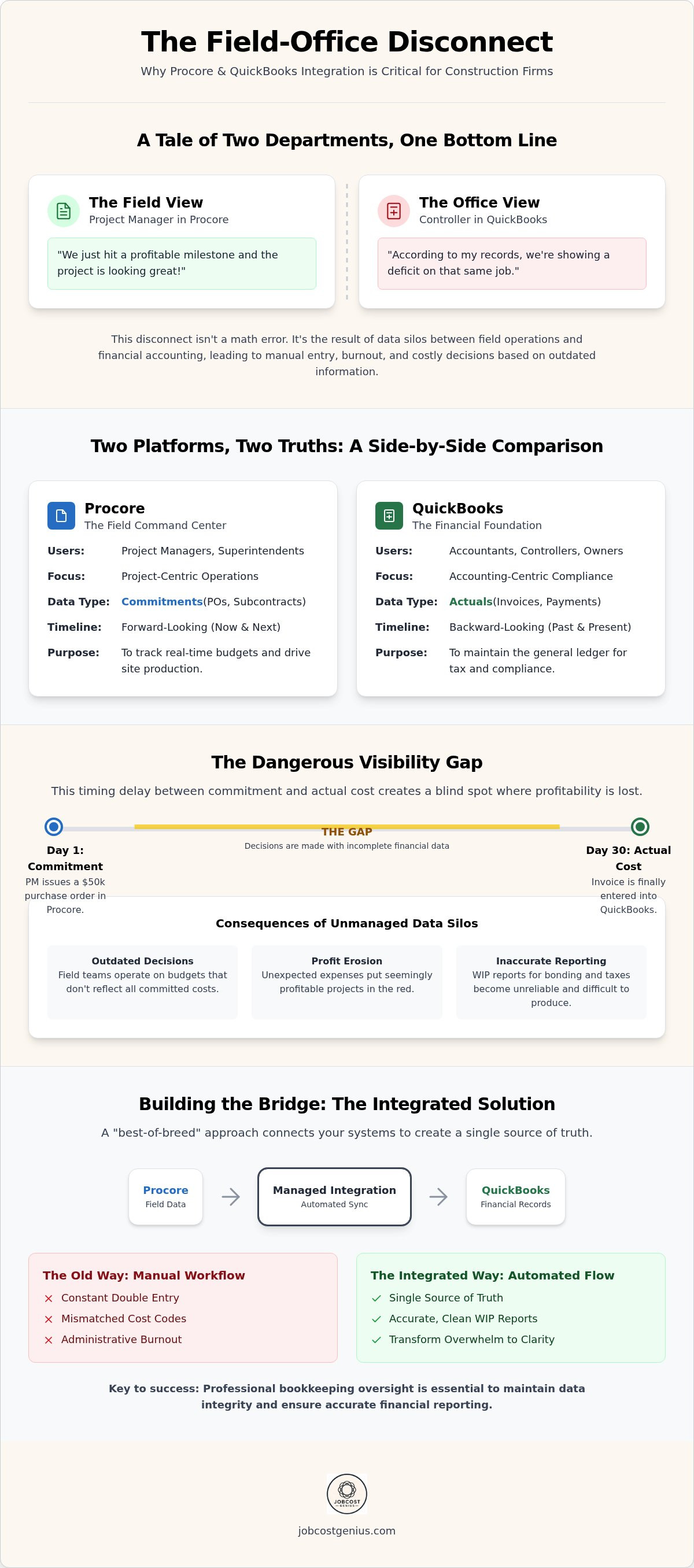
It is Friday afternoon and your project manager is celebrating a profitable milestone in Procore while your controller is staring at a QuickBooks deficit. This disconnect isn't a math error. It's a symptom of the data silos that plague growing firms. You already know that manual double entry for invoices and timecards is a recipe for burnout. It often feels like you're paying high-level staff to act as expensive data entry clerks just to keep your job costing somewhat accurate.
The reality is that software alone won't fix a broken workflow. You need a tech stack that actually communicates. We'll show you how to navigate the procore quickbooks integration challenges that arise as Intuit phases out QuickBooks Desktop and forces a shift to the cloud. You'll discover whether you need a project management powerhouse, a robust accounting engine, or a seamless integration of both to scale your construction firm effectively.
This article provides a clear roadmap for achieving automated data flow between the field and the office. We will explore the costs of third-party connectors, the requirements for QuickBooks Online Advanced, and how to produce clean WIP reports for bonding and taxes. By the end, you'll have the foundational strength needed to transform administrative overwhelm into financial clarity.
Key Takeaways
- Define the distinct roles of Procore for field operations and QuickBooks for general ledger compliance to eliminate operational friction.
- Identify the specific revenue thresholds and project complexities that signal when your firm must transition to an integrated tech stack.
- Navigate common procore quickbooks integration challenges by implementing a best-of-breed philosophy that connects project budgets with actual costs.
- Understand why professional bookkeeping oversight is essential to maintaining a single source of truth for your WIP reports and bonding requirements.
Procore vs. QuickBooks: Understanding the Field-Office Divide
Construction firms often find themselves caught between two essential but competing realities. On one side, your field team needs real-time data to drive production and manage site safety. On the other, your office staff requires precise historical records for compliance and tax readiness. This fundamental difference in objectives creates a gap that leads to many common procore quickbooks integration challenges. While Procore excels at managing the daily chaos of a job site, QuickBooks remains the industry standard for your firm's financial foundation. Understanding this divide is the first step toward building a tech stack that delivers financial clarity.
Procore: The Field Command Center
Procore is built for the people wearing hard hats. It serves as a project-centric platform where Project Managers and Site Superintendents track RFIs, submittals, and daily logs. The power of Procore Financials lies in its ability to track "commitments" before they ever hit your general ledger. When a PM signs a subcontract or issues a purchase order, that data exists in Procore long before an invoice arrives. This allows for real-time budget tracking. However, these commitments aren't yet "actuals" in your accounting system. It's a project-based source of truth focused on what's happening right now and what's expected to happen next.
QuickBooks: The Financial Foundation
QuickBooks serves as your accounting-centric general ledger. It's the tool of choice for bookkeepers, accountants, and owners who need to manage AP/AR, payroll processing, and tax compliance. Unlike the fluid nature of project management, QuickBooks is rigid by design. It tracks money that has already moved or is legally owed. This is your financial source of truth. Because QuickBooks is built for general business compliance rather than specialized construction job costing, it often lacks the granular detail field teams need to make production decisions. It's designed to keep your business's foundational numbers clean and audit-ready.
The friction between these two worlds arises when systems don't speak the same language. Field teams see a budget as a living document, while office staff see it as a fixed ledger entry. This leads to significant data integration challenges. While some argue for a single, massive ERP system to solve this, those platforms often come with high implementation failure rates and prohibitive costs. A "best-of-breed" approach using an integrated Procore and QuickBooks stack offers more flexibility, provided you have the professional oversight to ensure data flows accurately between the field and the office. Without this bridge, you're left with double entry and mismatched cost codes that make accurate WIP reporting impossible.
Comparing Core Functionality: Job Costing and Financial Reporting
Operational success in 2026 relies on your ability to predict the future, not just record the past. The 2026 Engineering and Construction Industry Outlook emphasizes that digital transformation is the primary differentiator for firms looking to maintain margins in a volatile market. While QuickBooks provides a reliable general ledger for tax compliance, it often fails to deliver the granular, real-time job costing required for complex projects. The disconnect between these two platforms is where most procore quickbooks integration challenges begin to erode your profitability.
Budget Tracking and Commitment Management
Procore is designed to manage the "living" budget of a project. Project managers use it to issue subcontracts and purchase orders directly from the field. These are known as commitments. They represent a legal obligation to pay, even before an invoice exists. QuickBooks, however, is a reactive system. It generally recognizes an expense only after an invoice is processed or a check is cut. This creates a dangerous visibility gap. Your field team might believe they have $50,000 remaining in a budget category, while your office staff is already processing invoices that put that same category in the red. Without a managed sync, this delay makes it impossible to see your true financial position in real time.
Construction-Specific Reporting Needs
Generalist reports in QuickBooks are built for standard businesses, not the unique requirements of the trades. They often lack the depth needed for accurate WIP reporting for construction companies. Procore solves this by tracking labor burden, productivity, and the "Estimated Cost at Completion" (ECC). This forecasting tool allows you to see where a project will end up based on current trends, giving you time to adjust before a project loses money. QuickBooks Online has significant limitations when it comes to complex, multi-tiered cost coding. It simply wasn't built to handle the hierarchical data structures that federal or large-scale commercial contracts demand.
Field-entered data is inherently more accurate because it happens at the point of origin. When a superintendent logs hours or material deliveries in Procore, that data is immediate. If you rely on office-entered data in QuickBooks, you're often working with information that is seven to ten days old. This lag is why software alone isn't a silver bullet. You need a structured workflow to ensure field data flows into your accounting engine without manual intervention. Implementing a Growth Plan can provide the professional oversight necessary to bridge this data gap, ensuring your reports reflect reality instead of history.
Navigating Procore QuickBooks Integration Challenges in 2026
Choosing between a single ERP and a best-of-breed stack is a defining decision for contractors in 2026. While some firms chase the "all-in-one" dream, most find that these massive systems are either too rigid for field use or too complex for office staff to manage. Instead, the combination of Procore for project management and QuickBooks for accounting has become the industry standard. This approach provides the most flexibility, but it isn't without hurdles. Success depends on how well you address specific procore quickbooks integration challenges, particularly as Intuit continues its aggressive phase-out of QuickBooks Desktop versions in favor of QuickBooks Online.
The Procore-QuickBooks Connector, typically supported by third-party tools like Smoothlink or hh2 for online versions, serves as the vital bridge between these two worlds. It allows you to sync field commitments directly to your office accounting engine. This automation eliminates the "integration fatigue" that sets in when staff must manually reconcile spreadsheets every Friday. By automating the data flow, you ensure that technology is changing construction from a game of administrative catch-up into a genuine strategic advantage.
Mapping Cost Codes and Data Integrity
The most critical technical hurdle is aligning your Procore cost codes with the QuickBooks Chart of Accounts. If these two structures don't match exactly, the sync will fail or, worse, create inaccurate reports. This is the classic "Garbage In, Garbage Out" scenario. Field teams often enter data under codes that make sense for production but don't align with accounting compliance. This is where Procore financials integration services become invaluable. Professional oversight ensures that every field entry is mapped correctly before it touches your general ledger, protecting your data integrity and preventing messy clean-up projects later.
The Timing Gap: Commitments vs. Actuals
A common point of friction occurs when a Project Manager sees a healthy budget in Procore while the bookkeeper is managing a cash crisis in QuickBooks. This happens because Procore tracks commitments, while QuickBooks tracks actuals. To solve this, you must sync job costs back from QuickBooks to Procore. This provides PMs a real-time view of what has actually been paid versus what was budgeted. Managing change orders across two platforms is equally dangerous. Without a managed integration, a change order approved in the field might never make it to the office. This leads to lost margins and inaccurate billing. A robust sync ensures that change orders are reflected in both systems immediately, maintaining your project’s financial health.
Choosing Your Path: Factors for Construction Firms in 2026
Deciding on your tech stack requires a cold-eyed look at your current project pipeline and internal capacity. Software is an investment in your firm's infrastructure, not just a line item expense. If you choose a system that is too complex for your current size, your team will likely ignore it. If it's too simple, your reporting will lag behind your growth. The primary drivers for this decision are your annual construction volume and the specific reporting requirements of your clients.
When QuickBooks Alone is Enough
For specialty contractors or small general contractors in the $1M to $5M revenue range, QuickBooks often provides sufficient utility. These firms should focus on the fundamentals outlined in our 2026 Construction Accounting Guide for Small Firms. At this scale, project volume rarely justifies Procore's Annual Construction Volume pricing model, which can range from $15,000 to $30,000 per year for smaller firms. You can successfully manage simple job costing and standard financial statements without the overhead of a project management powerhouse, provided your bookkeeping remains disciplined and accurate.
When to Add Procore to Your Stack
The shift usually occurs when you scale into larger commercial contracts or multi-state operations. Commercial owners and federal agencies often mandate advanced document control, submittals, and field collaboration tools that QuickBooks cannot provide. If your administrative staff is spending more than ten hours a week on manual data entry or double-entry of field notes, the cost of financial disorganization has already surpassed the cost of software implementation. Adding Procore allows your project managers to own their budgets, but it also introduces procore quickbooks integration challenges that require a structured approach to data management.
Your team's technical literacy is the final deciding factor. Field teams must be willing to adopt digital daily logs and mobile timecards for the integration to provide value. Without their buy-in, your office staff will still be chasing paper and manual spreadsheets. Transitioning to a high-level tech stack is a strategic move that positions you for professional growth and financial clarity. If you are ready to scale your operations without the overhead of a full-time internal controller, choosing a Growth Plan can ensure your systems remain synchronized and your financial reports stay clean for bonding and taxes.
Optimizing Your Tech Stack with JobCost Genius
Buying the most expensive ConTech tools won't fix a broken accounting process. Software is only as effective as the data entered into it. Many firms invest heavily in Procore only to find their office staff still struggling with manual reconciliations. This is where the human element becomes your most valuable asset. JobCost Genius acts as a Controller-as-a-Service, providing the professional oversight necessary to make your tech stack function as intended. We transform administrative overwhelm into financial clarity by managing the technical bridge between your field operations and your financial foundation.
The transition from messy, disconnected books to a streamlined field-to-office workflow requires a disciplined approach. It is not enough to simply install a connector and hope for the best. You must actively manage procore quickbooks integration challenges such as cost code mapping and timing differences between commitments and actuals. By positioning professional bookkeeping as your foundation, you create the stability needed to scale your business toward a Premium Plan, which offers the highest level of financial reporting and strategic support.
Expert Procore Financials Management
Our team ensures your field data and office books remain perfectly in sync. We provide the financial oversight needed to trust your Procore dashboards, allowing project managers to make decisions based on real-time numbers rather than guesswork. JobCost Genius bridges the Procore-QuickBooks data gap by providing expert human oversight to the automated sync, ensuring field commitments align perfectly with the general ledger. This meticulous management prevents the "Garbage In, Garbage Out" cycle that often leads to implementation failure.
Actionable Insights for Growth
Moving beyond basic bookkeeping allows you to focus on strategic financial reporting. Clean, integrated data is the prerequisite for accurate WIP reports, which are essential for maintaining your bonding capacity and staying tax-compliant. When your field team and office staff see the same numbers, you eliminate the friction that slows down project delivery. This level of organization prepares your firm for audits and ensures you are ready for the high-stakes requirements of larger commercial contracts. To ensure your systems are ready for the next level of growth, contact JobCost Genius to audit your current construction tech stack. We help you identify the specific bottlenecks in your data flow and provide a structured solution to resolve your procore quickbooks integration challenges for good.
Mastering Your Construction Tech Stack
Choosing between Procore and QuickBooks is not a matter of picking a winner; it's about building a bridge. Success in 2026 requires recognizing that project management and financial compliance are two sides of the same coin. You need the field-level detail of Procore to manage production and the foundational strength of QuickBooks to ensure tax and audit readiness. However, simply buying the licenses won't solve the core procore quickbooks integration challenges that arise from mismatched cost codes and data silos.
Professional oversight is the final piece of the puzzle. Without a disciplined expert to manage the data flow, your software becomes an expensive digital filing cabinet. JobCost Genius serves as a national construction bookkeeping authority, providing specialized Procore Financials integration and expert WIP reporting for contractors. We ensure that your field team and office staff finally see a single source of truth. Take the first step toward organized calm and financial clarity today. Get a Professional Tech Stack Audit from JobCost Genius and ensure your business is built on a foundation that's ready to scale.
Frequently Asked Questions
Does Procore replace QuickBooks for construction accounting?
Procore does not replace QuickBooks; instead, it complements your general ledger by focusing on project-specific financial management. While Procore handles commitments like subcontracts and purchase orders in the field, QuickBooks remains your foundation for bank reconciliations, payroll, and tax compliance. Using both systems ensures that project managers track real-time budgets while the office maintains a clean, audit-ready general ledger. This partnership is essential for firms scaling beyond basic residential projects.
How much does the Procore-QuickBooks integration cost in 2026?
In 2026, Procore pricing remains based on Annual Construction Volume (ACV). Small firms typically pay between $15,000 and $30,000 annually, while mid-sized firms can range from $30,000 to $80,000. Integrating with QuickBooks Online requires a third-party connector, which generally costs between $150 and $500 per month. Implementation fees can add another $50,000 to $150,000 in the first year, making professional oversight a critical investment to protect these significant software costs.
Can I sync QuickBooks Desktop with Procore, or do I need QuickBooks Online?
You can sync with both, but the landscape is shifting rapidly. Intuit ended support for QuickBooks Desktop 2023 in May 2026, and Desktop 2024 support ends in September 2027. Only QuickBooks Enterprise continues with full support. While Procore has a native integration for Desktop, most firms are migrating to QuickBooks Online Plus or Advanced. This transition often introduces new procore quickbooks integration challenges because QuickBooks Online requires a paid third-party connector to share data.
What are the main benefits of using Procore for project financials?
Procore Financials provides granular visibility into project health that standard accounting software lacks. It allows your field team to manage commitments, track labor burden, and forecast the Estimated Cost at Completion (ECC). By capturing data at the source, you eliminate the delay between field actions and office reporting. This real-time visibility helps project managers catch budget overruns early, ensuring that your firm remains profitable even as project complexity and volume increase.
How do I fix data sync errors between Procore and QuickBooks?
Fixing sync errors starts with auditing your cost code mapping. Most procore quickbooks integration challenges stem from misaligned data structures or incorrect QuickBooks Online versioning. Ensure you are using at least the Plus or Advanced version of QBO. You should also verify that your third-party connector permissions are active. Most importantly, professional oversight is required to manage the "Garbage In, Garbage Out" problem, ensuring that field-entered data is clean before it hits your books.
Is Procore too expensive for a small general contractor?
For a small general contractor, the decision depends on your annual volume and administrative burden. Firms with an ACV of $10M to $50M can expect to pay $15,000 to $30,000 per year for Procore. While this is a significant investment, the cost of financial disorganization and manual double entry often exceeds the software fees. If your team is struggling to produce accurate reports, the efficiency gains from a managed tech stack usually outweigh the licensing costs.
Do I need a specialized bookkeeper to manage a Procore integration?
Yes, having a specialized guide is often the difference between a failed implementation and a successful tech stack. Software alone does not fix broken bookkeeping processes. A specialized professional understands how to navigate data gaps between the field and the office. They ensure that your cost codes are mapped correctly and that your sync remains healthy. To explore how a strategic accounting firm can support your growth, read more. This oversight allows you to focus on construction while your financial infrastructure remains stable and compliant.
Without a sync, your WIP reports will likely be inaccurate and outdated. You will experience a timing gap where your field team sees a healthy budget while your office sees a cash shortage. This leads to significant overbillings or underbillings that aren't reflected in your financial statements until it is too late. Clean, integrated data is the only way to produce the reliable WIP reports needed for bonding and tax preparation, ensuring your firm's financial health.


