

A general bookkeeper is often the most expensive mistake a growing construction firm can make. You likely recognize the stress of looking at a bank balance that doesn't reflect your actual project reality. It's exhausting to wait for a billing cycle to close, only to discover a job's margin slipped away weeks ago. When you're investigating the bookkeeping services for construction companies cost, you're actually searching for a way to move from administrative overwhelm to organized calm.
We understand that uncertainty about project-level profitability and the fear of a looming union audit keep many contractors awake at night. This guide provides the 2026 pricing benchmarks you need to make an informed decision for your business. You'll learn how specialized WIP reporting and integrated financial systems protect your bottom line. We will preview how tiered service models, from foundational support to premium oversight, help you maintain clean, audit-ready financials without the overhead of a full-time in-house team.
Key Takeaways
- Recognize why generalist accounting services often lead to costly financial cleanup and how industry-specific expertise prevents margin erosion.
- Evaluate the primary factors, including project volume and labor compliance requirements, that drive the overall bookkeeping services for construction companies cost.
- Contrast the high overhead of full-time employees with a fractional model that provides expert-led oversight only when you need it.
- Identify contractual red flags and ensure your provider includes essential Work in Progress (WIP) reporting to maintain real-time profit visibility.
- Learn how to scale your financial infrastructure using tiered plans that grow alongside your project load and complexity.
The Construction Complexity Premium: Why Generalist Bookkeeping Often Fails
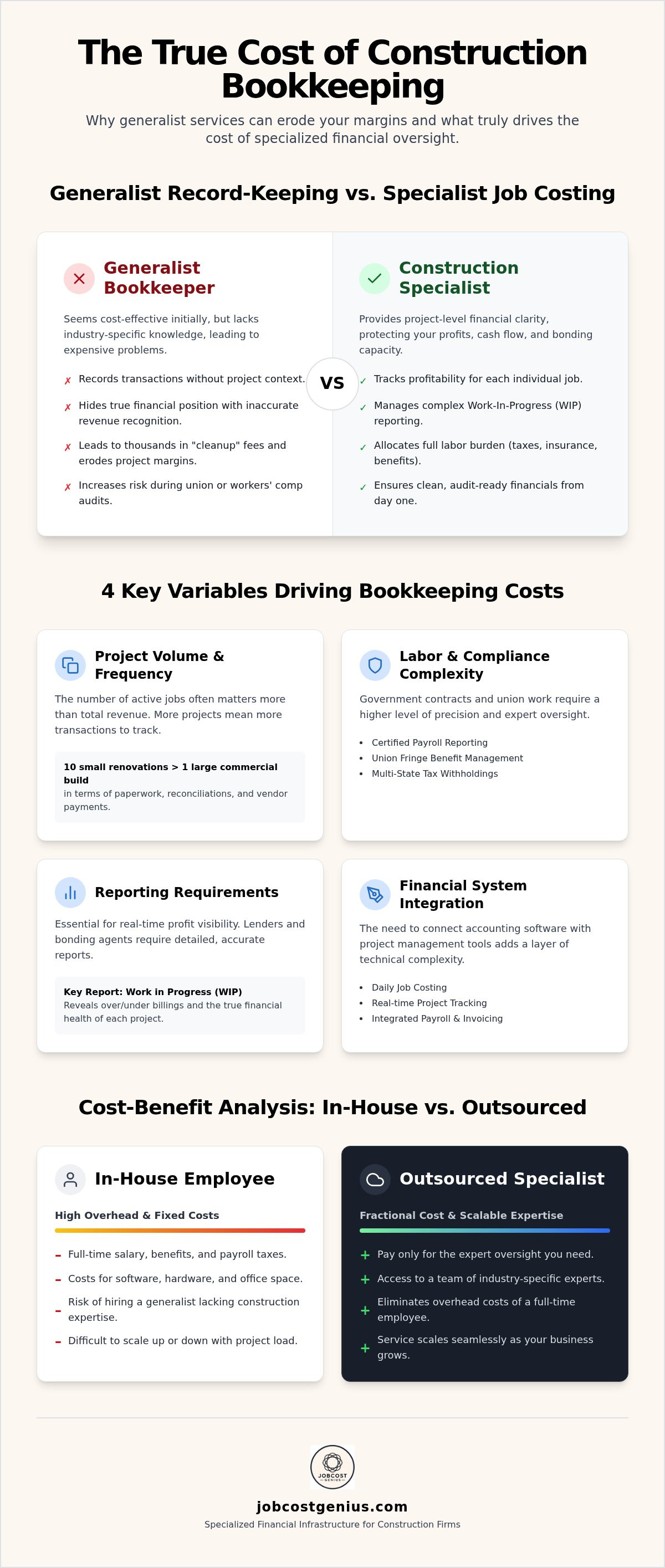
A generalist bookkeeper is often the most expensive shortcut a contractor can take. While a $150 per month service seems cost-effective, it frequently lacks the industry-specific knowledge required to handle complex project financials. When you investigate the bookkeeping services for construction companies cost, you're paying for a specialist who understands that construction isn't a transactional business. It's a project-based industry where missing a single retention line item can lead to thousands in "cleanup" fees later in the year. These hidden costs often outweigh the initial savings of a cheaper, non-specialized service.
Simple retail accounting doesn't translate to the job site. Contractors deal with long-term contracts, progress payments, and unique revenue recognition challenges. Without a deep understanding of Construction accounting principles, a generalist might miscalculate your overbillings and underbillings. This inaccuracy hides your true financial position, making it impossible to see if a specific project is actually generating a profit or slowly draining your cash reserves. Inaccurate revenue recognition doesn't just confuse your internal team; it can lead to serious trouble with lenders and bonding agents.
The Difference Between Record-Keeping and Job Costing
Generalists record transactions; specialists track project-level profitability. To maintain a healthy bottom line, you need specialized construction financial management that includes the full labor burden. This means every hour worked is accounted for alongside its associated taxes, benefits, and insurance costs. If these expenses aren't allocated to specific jobs, your financial reports are essentially guesses. This lack of precision doesn't just hurt your margins. It actively damages your bonding capacity, as sureties require detailed project data to assess your company's risk levels.
Audit Risks and Compliance Costs
Poor bookkeeping creates massive financial exposure during workers' comp or union audits. If your records don't clearly distinguish between different classes of labor, auditors will likely default to the highest possible premium rate. Failing to track 1099 compliance and subcontractor insurance certificates can also result in your firm paying premiums for people who aren't even on your payroll. Specialized bookkeeping reduces audit-related financial stress by ensuring every transaction is backed by the necessary compliance documentation from the start.
4 Key Variables That Determine Construction Bookkeeping Costs
Pricing for specialized financial oversight isn't a one-size-fits-all calculation. While generalist firms often base their fees solely on monthly revenue, construction-specific firms look at the underlying complexity of your operations. The bookkeeping services for construction companies cost is primarily driven by how much data must be tracked, verified, and reported to keep your jobs profitable. High-growth contractors often find that as their project lists expand, the administrative burden grows exponentially rather than linearly.
Compliance requirements represent another significant cost variable. If your firm handles government contracts or public works, you must adhere to strict federal contract cost principles to ensure expenses are allowable and properly allocated. Managing certified payroll, union fringe benefits, and multi-state tax withholdings requires a level of precision that standard bookkeeping doesn't cover. These layers of labor compliance require additional hours of expert oversight, which naturally influences the service fee. Choosing a specialized bookkeeping plan ensures these technical requirements are met without risking your project margins.
Project Volume and Transaction Frequency
The number of active jobs you manage is often more important than your total revenue. Ten small residential renovations generate significantly more paperwork and transaction entries than one large commercial build. Each project requires its own set of reconciliations, vendor payments, and lien waiver tracking. As you scale from residential work to commercial contracts, the demand for daily job costing increases. Moving from simple monthly reconciliations to real-time project tracking is a major step that impacts your monthly investment but provides the clarity needed to protect your cash flow.
Technology Stack and Software Integrations
Modern construction firms rely on specialized software to bridge the gap between the field and the office. Implementing Procore financials integration services typically commands a higher fee due to the technical expertise required to maintain data integrity. However, this investment pays for itself by reducing manual data entry and preventing costly communication errors. When your project management tools sync seamlessly with your accounting software, you gain a real-time view of your financial position. Maintaining this "Field-to-Office" sync ensures that your WIP reports are always accurate and ready for bonding or bank reviews.
In-House vs. Outsourced Bookkeeping: A Cost-Benefit Analysis
Deciding between a dedicated employee and a professional firm is a foundational decision for your infrastructure. Many contractors assume an in-house hire provides better control, yet they often overlook the massive financial burden that comes with a full-time staff member. When you evaluate the bookkeeping services for construction companies cost, you must compare the price of a subscription against the fully burdened cost of employment. Moving to an outsourced model transforms a high fixed expense into a scalable, results-driven investment.
Relying on a single person also creates a significant point of failure. If your bookkeeper leaves, your financial operations stall, often at the most critical point of a project. Turnover costs for a skilled financial professional include recruitment fees, training time, and the potential for errors during the transition. A specialized firm provides continuity. You gain access to a team of experts who ensure your books remain audit-ready and your billing cycles stay consistent, regardless of individual staff changes. To see how a chartered firm manages these complexities, you can visit Fair View Accounting Services for more information on professional financial support.
A base salary is only the starting point. In 2026, a competent construction bookkeeper expects a competitive wage, but the "invisible" costs add another 30% to 40% to that figure. You're responsible for employer-side payroll taxes, health insurance premiums, 401k matching, and workers' compensation coverage. Additionally, you must provide office space, a high-end workstation, and dedicated software licenses. While a $60,000 annual salary sounds straightforward, the total employer burden often exceeds $85,000, which is significantly higher than a premium monthly bookkeeping subscription.
The ROI of Specialized Outsourcing
Choosing outsourced bookkeeping for construction firms pays for itself by preventing profit fade. Generalist employees often lack the time or expertise to maintain rigorous Work in Progress (WIP) reports. Without these, you can't see the true profit on a job until it's finished and potentially too late to fix. A specialized partner identifies margin erosion in real time, allowing you to adjust field operations before the project ends. This proactive oversight protects your project margins and ensures you have the financial clarity needed to secure larger bonds and more complex contracts.
How to Evaluate a Bookkeeping Quote: Red Flags and Must-Haves
Comparing the bookkeeping services for construction companies cost across different providers requires a sharp eye for detail. A low monthly fee often masks "scope creep," where essential tasks like lien waiver tracking or certified payroll become expensive add-ons. You should insist on WIP reporting for construction companies as a standard inclusion in any professional contract. This report provides the real-time visibility you need to protect your project margins. Without it, your financial statements only show where your money went, rather than where your profit is currently sitting.
Commercial contractors must also verify that a provider has experience with AIA G702 and G703 billing formats. These progress payment applications are the lifeblood of commercial cash flow; errors here lead to rejected draws and delayed payments. Additionally, ensure the quote reflects accrual-basis accounting. While cash-basis pricing is often lower because it requires less technical effort, it fails to provide the accuracy required for bonding or complex project management. For a reliable financial foundation, review our transparent service plans to see what a professional construction partnership includes.
The Essential Construction Reporting Checklist
A comprehensive quote must provide more than just a balanced checkbook. Your financial partner should act as a strategic guide, not just a data entry clerk. Verify that your service agreement includes the following essentials:
- Job cost reports broken down by specific cost codes or categories.
- Provisions for managing retention and tracking subcontractor payment applications.
- Scheduled monthly financial reviews to discuss project-level profitability with the business owner.
- Clear protocols for handling insurance certificates and 1099 compliance.
Red Flags in Low-Cost Quotes
Be cautious of "flat-rate" offers that seem significantly lower than the industry average. These often exclude payroll management or year-end 1099 filing, leading to unexpected "catch-up" fees later. A major red flag is a lack of familiarity with your specific technology stack. If a firm doesn't understand tools like Procore, Sage, or Buildertrend, they won't be able to maintain data integrity between the field and the office. Vague communication schedules are another warning sign. You need a partner who provides consistent, proactive updates rather than one who only responds when you find a problem in the books.
Scaling Your Infrastructure with JobCost Genius Tiered Plans
Growth in the building industry requires more than just a larger crew; it demands a financial infrastructure that expands alongside your project load. Many firms struggle because they attempt to use the same basic processes for a $5M annual revenue that they used at $500k. This mismatch leads to the administrative overwhelm that erodes profit margins. Our tiered subscription models ensure the bookkeeping services for construction companies cost remains proportionate to your firm's complexity. We provide a structured roadmap that transitions your business from basic record-keeping to enterprise-level financial oversight.
We offer three distinct paths to financial clarity. The Starter Plan provides a disciplined foundation for contractors who need to move away from disorganized spreadsheets and establish a professional chart of accounts. As your team expands, the Growth Plan introduces enhanced reporting and more complex payroll management to handle larger crews. For high-volume firms, the Premium Plan delivers full-scale financial oversight. This includes advanced technology support and the technical expertise required to maintain data integrity across complex project portfolios.
Tailored Support for Every Stage of Construction
Scaling doesn't happen by accident. It requires a methodical transition where construction accounting for small firms evolves into sophisticated financial management. A key part of this evolution is moving from simple expense categorization to advanced WIP management. WIP reporting isn't just an administrative requirement for your bonding agent; it's a diagnostic tool that reveals the true health of your projects. By identifying overbillings and underbillings early, we help you stop profit fade before it impacts your cash flow. JobCost Genius acts as a strategic partner, ensuring your financial data informs your operational decisions.
Getting Started: The Path to Financial Clarity
The journey toward organized calm begins with a rigorous onboarding process. We don't just pick up where your last bookkeeper left off. We perform a deep dive into your existing records to clean up historical errors and secure your financial future. This involves setting up a custom construction chart of accounts tailored to your specific trade. This foundational step ensures that every dollar spent in the field is accurately tracked against your budget. When your books are clean and your processes are structured, you gain the professional confidence to bid on larger, more profitable contracts. Ready to stabilize your cash flow? View our tiered plans and find your fit.
Securing Your Financial Foundation for Future Growth
Choosing the right financial partner is a strategic decision that directly impacts your project margins. The bookkeeping services for construction companies cost is justified by the protection it offers against profit fade and audit risks. By moving away from generalist record-keeping, you ensure that every job is tracked with the precision required for bonding and long-term stability. A structured approach to your books transforms administrative overwhelm into a state of organized calm.
Whether you need foundational support or enterprise-level oversight, specialized expertise ensures your financial data is always audit-ready. You don't have to manage these complexities alone. Scale your construction business with expert financial oversight from JobCost Genius. Our team provides specialized WIP reporting for every project, expert Procore and tech stack integration, and tiered plans designed to grow with your firm. Take the first step toward financial clarity and start building with confidence today.
Frequently Asked Questions
Why is construction bookkeeping more expensive than general bookkeeping?
Construction accounting requires specialized knowledge of job costing, labor burden, and revenue recognition methods like percentage of completion. Unlike retail, you're tracking retention, progress billings, and lien waivers for every project. This technical complexity demands more hours from a specialist who understands how these variables impact project margins. The bookkeeping services for construction companies cost reflects this need for industry-specific expertise that generalists simply don't provide.
What is the average monthly cost for construction bookkeeping in 2026?
Industry data for 2026 suggests that monthly bookkeeping for small contractors with five or fewer employees typically ranges from $350 to $450. Medium-sized firms with up to twenty employees often pay between $450 and $1,000 per month. Large contracting businesses with over twenty-one employees can expect costs ranging from $1,000 to over $3,000. These rates vary based on transaction volume, project complexity, and the depth of reporting required to maintain financial clarity.
Does the cost of bookkeeping include software licenses like QuickBooks or Procore?
Bookkeeping service fees typically cover professional oversight and data management rather than the software subscriptions themselves. You're usually responsible for the monthly costs of QuickBooks, Procore, or Buildertrend. However, a specialized firm ensures these tools are integrated correctly to prevent data silos. Investing in a bookkeeping services for construction companies cost model that includes Procore Financials integration can save you thousands by automating data sync and reducing manual entry errors.
Can a generalist bookkeeper handle WIP reporting and AIA billing?
Generalist bookkeepers usually lack the technical training to manage Work in Progress (WIP) reports or AIA G702 and G703 billing formats. These tasks require an understanding of overbillings, underbillings, and percentage of completion accounting. If these are handled incorrectly, your profit and loss statements will be inaccurate, potentially hiding a cash flow crisis. Specialized firms include these reports as a standard part of their tiered plans to ensure you have a true view of profitability.
How much does it cost to clean up messy construction books?
Cleanup fees vary significantly based on the volume of transactions and the length of time since the books were last reconciled. Industry research indicates that one-time setup and cleanup fees for construction firms can start around $1,800. This process involves correcting misallocated costs, reconciling old bank statements, and establishing a proper chart of accounts. While it's an upfront investment, starting with clean, audit-ready financials is essential for securing bonding and protecting your future margins.
Is payroll processing usually included in the monthly bookkeeping fee?
Payroll processing is often treated as a separate service or an add-on to the base bookkeeping subscription. In construction, payroll is complex due to union dues, certified payroll reports, and multi-state requirements. Some firms offer bundled packages that include payroll management to ensure labor compliance and accurate job costing. You should check your service agreement to see if these fees are integrated or if they will be billed as a separate monthly line item.
What happens if my project volume increases mid-year?
Most specialized firms utilize tiered subscription models that allow your service level to scale alongside your business. If your project volume or transaction frequency increases significantly mid-year, you may transition from a Starter Plan to a Growth or Premium Plan. This ensures you continue to receive the necessary depth of reporting and oversight without overwhelming your administrative infrastructure. This flexibility allows you to bid on larger contracts with the confidence that your financial backend can support the growth.
How do specialized services help reduce my tax liability?
Specialized bookkeepers focus on accurate job costing and labor burden allocation, which ensures you aren't over-reporting taxable income. By maintaining clean, audit-ready financials and accurate WIP reports, you provide your tax professional with the data needed for proactive tax planning. For startups and SMEs needing a more comprehensive approach, Proledger offers accounting and tax compliance services that establish the foundational strength required to identify deductible project expenses and ensure you stay compliant with all regulations.


