

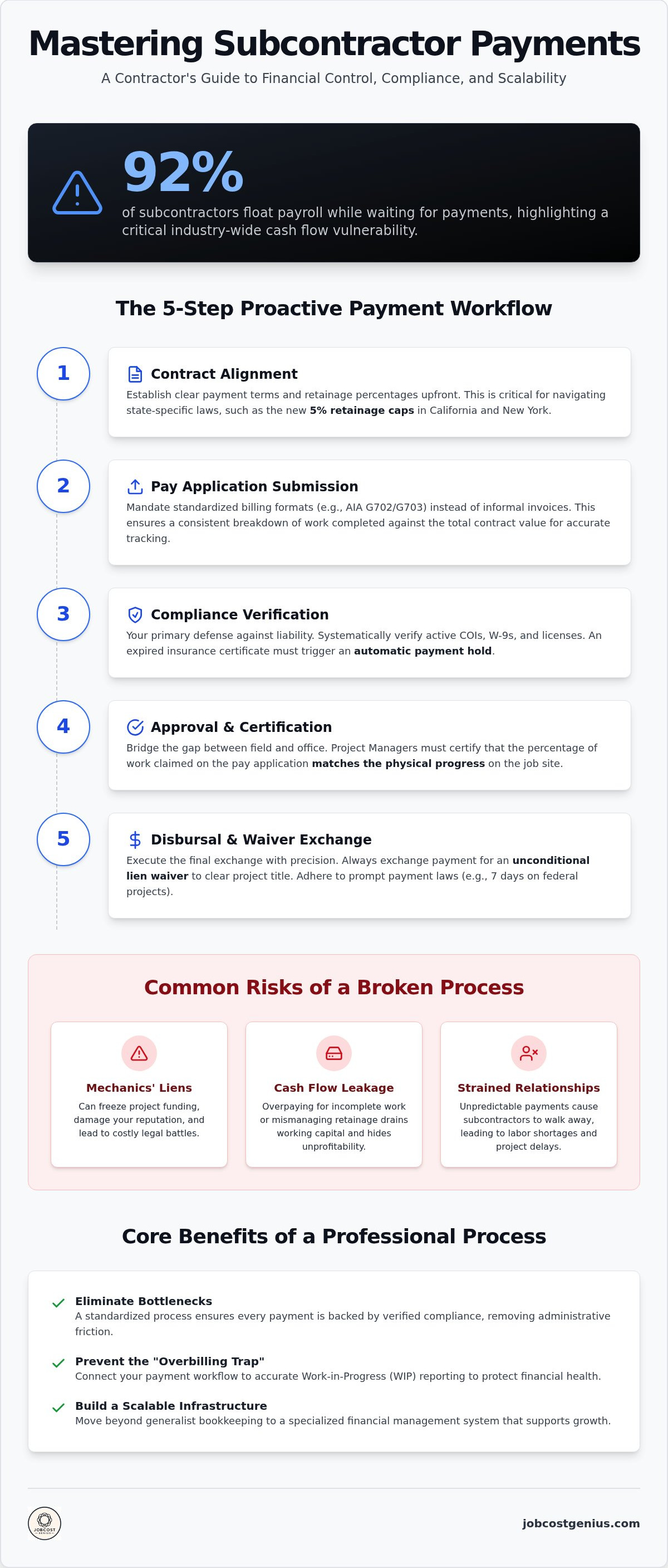
92% of subcontractors reported floating payroll while waiting for customer payments in 2026. This statistic highlights a critical vulnerability in the construction industry: a fragmented subcontractor payment management process that often leaks cash and increases legal risk. You likely understand the frustration of tracking down missing insurance certificates or managing the administrative weight of lien waivers while your own cash flow sits in limbo. It's a high-stakes balancing act where a single oversight can lead to a mechanic's lien or a stalled project.
We've designed this guide to help you transition from administrative overwhelm to a state of organized financial clarity. You'll learn how to master the complexities of subcontractor payments to protect your cash flow, ensure compliance with new 5% retainage caps in states like New York and California, and maintain project profitability. We'll walk through building a repeatable workflow that generates accurate WIP reports and provides the foundational strength your firm needs to scale with confidence. By the end of this guide, you'll have a roadmap for professionalizing your financial operations and maintaining better control over your project margins.
Key Takeaways
- Establish a standardized subcontractor payment management process to eliminate administrative bottlenecks and ensure every payment is backed by verified compliance.
- Navigate 2026 regulatory changes with confidence, including the new 5% retainage caps in California and New York that directly impact project cash flow.
- Protect your firm from legal risk by implementing a rigorous system for tracking insurance certificates and managing both conditional and unconditional lien waivers.
- Connect your payment workflow to accurate WIP reporting to prevent the "overbilling trap" from hiding project losses or distorting your financial health.
- Build a scalable back-office infrastructure by moving beyond generalist bookkeeping toward specialized construction financial management.
What is the Subcontractor Payment Management Process?
The subcontractor payment management process is the financial heartbeat of a construction project, serving as the end-to-end workflow for validating, approving, and disbursing funds to specialized vendors. While a generalist bookkeeper might view this as simple accounts payable, construction professionals know it's a high-stakes cycle that integrates compliance, lien rights, and project milestones. It is the primary mechanism that ensures work performed on-site translates into accurate financial data in the back office.
To understand the complexity, one must first define the role of the participants. Understanding What is a Subcontractor reveals that these entities operate under specific contractual obligations that differ from standard suppliers. Because their work is often performed over many months, payments are tied to percentage-of-completion milestones. This requires a level of verification and technical oversight that standard AP processes simply aren't built to handle.
The foundational health of your firm depends on this process. Accurate subcontractor tracking is the only way to maintain reliable WIP reporting and protect your bonding capacity. If your payment cycle is messy, your job costing is likely inaccurate. This lack of clarity can lead to "overbilling" scenarios where you've paid out more than the project has earned in revenue, effectively draining your working capital.
The Stakeholders in the Payment Chain
Every payment involves a chain of accountability. The project owner provides the primary funding and approves draw requests based on verified progress. The general contractor acts as the central hub, managing the approval workflow and collecting the mountain of compliance documentation required for each draw. Subcontractors are responsible for submitting standardized pay applications and providing lien waivers in exchange for payment. When any stakeholder fails to meet their requirements, the entire project's financial stability is at risk.
Common Risks of a Broken Process
A failed workflow creates immediate liabilities. Mechanics' liens are the most visible risk; they can freeze project funding and destroy your reputation with owners. Beyond legal threats, a broken process leads to cash flow leakage. You might overpay for work not yet completed or fail to track retainage correctly, leaving you with a financial gap at the end of the job. Strained vendor relationships are another byproduct. In a tight labor market, subcontractors will walk away from contractors who can't manage a predictable payment cycle, leading to costly delays and labor shortages on-site.
The 5-Step Construction Payment Workflow
A disciplined subcontractor payment management process is the only way to scale your operations without losing control of your project margins. This workflow moves your back office from a reactive state to a proactive financial strategy. By following a structured sequence, you ensure that every dollar disbursed is earned and every legal risk is mitigated before the check is cut.
- Step 1: Contract Alignment. Financial control begins during the pre-construction phase. You must establish clear payment terms and define retainage percentages. In 2026, navigating state-specific laws is critical; for instance, California and New York now cap retainage at 5% for most private contracts.
- Step 2: Pay Application Submission. Move away from informal email invoices. Transitioning to standardized billing ensures that subcontractors provide a consistent breakdown of work completed against the total contract value.
- Step 3: Compliance Verification. This is your primary defense against liability. Verify that COIs are active, W-9s are on file, and professional licenses are current. An expired insurance certificate should trigger an automatic payment hold in your system.
- Step 4: Approval and Certification. Field progress must align with office records. Project managers certify that the percentage of work claimed on the pay app matches the physical reality on the job site.
- Step 5: Disbursal and Waiver Exchange. The final hand-off requires strict timing. Under the Federal Prompt Payment Act, prime contractors on federal projects must pay subcontractors within seven days of receiving payment from the government. Always exchange payment for an unconditional lien waiver to clear your project title.
Standardizing Pay Applications (AIA Billing)
Using G702 and G703 forms provides a level of transparency that standard invoices cannot match. These documents require a detailed Schedule of Values, which prevents subcontractors from "front-loading" their billing. By breaking the contract into specific line items, you can track progress with surgical precision. If you're looking to professionalize your billing cycle, implementing AIA billing services for contractors is a foundational step toward financial stability.
The Approval Chain: Field to Office Sync
Modern firms use tools like Procore Financials to bridge the gap between the job site and the accounting department. When a project manager approves a progress milestone in the field, that data should flow directly into your bookkeeping system. This reconciliation prevents the back office from paying for work that hasn't been completed or inspected. Maintaining this sync is how you build a scalable financial infrastructure that supports long-term growth.
Compliance Management: Protecting Your Firm from Risk
Insurance tracking is your first line of defense. An expired Certificate of Insurance (COI) creates a massive liability gap. If a subcontractor's worker is injured on-site and their policy has lapsed, the financial burden often rolls up to the general contractor. Your bookkeeping system must trigger an immediate payment hold the moment a policy expires. To ensure your own business coverage is as robust as your compliance checks, you can discover Paterson Insurance Brokers for tailored risk management solutions. Similarly, maintaining updated W-9s and ensuring labor compliance, such as prevailing wage documentation on public works, is non-negotiable for avoiding federal penalties. A disciplined subcontractor payment management process ensures that every lien waiver is reconciled against a specific payout.
The timing of waiver collection is as important as the document itself. Use Conditional Progress waivers for ongoing work; these only become valid once the subcontractor actually receives the funds. Once the project reaches its conclusion, switch to Unconditional Final waivers to clear the title completely. Collecting these electronically through specialized portals reduces the administrative friction that often causes project delays.
You must also understand your contractual leverage. "Pay-when-paid" clauses generally establish a timing mechanism for payment, while "pay-if-paid" clauses attempt to shift the entire risk of owner non-payment to the sub. Many states are increasingly scrutinizing these clauses. Clear communication during the waiver exchange helps maintain trust even when these complex legal triggers are present. For business owners seeking comprehensive protection beyond contract management, such as estate planning and business law, you can learn more about Massingill Attorneys & Counselors at Law.
Retainage serves as your financial guarantee that the subcontractor will return to finish punch-list items. While 10% was once the industry standard, 2026 regulations in states like New York and California have capped retention at 5% for many private contracts. This change requires tighter project management, as you have less leverage held back at the end of the job.
From an accounting perspective, retainage must be tracked as a liability on your balance sheet. It is not your money; it is funds earned by the subcontractor but withheld for performance security. Treating it as profit prematurely can lead to disastrous cash flow gaps during project closeout. A disciplined closeout process ensures that retention is released only after final inspections are passed and all unconditional waivers are secured. Reconciling these holdbacks correctly is essential for maintaining a clean set of books and accurate job costing.
Optimizing the Cycle for Cash Flow and WIP Accuracy
A streamlined subcontractor payment management process serves as the foundation for real-time financial visibility. When sub-invoices are delayed or missing, your project's financial status becomes a guess rather than a calculation. This lag creates a dangerous distortion in your WIP reporting for construction companies, making projects appear more profitable than they actually are. By the time the bill arrives, you might discover that your expected margin has already faded.
The "overbilling trap" is equally hazardous. This occurs when you pay subcontractors faster than their actual field progress or before you've received funding from the project owner. While it keeps the job moving, it effectively masks project losses and drains your working capital. Aligning your subcontractor draws with owner funding cycles is a strategic move to protect your cash reserves and ensure you aren't financing the project out of your own pocket.
Connecting AP to WIP Reporting
Construction firms must utilize accrual-based accounting to capture the true cost of a project. Unlike cash-based systems, accrual accounting records subcontractor liabilities when the work is performed, not just when the check is cut. Your "Estimated Cost to Complete" must account for unbilled work to provide a clear picture of project health. If you fail to accrue these costs, your job costing data will remain perpetually behind the reality of the field. For those just starting to professionalize their books, understanding Construction accounting for small firms is the first step toward this level of precision.
Strategies for Cash Flow Stability
Maintaining stability requires proactive risk mitigation. Joint checks are an effective tool for ensuring that sub-tier suppliers are paid, which prevents lien claims from reaching your level. Additionally, you should build a cash buffer to take advantage of prompt-pay discounts from vendors, turning your accounts payable department into a profit center. Don't forget to track your retention receivables diligently. Leaving these funds uncollected at the end of a project is a common way for firms to leak profit. Reconciling these amounts monthly ensures that your balance sheet reflects the true value of your completed work.
To ensure your back office is built for this level of accuracy, consider how JobCost Genius can help you integrate Procore Financials into your daily workflow.
Scaling Your Back Office: Professional Subcontractor Management
Generalist bookkeepers often find themselves underwater when faced with the unique demands of a growing construction firm. While they may excel at standard accounts payable, they frequently lack the industry-specific knowledge required to manage complex pay applications or reconcile multi-tiered lien waivers. As your project volume increases, these administrative gaps can lead to significant financial exposure. A professional subcontractor payment management process is the backbone of this transformation, moving your firm from a state of constant administrative catch-up to one of organized calm.
Scaling your infrastructure requires a shift toward specialized expertise. Utilizing outsourced bookkeeping for construction firms allows you to implement a repeatable framework that generalists simply cannot provide. This approach ensures that your financial data is not just recorded, but strategically managed to support long-term growth. By professionalizing your back office, you create a scalable foundation where compliance and cash flow are handled with the meticulousness that high-stakes construction projects demand.
The integration of field technology with office financials is a critical component of this evolution. When you connect Procore Financials with your accounting system, you establish a single source of truth for every project. This sync prevents the common disconnect where project managers approve work in the field that the accounting department hasn't yet accounted for in the budget. Maintaining this data integrity is essential for producing the accurate WIP reports that banks and bonding agents require for your firm to secure larger contracts.
Why Specialized Oversight Beats Software Alone
Software is a powerful tool, but it is not a replacement for financial strategy. Even the most advanced platform requires human verification to ensure that compliance documents are valid and that waiver exchanges are executed correctly. A disciplined subcontractor payment management process involves a seasoned expert who understands how to navigate the AP/AR cycle. At JobCost Genius, we manage this cycle to fast-track your payment applications, ensuring that data flows seamlessly from the site to your financial statements without the risk of manual error.
Choosing the Right Support for Your Scale
Your financial oversight should match your current revenue and future goals. Whether you are utilizing a Starter Plan for foundational support, a Growth Plan to manage increasing complexity, or a Premium Plan for comprehensive financial management, the goal remains the same: accurate job costing and reduced risk. Investing in specialized construction bookkeeping provides a clear ROI by eliminating late-payment penalties and protecting your firm from the devastating impact of mechanics' liens. If you are ready to move past the limitations of generalist accounting, you should schedule a strategy session to professionalize your subcontractor payments and build a more resilient business infrastructure.
Mastering Your Financial Infrastructure
Professionalizing your subcontractor payment management process is the definitive step toward long-term operational stability. By implementing a standardized five-step workflow and enforcing rigorous compliance checks, you protect your firm from the legal risks of mechanics' liens and the financial drain of unverified overpayments. This level of meticulousness ensures that your WIP reporting reflects the true health of your projects, providing the clarity needed to secure higher bonding limits and larger contracts.
You don't have to manage this complexity alone. As national construction bookkeeping authorities and specialized Procore Financials integration experts, we help you build a scalable back office that supports your growth. Our Growth Plan and Premium Plan include comprehensive WIP reporting to keep your margins protected and your data accurate. Ready to professionalize your back office? Explore JobCost Genius Bookkeeping Plans today. It's time to trade administrative overwhelm for the organized calm and foundational strength your business deserves.
Frequently Asked Questions
What is the difference between a conditional and unconditional lien waiver?
A conditional lien waiver is only effective once the payment has cleared the bank, providing protection for the subcontractor. An unconditional lien waiver is effective immediately upon signing, regardless of whether the funds have actually been received. For a secure subcontractor payment management process, you should collect conditional waivers for progress payments. Only exchange unconditional final waivers once the project is complete and the final payment is verified in your account.
How much retainage is standard in construction subcontracts?
While 10% was the historical industry standard, 2026 regulations in states like New York and California have capped retainage at 5% for most private construction contracts. This shift toward lower retention caps requires general contractors to maintain tighter project controls. You must track these holdbacks as liabilities on your balance sheet. Proper management ensures you have sufficient security for project closeout without violating new state-level prompt pay laws.
Can I pay subcontractors before I get paid by the owner?
You can choose to pay subcontractors early, but doing so creates a cash flow gap that your firm must finance. Most general contractors use "pay-when-paid" clauses to align their accounts payable with the owner's funding cycle. Paying before the owner draw effectively means you are using your own working capital to float the project. This practice increases your financial risk if the project owner experiences payment delays or insolvency.
What documents are required before paying a subcontractor?
A compliant payment application requires several key documents to mitigate risk. You should collect a signed time or material log, a lien waiver for the previous payment cycle, and a current W-9. Most importantly, you must verify that the subcontractor’s insurance certificate (COI) is active and meets your contract requirements. Failure to collect these documents before disbursing funds leaves your firm vulnerable to mechanics' liens and unverified liability claims.
How do late subcontractor invoices affect my WIP report?
Late invoices create "underbilling" distortions that hide the true cost of your project. When sub-costs aren't recorded in the period the work was performed, your Work in Progress (WIP) report will show artificially high profitability. This lack of data integrity makes it impossible to calculate an accurate "Estimated Cost to Complete." Consistent delays in your subcontractor payment management process eventually lead to margin fade that you won't discover until the project ends.
What is a 'pay-when-paid' clause and is it legal?
A "pay-when-paid" clause is a timing mechanism that states the general contractor will pay the subcontractor after receiving payment from the project owner. These clauses are legal in most states, though they don't eliminate the GC’s ultimate obligation to pay for work performed. They differ from "pay-if-paid" clauses, which attempt to shift the entire risk of owner non-payment to the subcontractor. Always check local statutes as state-level regulations are increasingly restrictive.
How does Procore Financials help with subcontractor payment management?
Procore Financials bridges the gap between field progress and back-office accounting. It allows project managers to certify percentage-complete milestones on-site, which then flows directly into your subcontractor payment management process for reconciliation. This integration automates compliance tracking and ensures that you only pay for verified work. By creating a single source of truth, you eliminate the data silos that typically cause billing errors and payment delays.
Why is a generalist bookkeeper often insufficient for construction firms?
Generalists often lack the specialized knowledge required for AIA billing, retainage tracking, and percentage-of-completion accounting. They may not understand how to produce the WIP reporting necessary for securing bonding and bank lines. Specialized construction bookkeeping ensures that every transaction is tied to a specific job and compliance requirement. Our Starter Plan, Growth Plan, and Premium Plan provide the industry-specific oversight that generalists cannot offer, ensuring your firm maintains foundational financial strength.


