

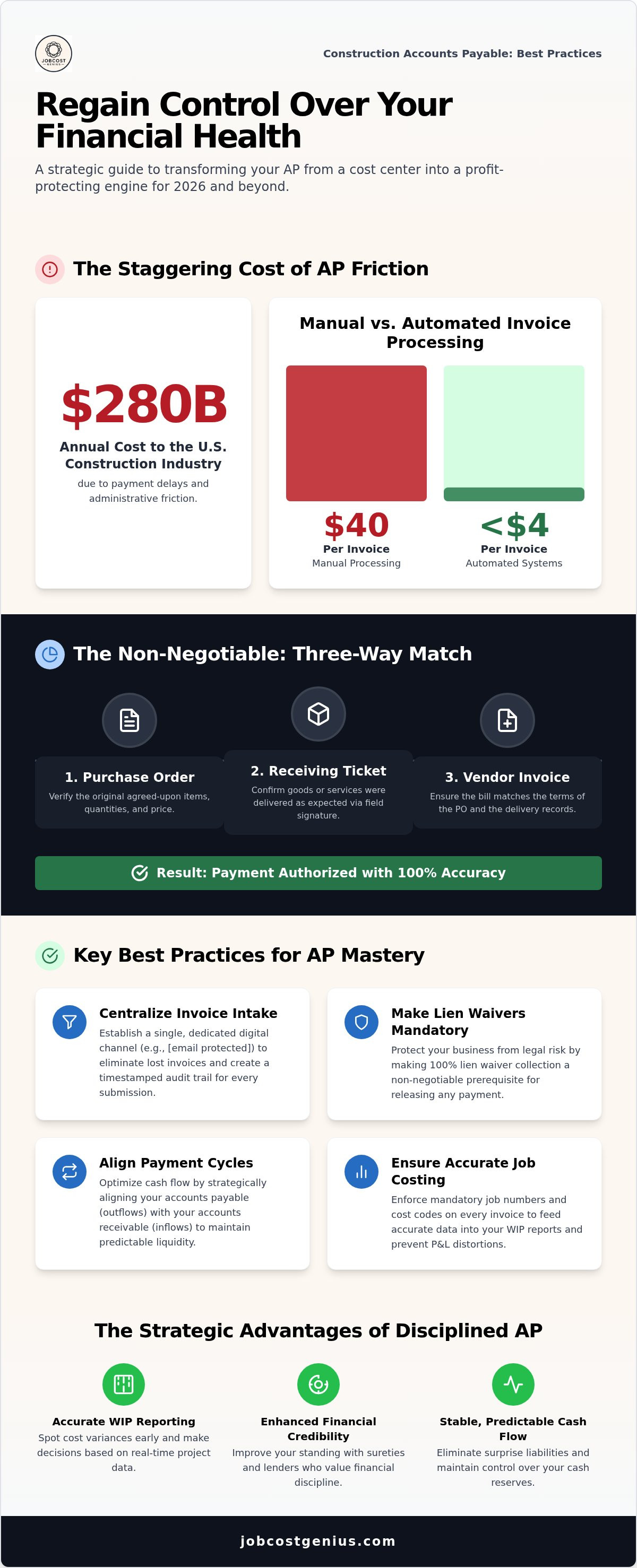
The U.S. construction industry is absorbing an estimated $280 billion in annual costs this year due to payment delays and administrative friction. It's a staggering drain on capital that often stems from a back office struggling to keep pace with the field. You likely know the frustration of chasing down a missing lien waiver minutes before a draw or discovering a duplicate payment after a project has closed. These aren't just administrative headaches. They're direct threats to your company's solvency and professional reputation.
Mastering construction accounts payable best practices is the most effective way to regain control over your financial health. In 2026, manual invoice processing costs some firms up to $40 per document, while automated systems can slash that to under $4. This guide provides a clear roadmap to transition your AP from a clerical task into a profit-protecting engine. We'll explore the specialized workflows and strategic controls you need to ensure 100% lien waiver compliance, maintain accurate job costing data, and stabilize your cash outflows through disciplined, industry-specific management.
Key Takeaways
- Establish a specialized strategy that accounts for the unique timing of job costs and retention rather than relying on generalist bookkeeping.
- Implement construction accounts payable best practices by centralizing invoice routing and enforcing a mandatory three-way match for every transaction.
- Protect your business from legal risk by making lien waiver collection a non-negotiable prerequisite for every payment release.
- Optimize cash flow by aligning your accounts payable cycles with accounts receivable collections to maintain predictable liquidity.
- Scale your financial infrastructure by identifying when to move from manual clerical tasks to specialized managed services and automated reporting.
Why Construction Accounts Payable Requires a Specialized Strategy
Construction AP is a specialized discipline. It involves far more than just processing checks; it requires deep integration with job costing, retention management, and rigorous compliance standards. While standard accounts payable focuses on administrative overhead, construction-specific workflows must account for the high-stakes timing of project milestones. Construction AP is the strategic management of project-related liabilities. Generalist bookkeeping fails here because it doesn't recognize that a single invoice can impact project margins, tax liabilities, and subcontractor relationships simultaneously. Adopting construction accounts payable best practices is not optional for firms that intend to scale in 2026.
The High Cost of Generalist AP Mistakes
Generalist mistakes carry a high price tag. Miscategorized invoices lead to "lying" P&L statements that obscure the actual performance of your jobs. If a material bill for Project A is coded to Project B, both project managers are making decisions based on false data. This lack of precision often leads to overpayments that vanish into a vendor's pocket, directly impacting your cash reserves. Additionally, poor AP data makes it impossible to conduct accurate labor burden or equipment cost analysis. You can't optimize your field operations if your back-office data is a mess of generalized entries. It's the difference between guessing your margins and knowing them.
AP as a Foundation for Accurate WIP Reporting
Accurate AP serves as the essential foundation for WIP reporting for construction companies. Unrecorded liabilities are the silent killers of construction firms. They create a false sense of project profit by showing low costs simply because an invoice is sitting in a project manager's truck rather than the accounting system. By strictly following construction accounts payable best practices, you ensure that every committed cost is recognized in real-time. This allows you to spot cost-to-complete variances early enough to take corrective action. Reliable AP data also maintains your professional standing; it's the primary metric sureties and lenders use to evaluate your financial discipline and bonding capacity. When your AP is tight, your financial credibility is high.
Best Practices for Centralizing and Validating Vendor Invoices
Centralizing the intake process is the first step in mastering construction accounts payable best practices. Without a single entry point, invoices get lost in field trucks or buried in personal inboxes. You must establish a dedicated email address as the only "source of truth" for your firm. Require vendors to include specific job numbers and cost codes on every submission. This ensures that every expense is tied to a specific project from the moment it enters your system. Digital intake tools eliminate the risks of paper-shuffling and lost envelopes, providing a permanent digital audit trail for every dollar spent.
Validation requires a disciplined three-way match. You must verify the invoice against the original Purchase Order and the field-signed Receiving Ticket. This prevents overbilling for materials never delivered or quantities that exceed the agreed-upon price. While automation can speed up data entry, the human validation of project-specific details remains essential for protecting your margins. If your current intake process feels like a bottleneck, our Growth Plan can help automate these workflows and provide the financial clarity you need.
Standardizing the Invoice Intake Process
Digital document capture ensures every invoice is timestamped the moment it arrives. Immediate logging is critical to avoid "hidden" liabilities that can skew your cash flow projections. Provide your vendors with a clear checklist to ensure invoices are processed without delay. This checklist should require the correct Job Number, the relevant Purchase Order number, and attached delivery tickets. Clear instructions reduce back-and-forth communication and keep your accounting team focused on high-value tasks.
Implementing Smart, Tiered Approval Workflows
Approvals should follow a logical hierarchy based on dollar thresholds and project roles. For instance, a Project Manager might approve anything under $5,000, while the VP of Operations reviews larger amounts. Successful firms use Procore financials integration services to keep the field and office in sync. This allows PMs to approve costs directly from the job site, which provides real-time data to the accounting team. If a dispute arises, flag the "exception" and move it to a separate queue. This keeps the rest of your payment cycle moving while you resolve the specific issue with the vendor.
Mitigating Risk Through Compliance: Lien Waivers and Retention
Compliance management is the most critical firewall in your financial workflow. In 2026, failing to secure a lien waiver before releasing funds is a risk no contractor can afford. A robust approach to construction accounts payable best practices requires that every payment is linked to a corresponding compliance document. If a subcontractor hasn't provided a valid Certificate of Insurance (COI) or a signed waiver, the payment should be automatically flagged and held. This discipline protects you from the "hidden" liabilities of lower-tier claims and ensures your digital audit trail is ready for any potential dispute or audit.
Your compliance checklist must be comprehensive and non-negotiable. Before any invoice enters the payment run, verify the following:
- Lien Waiver Status: Ensure the correct statutory form is used based on the project's state.
- Insurance Validity: Confirm that general liability and workers’ comp policies are active and meet contract minimums.
- Retention Accuracy: Verify the holdback percentage aligns with current state regulations, such as California’s SB 61, which caps retention at 5% for private projects executed after January 1, 2026.
- W-9 Status: Ensure tax documentation is current to avoid year-end reporting scrambles.
The "No Waiver, No Check" Policy
Paying a subcontractor without a signed lien waiver creates a massive legal vulnerability. You risk paying twice if the subcontractor fails to pay their own suppliers, who can then place a lien on the property despite your original payment. You must distinguish between conditional waivers, which are effective once the payment clears, and unconditional waivers, which confirm payment has already been received. As of 2026, 12 states require specific statutory forms to be used. Using a generic form in states like Texas or Florida can render the waiver invalid. Always verify the authenticity and form type before a single dollar leaves your bank account.
Managing Retention Without Losing the Margin
Retention is more than just a holdback; it's a long-term liability that must be booked with precision. If you don't track these amounts systematically, you risk losing your project margin to forgotten or disputed releases. You must book retention in a dedicated account and track release dates based on project milestones or substantial completion. Effective construction accounting for small firms focuses on these specialized entries to ensure cash is available when the retention becomes due. Missing a release date doesn't just hurt your cash flow; it damages the trust of your vendors and subcontractors who rely on those funds for their own liquidity.
Strategic Payment Cycles: Protecting Your Cash Flow
Cash flow is the lifeblood of every job site. You can't simply pay invoices as they arrive without considering your incoming revenue. Aligning your AP payment runs with your AR collection cycles is essential for maintaining liquidity and project momentum. In 2026, 82% of contractors report waiting more than 30 days for payments. This reality makes strategic timing a pillar of construction accounts payable best practices. By establishing a consistent, weekly payment schedule, you manage vendor expectations while ensuring your cash outflows don't outpace your actual collections.
Utilize "Pay-When-Paid" or "Pay-If-Paid" clauses appropriately within your subcontracts to mirror the timing of the owner's payment. While some competitors focus solely on speed, the strategic alignment of payments with revenue protects your firm from insolvency during lean months. Conversely, when your cash reserves allow, you should leverage early-payment discounts from material suppliers. These small percentages, often 1% or 2%, add up to significant margin protection over the course of a multi-million dollar project. It's about being disciplined with your capital rather than just reactive to your inbox.
Timing Payments for Maximum Liquidity
Forecasting your cash needs requires a deep dive into your AP aging reports. You must know exactly when liabilities are due to avoid scrambling for funds. Balancing vendor goodwill with bank balance protection is a delicate art that requires constant oversight. If you're struggling to maintain this balance, our construction bookkeeping services provide the strategic cash flow analysis and reporting you need to scale with confidence.
Leveraging Technology for Automated Payment Runs
Modern firms are rapidly moving away from paper checks to reduce administrative friction. Utilizing ACH and virtual cards for construction vendors lowers processing costs and simplifies the reconciliation process. Integrating these payment platforms with your existing ERP or bookkeeping software ensures that your financial data is always current. Centralized digital payment controls also provide superior security and fraud protection compared to manual systems. Ready to transform your back office into a profit-protecting engine? Explore our Premium Plan for comprehensive AP management and expert financial oversight.
Scaling Your AP Infrastructure: Software vs. Managed Services
As your firm grows, the administrative burden of accounts payable often outpaces your internal capacity. Evaluating when you've outgrown DIY bookkeeping is a critical milestone for any contractor. Many firms attempt to solve this by purchasing generalist software, but software alone cannot implement construction accounts payable best practices without expert configuration. Comparing the cost of an in-house AP clerk, including salary, benefits, and training, against outsourced bookkeeping for construction firms often reveals that specialized managed services are more cost-effective and accurate.
JobCost Genius offers tiered solutions designed to scale with your specific volume. Our Starter Plan provides a solid foundation for emerging contractors, while the Growth and Premium plans offer the deep financial oversight and Procore financials integration required by larger enterprises. Having a "Genius" partner means you aren't just buying a tool; you're gaining a team that understands the nuances of WIP reporting and the high-stakes nature of construction-specific liabilities. This specialized partnership transforms your back office from a bottleneck into a strategic asset.
The Limits of Automation Without Expertise
Automation is a powerful tool, but it has distinct limitations in the construction field. AI can capture data from an invoice, but it cannot verify if a subcontractor actually completed the scope of work or if a delivery was shorted. Human oversight remains essential for spotting overbilling and identifying compliance gaps before funds are released. Specialized managed services provide an "audit-ready" environment where every transaction is validated against project realities. This level of meticulousness ensures that your financials reflect the true state of your field operations, not just the data on the page.
Building a Foundation for National Growth
Standardized AP processes are the prerequisite for taking on larger, more complex jobs. When your infrastructure is disciplined, you can provide the transparency that lenders and sureties demand. Clean, professional financials lead to better bonding terms and increased credit capacity, which are the primary engines of national growth. Accounts payable is not just a cost center; it's the heartbeat of your operational discipline. By mastering these workflows today, you're building the financial strength necessary to lead the industry in 2026 and beyond.
Securing Your Financial Foundation for 2026 and Beyond
Implementing construction accounts payable best practices is more than an administrative upgrade; it's a strategic move to insulate your company from the financial friction caused by payment delays and compliance gaps. By centralizing your invoice intake and enforcing a strict "no waiver, no check" policy, you transform your back office into a profit-protecting engine. These workflows ensure your WIP reports are accurate and your cash flow remains predictable, providing the stability needed to take on larger projects with total confidence.
Professionalizing your financial infrastructure shouldn't be a source of overwhelm. Whether you're managing a single site or a national portfolio, specialized oversight ensures you never overpay a vendor or miss a critical compliance deadline. This level of meticulous management is what separates scalable firms from those that struggle with administrative drag. It's about moving from reactive clerical tasks to proactive financial control.
Stop the profit leaks and professionalize your AP with JobCost Genius. With plans starting at $800 per month, our services include WIP Reporting, Job Costing, and specialized Procore Financials support to keep your operations precise. You've built the business; now let's build the foundation for your next phase of growth.
Frequently Asked Questions
What are the most common accounts payable mistakes in construction?
The most frequent errors include miscoding invoices to the wrong project and failing to verify lien waivers before releasing funds. These oversights lead to inaccurate project margins and significant legal exposure. Many firms also struggle with hidden liabilities when field teams don't log invoices immediately upon receipt. Without disciplined construction accounts payable best practices, these small clerical mistakes can snowball into profit leaks that threaten your company's overall solvency.
How does accounts payable affect a construction company’s WIP report?
Accounts payable data serves as the essential foundation for an accurate Work in Progress (WIP) report. If project-related costs aren't recorded in real-time, your WIP report will show an inflated profit margin because the expenses haven't hit the ledger yet. This false profit prevents you from seeing cost-to-complete variances early enough to take action. Expert AP management ensures every committed cost is captured, allowing for a precise calculation of project profitability.
Why are lien waivers so important in the accounts payable process?
Lien waivers act as a legal receipt that protects you from paying for the same work twice. If a subcontractor fails to pay their own suppliers, those vendors can place a lien on the project even if you've already paid the sub. Collecting a signed waiver for every payment ensures that the right to file a lien is released. In 2026, 12 states require specific statutory forms that must be used to remain valid.
What is the best way to track retention in construction accounting?
The most effective way to track retention is to book it into a dedicated liability account on your balance sheet; don't leave it in general accounts payable. This keeps the holdback visible as a long-term obligation that doesn't skew your immediate cash flow needs. You should systematize the tracking of release dates based on project milestones. Proper management prevents these funds from being forgotten and ensures your project margins are protected through final closeout.
Should I use a general bookkeeper or a construction-specific service for AP?
General bookkeepers often lack the specialized knowledge required for job costing, retention tracking, and complex compliance documents. A construction-specific service understands how construction accounts payable best practices integrate with your WIP reporting and bonding requirements. Specialized partners, such as JobCost Genius, bring industry-specific expertise in Procore financials and tiered plans starting at $800 per month. This ensures your financials are audit-ready and reflect the unique timing of construction cash cycles.
How can I prevent duplicate payments to my subcontractors and vendors?
You can prevent duplicate payments by establishing a centralized digital intake process and enforcing a mandatory three-way match. This requires every invoice to be verified against the original Purchase Order and the field-signed Receiving Ticket. Standardizing your invoice numbering and vendor names in your accounting system also helps flag potential duplicates automatically. When all invoices are routed through a single source of truth email address, the risk of paying from a duplicate copy is eliminated.
What software integrations are best for construction accounts payable?
Procore Financials is the gold standard for construction-specific integration; it bridges the gap between field operations and the back office. Integrating your project management software with your accounting system allows for real-time cost tracking and faster approval workflows. Other essential integrations include automated payment platforms that handle ACH and virtual cards. These tools reduce manual data entry and provide a secure, digital audit trail for every transaction, ensuring your data remains consistent across all platforms.


