

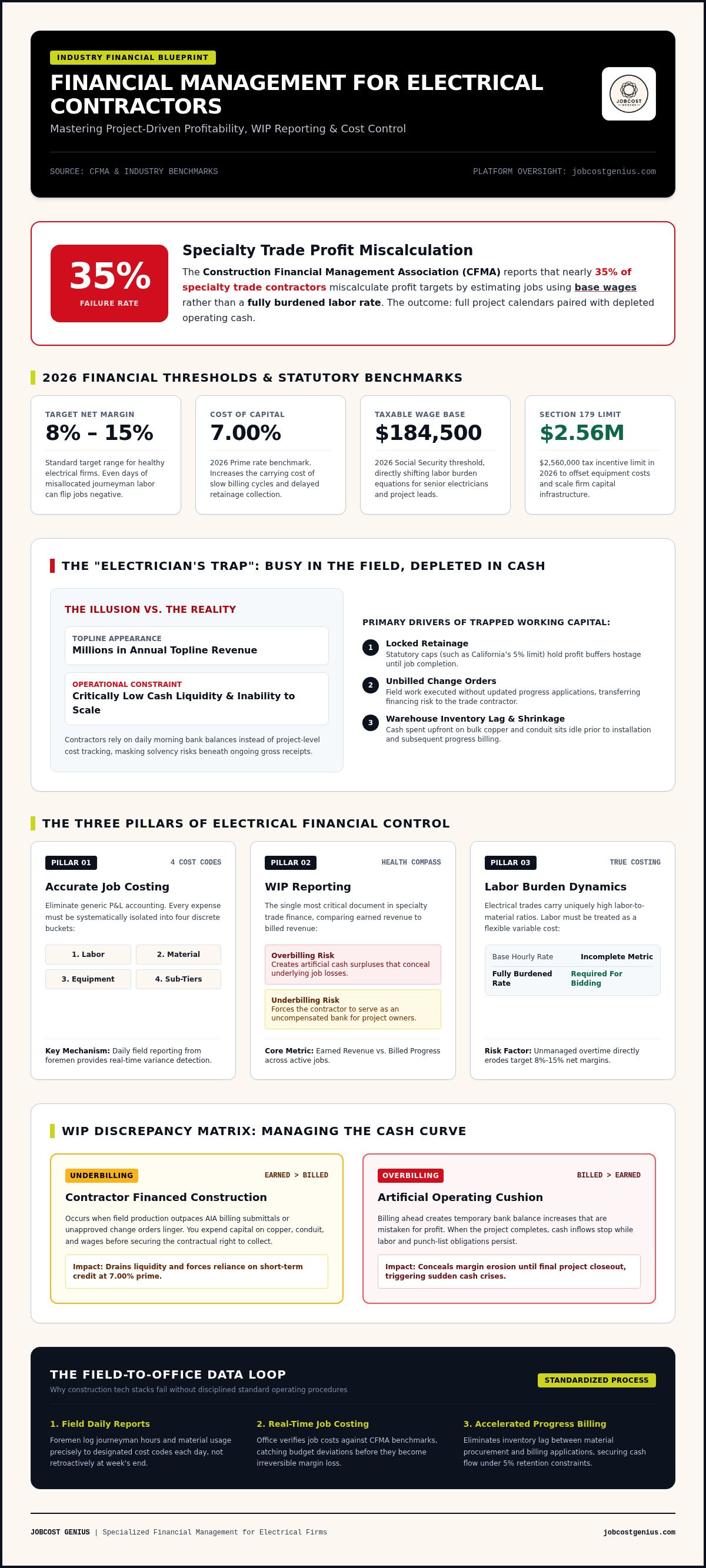
The Construction Financial Management Association reports that nearly 35% of specialty trade contractors miscalculate profit targets because they estimate jobs using base wages rather than a fully burdened labor rate. For many, the result is a calendar full of projects but a bank account that doesn't reflect the hard work. Effective financial management for electrical contractors isn't just about keeping the books. It's a specialized project management discipline that bridges the gap between field performance and office insights.
You likely feel the pressure of fluctuating material prices and the administrative burden of complex AIA billing cycles. We understand that managing 2026's 7.00% prime rate and new retention caps, such as California’s 5% limit, requires more than just a generalist's approach. This guide will help you master the specialized financial frameworks you need to move from administrative overwhelm to project-driven profitability. We'll explore how to leverage WIP reporting, optimize your labor burden calculations, and utilize 2026 tax incentives like the $2,560,000 Section 179 limit to build a more resilient, scalable electrical firm.
Key Takeaways
- Shift your perspective from administrative tracking to project-driven profitability by treating your books as a strategic management tool.
- Master the three essential pillars of financial management for electrical contractors, including job costing, WIP reporting, and labor burden, to gain clear visibility into project-level health.
- Learn why even the best construction tech stacks fail without a standardized data entry process that bridges the gap between the field and the office.
- Identify strategies to accelerate your billing cycles and eliminate cash flow bottlenecks caused by complex progress billing and retention.
- Discover how professional financial oversight allows you to transition from working in the daily administrative weeds to strategically scaling your business.
The Unique Financial Blueprint of Electrical Contracting
Financial management for electrical contractors is not a back-office administrative task. It is a project-first discipline that dictates whether a firm thrives or merely survives. Many owners fall into the "Electrician’s Trap." This occurs when a firm sees millions in annual revenue but struggles with low cash liquidity because capital is locked in retention, unbilled change orders, or warehouse inventory. It's a frustrating cycle where you're busy in the field but cash-poor in the office.
A generalist bookkeeper often looks at the company through a broad lens, focusing on generic profit and loss statements. However, electrical firms require a specialized job costing methodology that tracks every dollar down to the specific cost code. Without this level of detail, you lose visibility into project health until the job is closed. Effective financial management for electrical contractors transforms messy field data into strategic office insights, ensuring every bid is grounded in reality rather than guesswork.
Material Volatility and Inventory Management
Copper and conduit price swings can erode margins overnight if your bids don't reflect 2026 market realities. You must implement strategies to track inventory from the moment it enters the warehouse until it's installed on the job site. This prevents "shrinkage" and ensures that material costs are allocated correctly to the right project. Inventory lag is the financial delay between paying for bulk materials and successfully billing them out on a progress application, a gap that can cripple 2026 cash flow if not actively managed.
Labor-Heavy Project Dynamics
Electrical trades face significantly higher labor-to-material ratios compared to other subcontractors. This dynamic makes your workforce your greatest asset and your biggest financial risk. Labor should be managed as a variable cost rather than a fixed overhead burden. When you treat labor as variable, you gain the flexibility to scale crews based on actual project demand.
Unmanaged overtime and poor scheduling of specialized crews don't just delay the schedule. These inefficiencies directly attack your net profit margin. In an industry where healthy firms target net margins between 8% and 15%, even a few days of misallocated journeyman time can turn a profitable job into a loss. Precision in tracking labor burden is essential, especially as the 2026 Social Security taxable wage base rises to $184,500. You must ensure your billing rates accurately cover the true cost of your senior electricians and project managers.
Master the Pillars: Job Costing, WIP, and Labor Burden
Many business owners manage their firms by checking the bank balance every morning. While this provides a snapshot of cash, it doesn't tell you if you're actually making money on your projects. True financial management for electrical contractors requires a disciplined shift to job cost accounting. This method assigns every expense to a specific project and cost code, transforming your books from a historical record into a forward-looking management tool. Reliable financial reports depend entirely on the quality of data entry from the field to the office.
Accurate Job Costing for Electrical Projects
Job costing breaks down your project expenses into four critical categories: labor, material, equipment, and sub-tier contractors. In 2026, using your actual historical data to refine your bidding strategy is the only way to maintain a competitive edge. Daily field reports serve as the backbone of this accuracy. When your foremen record hours and material usage precisely each day, the office can identify budget deviations before they become permanent losses. This real-time feedback loop allows you to align your internal numbers with Construction Financial Management Association benchmarks for specialty trades.
The WIP Report: Your Profitability Compass
A Work-in-Progress (WIP) report is the single most important document for an electrical contractor's financial health. It provides a clear snapshot of earned revenue versus billed revenue across all active jobs. For the electrical trade, this means identifying overbilling and underbilling before they trigger a cash crisis. You can find a deeper breakdown in our WIP Reporting for Construction: The Definitive 2026 Guide. Overbilling often masks project losses by creating a temporary cash surplus. Conversely, underbilling indicates you're financing the owner's project. Fixing overbilling on WIP reports is essential to ensure your cash position represents true earned profit.
Calculating the True Labor Burden
Your base hourly rate is just the beginning of your labor costs. To protect your margins, you must calculate the true labor burden, which includes payroll taxes, workers' comp, health insurance, and retirement matches. For non-union electrical contractors, this multiplier typically adds 38% to 55% on top of base wages. If you don't account for the 2026 Social Security taxable wage base of $184,500, you'll likely underestimate the cost of your senior journeymen. To calculate a crew's true hourly cost, total all annual employer-paid benefits and taxes, divide by their total billable hours, and add that figure to the base hourly rate. If tracking these variables feels like a full-time job, our Growth Plan offers the specialized oversight needed to keep your labor rates accurate and your bids profitable.
Why Software Alone Won’t Save Your Electrical Business
Buying Procore or QuickBooks is a logical first step toward organization. It feels like progress. However, software is merely a recording engine. It doesn't possess the industry intuition required for effective financial management for electrical contractors. Without a disciplined strategy, these platforms simply automate your existing administrative mess. The "Garbage In, Garbage Out" reality of construction tech means that if your field data is flawed, your executive reports will be dangerously misleading. You cannot expect a tool to fix a broken process.
Software lacks the ability to identify a project anomaly or a sudden shift in material pricing trends. It won't tell you if a project manager is "padding" a progress report to hide a labor overrun. You need a human-led approach to transform raw data into actionable business intelligence. This level of oversight ensures that your financial reports are audit-ready and reflect the true state of your operations. It provides the organized calm you need to focus on scaling your crew rather than chasing down missing receipts.
The Tool vs. Strategy Gap
Software tracks data points. Experts interpret those points to make high-stakes business decisions. For instance, a generic Chart of Accounts rarely captures the nuances of electrical contracting. You need a customized setup that separates high-margin service work from capital-intensive commercial projects. The Construction Financial Management Association emphasizes that accurate reporting requires a deep understanding of revenue recognition. A tool can't decide which cost code a wire purchase belongs to; a seasoned expert must verify that allocation.
Field-to-Office Data Integrity
Bridging the communication gap between project managers and the bookkeeping team is essential for accuracy. Data entry errors frequently occur during the transition from daily field reports to office accounting software. Professional oversight ensures that your Procore Financials Integration Services serve as a bridge rather than a bottleneck. This meticulousness in financial management for electrical contractors transforms your tech stack from a simple expense into a foundational asset for growth.
Managing Cash Flow and Progress Billing
A dollar earned in the field is not the same as a dollar in the bank. For electrical contractors, the lifecycle of a dollar begins with purchasing materials and funding weekly payroll, often weeks before an invoice is even generated. This delay creates a working capital gap that can stifle your operations. Effective financial management for electrical contractors requires narrowing this gap through aggressive accounts receivable (AR) management and precise billing cycles. You are effectively acting as a short-term lender to your General Contractor (GC) until that progress payment clears.
Managing this liquidity is critical for sustainable scaling. Without a clear strategy, your cash is constantly locked in the field, leaving you vulnerable to market shifts. For a comprehensive look at protecting your liquidity, read our guide on Construction Cash Flow Management: Strategies for Sustainable Growth in 2026.
Navigating AIA Billing and Progress Payments
Commercial electrical projects rely on standard AIA Document G702 and G703 forms. These documents require a meticulous Schedule of Values (SOV) that aligns with your project cost codes. If your SOV isn't structured to account for mobilization costs legitimately, you'll likely remain cash-negative for the first half of the project. To get billings approved faster, you must submit your applications two to three days before the GC's deadline and ensure all lien waivers are attached. Common mistakes, such as including unapproved change orders on a G703, trigger immediate rejections and can delay your payment by an entire 30-day cycle.
Retention Tracking and Cash Reserves
Retention is often the difference between a profitable year and a net loss. In 2026, legislative shifts like California’s SB 61 have capped retention at 5% on private works, providing much-needed relief to trade subcontractors. However, you must still track these funds across multiple long-term projects to ensure they don't disappear into the GC's bottom line at closeout.
Building a dedicated cash reserve is essential to handle front-loaded material costs like switchgear or bulk copper. With the 2026 prime loan rate standing at 7.00%, relying on a line of credit to bridge payment lags is an expensive strategy that erodes your profit margins. A robust reserve allows you to self-finance project starts without the burden of high-interest commercial debt. If your current billing process is creating bottlenecks, explore our Growth Plan to implement a more predictable cash flow framework.
Scaling Your Firm with Professional Financial Oversight
Scaling an electrical contracting firm is a high-stakes evolution. It requires moving past the daily administrative weeds to a position of strategic oversight. Many owners find themselves trapped in a cycle of reactive management, where financial decisions are based on gut feelings rather than hard data. Professional financial management for electrical contractors provides the foundational clarity needed to break this cycle. It transforms your books from a source of stress into a roadmap for expansion, allowing you to focus on high-level project acquisition and crew leadership.
To support this transition, we offer structured service tiers designed for different stages of growth. Our Starter Plan serves as an entry point for firms needing foundational clarity, while our Growth and Premium plans provide the deeper analytical depth required by larger operations. These services ensure your field data is consistently translated into office insights, regardless of your firm's current size. By establishing these frameworks early, you ensure that your infrastructure is ready to handle the increased complexity of larger commercial contracts.
The Case for Outsourced Construction Bookkeeping
Hiring in-house administrative staff often presents a significant overhead burden without providing the specialized expertise your trade demands. A generalist bookkeeper might understand basic accounting, but they often lack the technical knowledge to manage WIP reporting or Procore Financials Integration effectively. Outsourcing these functions gives you access to high-level CFO insights on a subcontractor’s budget, providing a level of meticulousness that a generalist simply can't match.
By partnering with a specialized service, you benefit from a team that understands the nuances of electrical labor burden and material volatility. For a detailed breakdown of how this model supports your bottom line, see our Outsourced Bookkeeping for Construction: 2026 Guide. This approach ensures your financial infrastructure is built to scale alongside your project list without the need for on-site administrative staffing.
Strategic Growth and Financial Confidence
Clean, accurate financial statements are your most powerful tool when negotiating with sureties and banks. In the 2026 lending environment, where the prime rate sits at 7.00%, lenders require meticulous documentation before extending credit lines or bonding limits. Consistent monthly reporting demonstrates to stakeholders that your business is a disciplined, low-risk operation. It provides the confidence you need to bid on larger projects, knowing your cash flow can support the mobilization costs.
Beyond immediate financing, professional financial management for electrical contractors increases the long-term valuation of your business. A firm with organized, audit-ready records is far more attractive to potential buyers or partners than one with messy field-to-office data. If you're ready to fix your books and build a resilient infrastructure, the first step is reconciling your current WIP and establishing a standardized job-costing framework. This commitment to accuracy is what separates a busy electrician from a successful business owner who works on the business rather than just in it.
Build a Foundation for Predictable Growth
Transitioning from administrative overwhelm to organized clarity is a choice that defines the trajectory of your firm. By mastering specialized job costing and maintaining a rigorous WIP schedule, you protect your margins from material volatility and labor inefficiencies. Robust financial management for electrical contractors isn't just about compliance; it's about gaining the visibility needed to scale with confidence. You've worked hard to build your reputation in the field. It's time your office infrastructure reflected that same level of excellence.
You don't have to navigate these complexities alone. Our team provides specialized WIP reporting and acts as your Procore Financials integration experts. We operate without long-term contracts, focusing instead on delivering consistent monthly value. Stop guessing your project profits and get professional financial oversight with JobCost Genius starting at $800 per month. Your path to financial clarity and sustainable growth starts with accurate data and expert guidance. We're here to help you turn messy field data into strategic office insights.
Frequently Asked Questions
What is the most important financial report for an electrical contractor?
The Work-in-Progress (WIP) report is the most critical document for maintaining project health. It provides a real-time view of profitability by comparing actual costs incurred against the total contract value and estimated costs. This report identifies overbillings and underbillings, allowing you to see which projects are generating cash and which are draining it. Without a regular WIP schedule, your profit and loss statement remains an incomplete picture of your firm's true health.
How do I calculate labor burden for my electrical crew?
To calculate labor burden, you must sum all costs associated with an employee beyond their base hourly wage. This includes FICA, FUTA, SUTA, workers' compensation insurance, health benefits, and retirement contributions. Divide the total annual cost of these benefits by the employee's total billable hours to find the hourly burden rate. Adding this to the base wage gives you the fully burdened rate, which is essential for accurate financial management for electrical contractors.
Why is my electrical business profitable on paper but low on cash?
This discrepancy typically occurs because your profit and loss statement records revenue when it's earned, not when the cash hits your bank account. High revenue figures often mask cash flow bottlenecks caused by slow AIA billing cycles or retention withheld by General Contractors. Additionally, front-loading material costs for large electrical projects can deplete your liquidity even if the project is technically profitable according to your accounting software.
What is the difference between general bookkeeping and construction bookkeeping?
General bookkeeping focuses on recording company-wide transactions like rent and utility payments. Construction bookkeeping is a specialized project-first discipline that prioritizes job costing and revenue recognition based on the percentage of completion. It requires tracking labor burden, material volatility, and complex progress billing across multiple job sites. Generalist bookkeepers often lack the technical expertise to manage these trade-specific requirements, leading to inaccurate financial reports and missed profit opportunities.
How often should an electrical contractor review their WIP report?
You should review your WIP report at least once a month during your formal financial closing process. However, for fast-moving projects or firms experiencing rapid growth, bi-weekly reviews are more effective for catching cost overruns early. Regular reviews ensure that your billings stay aligned with your actual costs incurred. This discipline prevents profit fade and gives you the confidence to make strategic decisions about staffing and project acquisition.
Can I integrate my field software with my financial management system?
Yes, integrating field software with your financial system is vital for maintaining data integrity. Specialized integrations, such as Procore Financials, bridge the gap between project managers in the field and the bookkeeping team in the office. This sync ensures that daily field reports and material logs flow directly into your accounting software. It eliminates manual data entry errors and provides a single source of truth for your financial management for electrical contractors.
What are the risks of underbilling on a large electrical contract?
Underbilling occurs when you have incurred costs but haven't yet billed the client for that work. This effectively means you are financing the owner's project with your own capital. On large electrical contracts, chronic underbilling can lead to severe cash flow strain and an inability to meet payroll or vendor obligations. It also makes your balance sheet look weaker to bonding agents, as it represents an asset that hasn't been converted to cash.
How much should an electrical contractor spend on financial management services?
Most electrical contractors find that specialized financial oversight pays for itself by identifying hidden labor costs and accelerating billing cycles. Professional services are typically tiered based on the complexity and volume of your projects. For example, JobCost Genius offers a Starter Plan starting at $800 per month for firms needing foundational clarity. Larger firms requiring deeper analysis and software integration can choose from Growth or Premium plans to ensure their infrastructure supports sustainable scaling.


