

Every dollar you underbill is an interest-free loan you've unknowingly granted your client. While your project pipeline looks full, your cash flow remains dangerously thin. This disconnect often stems from a lack of precision when calculating underbillings in construction, leading to financial statements that don't reflect the true health of your jobs. It's a common struggle that leaves even seasoned contractors feeling overwhelmed by their own data.
You deserve financial clarity that transforms administrative stress into organized confidence. We've designed this guide to help you master the exact formulas and reporting strategies required to identify hidden underbillings and secure your company’s liquid capital. We'll examine the specific WIP reporting methods used by industry leaders in 2026 to ensure audit-ready accuracy. You'll learn how to tighten your billing cycles, improve your bonding capacity, and finally sync your field data with your office financials for a more resilient bottom line.
Key Takeaways
- Recognize why underbillings appear as assets on your balance sheet while simultaneously draining your monthly cash reserves.
- Master the multi-step WIP formula for calculating underbillings in construction to ensure your earned revenue matches actual project progress.
- Identify the "silent killers" of your margins, such as unbilled change orders and delayed field reports, to prevent unnecessary profit fade.
- Implement a structured billing calendar and approval process to transform your financial statements into audit-ready documents that satisfy surety bonds.
- Leverage specialized WIP reporting to maintain a clear, real-time view of your project health and operational stability.
What Are Underbillings in Construction Accounting?
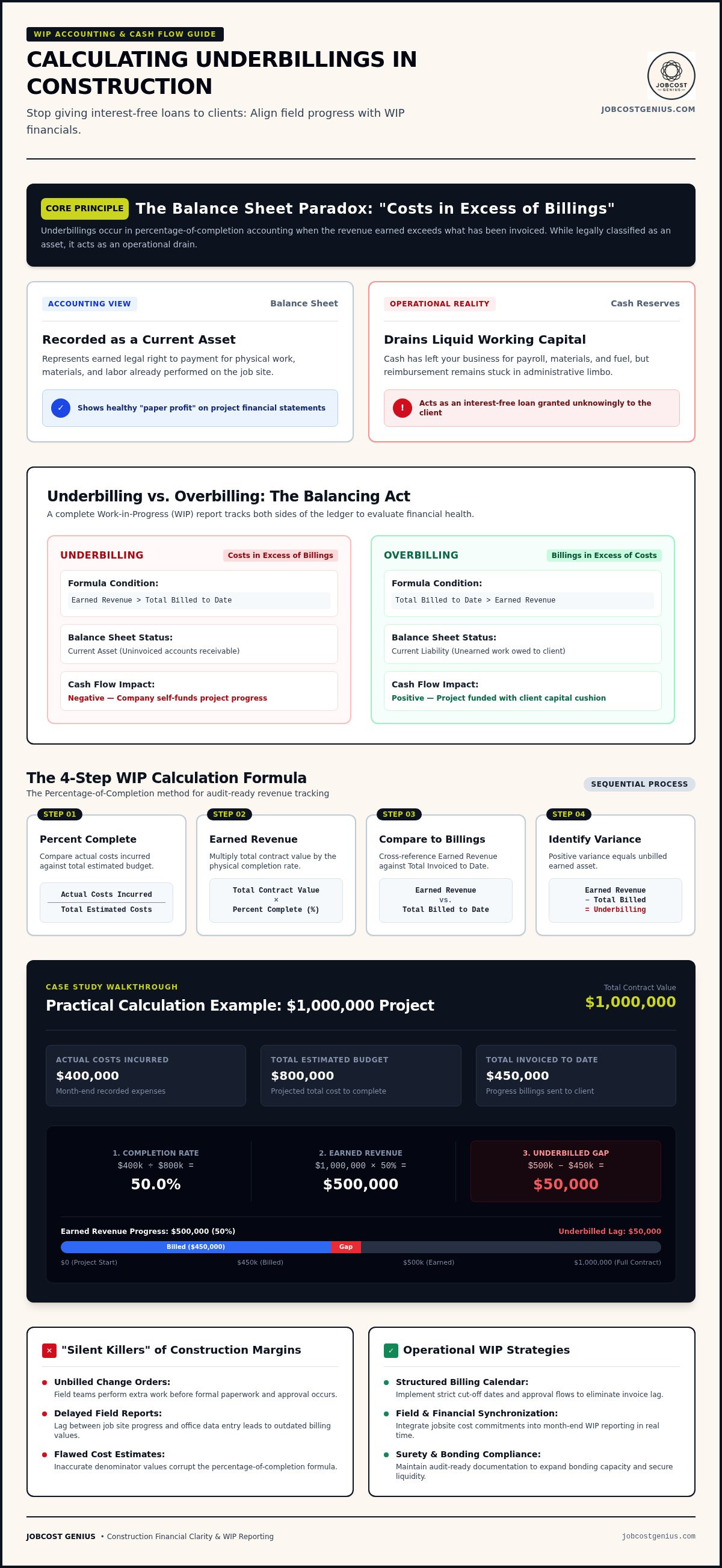
Underbillings, often labeled "Costs in Excess of Billings" on a financial statement, occur when the revenue you've earned on a project exceeds the amount you've actually invoiced to the client. This happens frequently in percentage-of-completion accounting. If your field team has installed $100,000 worth of materials and labor, but the office has only sent a progress bill for $80,000, you are underbilled by $20,000. In the current 2026 economic environment, where lending is tighter and interest rates remain a significant factor in project financing, mastering the process of calculating underbillings in construction is no longer optional. It's a survival skill for maintaining liquidity.
The Asset That Drains Your Cash
Accountants classify underbillings as a current asset because they represent a legal right to payment for work already performed. It’s essentially an accounts receivable entry that hasn't been formalized yet. While this looks excellent on a balance sheet, it feels like a liability in your day-to-day operations. You've already paid for the labor, the fuel, and the materials. The cash has left your business, but the reimbursement is stuck in administrative limbo. This creates a psychological trap for many contractors. You might see a healthy "paper profit" on your reports while simultaneously struggling to meet Friday's payroll. Without accurate WIP reporting, this "profit fade" can hide until it’s too late to recover the costs.
Underbilling vs. Overbilling: The Balancing Act
A complete WIP report tracks both sides of the ledger to give you a full picture of project health. Overbilling, or "Billings in Excess of Costs," occurs when you invoice for more work than has been physically completed. Accountants call this a liability because you technically owe that work to the client. However, from a cash flow perspective, a slightly overbilled position is often the goal. It allows you to use the client's capital to fund the project rather than your own. Underbilling is the gap between work performed and invoices sent.
Maintaining this balance is delicate. While overbilling provides a cash cushion, excessive underbilling signals a breakdown in communication between the field and the office. If your reports show persistent underbilling, it usually points to unapproved change orders or a lagging billing cycle that needs immediate attention. Regularly calculating underbillings in construction ensures you aren't providing interest-free loans to your customers at the expense of your own operational stability.
How to Calculate Underbillings: The Step-by-Step Formula
Understanding the theory behind underbillings is only the first step. To protect your cash flow, you need a repeatable process for calculating underbillings in construction across your entire project portfolio. This calculation relies on the percentage-of-completion method, which aligns your financial reporting with the physical progress made on the job site. It's a structured approach that removes the guesswork from your month-end close.
- Step 1: Determine the Percent Complete for each active project by comparing costs incurred to your total budget.
- Step 2: Calculate Earned Revenue by multiplying the total contract value by the percentage of completion.
- Step 3: Compare this Earned Revenue figure to your Total Billed to Date.
- Step 4: Identify the variance. If your Earned Revenue is higher than your Total Billed, the difference is your underbilling amount.
The Percent Complete Method
Costs are the most reliable metric for measuring progress in construction. The formula is straightforward: Actual Costs Incurred divided by Total Estimated Costs equals your Percent Complete. However, this math is only as strong as your underlying data. If your estimates are wrong, your underbilling calculation is a lie. You must account for every committed cost and anticipated expense to ensure the denominator of your fraction is accurate. Without disciplined cost tracking, your WIP report will provide a false sense of security while your actual margins erode in silence.
A Practical Calculation Example
Let's look at a concrete scenario. Imagine you're managing a $1,000,000 contract. As of the end of the month, you've incurred $400,000 in actual costs. Your latest projections show that the total estimated costs to finish the project are $800,000.
First, find your percentage of completion: $400,000 divided by $800,000 equals 50% complete. Next, determine your earned revenue: $1,000,000 multiplied by 50% equals $500,000. Finally, check your accounts receivable. If you've only sent invoices totaling $450,000, you have a $50,000 underbilling asset. This $50,000 represents work you've finished and paid for, but haven't yet collected from the client. For many growing firms, implementing specialized WIP reporting is the most effective way to automate these calculations and prevent this capital from staying trapped on the balance sheet.
Why Underbillings Occur: Identifying Profit Gaps
While the formula for calculating underbillings in construction provides the data, understanding the root causes allows you to fix the underlying operational leaks. Underbillings don't just happen by accident. They're often the result of systemic communication breakdowns or well-intentioned but misguided management decisions. Identifying these gaps is the only way to move from simply tracking losses to actively preventing them.
One common, yet overlooked, cause is "nice guy syndrome." This occurs when a project manager delays an invoice to help a client stay within a monthly budget or to maintain a positive relationship on a difficult site. While this might feel like good customer service, it's actually an interest-free loan that puts your own payroll at risk. Additionally, inaccurate initial estimates can create a situation that looks like underbilling but is actually "profit fade," where the costs to complete the work simply exceed the original budget.
The Change Order Trap
Unbilled change orders are the primary cause of margin erosion in the industry. When a field crew performs extra work based on a verbal agreement or an urgent site need, costs begin to accumulate immediately. If that work hasn't been formalized in your accounting system, your expenses rise while your billable contract value stays the same. This creates a massive spike in underbillings. Successfully managing construction change orders financials requires a strict "no paperwork, no work" policy or, at the very least, a dedicated process to log pending changes in your WIP report. Without this discipline, your office remains blind to the true cost of the project until the margins have already disappeared.
Lagging Field to Office Data
The speed of your financial reporting depends entirely on the speed of your field data. Timesheets, subcontractor invoices, and material receipts often sit in a truck or a field office for days before reaching the accounting department. This delay creates a "blind spot" where your books show low costs simply because the data hasn't arrived. When two weeks of backlogged expenses finally hit the system at once, you'll see a sudden, alarming jump when calculating underbillings in construction for that period.
This lag is particularly dangerous during cost-heavy periods where underbilling is inevitable but must be tracked. For example, during the mobilization or foundation phases, you might incur massive upfront expenses before the first major milestone allows for a significant billing. If your data sync isn't daily or weekly, you won't know if that underbilling is a standard part of the project lifecycle or a sign that the job is spiraling out of control. Streamlining this field-to-office pipeline is essential for maintaining a clear, real-time view of your cash position.
Strategies to Minimize Underbilling and Protect Cash
Calculating the numbers is only half the battle. To truly protect your bottom line, you need active strategies that keep your underbilling figures as low as possible. This requires an operational shift from reactive accounting to proactive project management. When you treat billing as a core project milestone rather than a monthly administrative chore, your cash flow becomes predictable and your financial statements remain audit-ready. It's about closing the gap between the work performed and the invoice sent.
One of the most effective methods is implementing a strict billing calendar. Every project manager and subcontractor should know that work completed by a specific cutoff date must be documented and submitted for invoicing immediately. This prevents the "nice guy" delays discussed earlier and ensures you aren't funding project costs out of your own pocket. Additionally, you should streamline your change order approval process. Use digital signatures and mobile field tools to get extra work authorized in hours, not weeks. This ensures that when you're calculating underbillings in construction at month-end, those costs are already attached to a billable contract value.
Improving Field-to-Office Sync
Manual data entry is the enemy of accuracy. Utilizing Procore financials integration services allows your field teams to log costs and progress in real-time without the office staff needing to chase down paper receipts. This integration isn't just a tech buzzword; it's a fundamental cash flow strategy. When your accounting system speaks directly to your project management software, you eliminate the reporting lag that causes underbilling spikes. Project managers gain immediate visibility into their budget health, allowing them to spot potential profit fade before it impacts the company's liquidity.
Standardizing the WIP Review Process
Regular WIP review meetings are essential for maintaining financial clarity. These sessions should include both the project managers and the accounting team to ensure everyone is looking at the same data. During these meetings, don't just look at the totals. Ask specific, targeted questions like, "Why hasn't this $20,000 in foundation costs been billed yet?" or "Is this underbilling due to a pending change order or a site delay?"
This level of scrutiny is a cornerstone of effective construction cash flow management. By forcing a dialogue between the field and the office, you identify bottlenecks in your billing cycle that software alone can't fix. If you're struggling to maintain this level of detail while growing your firm, our specialized WIP Reporting can provide the foundational strength you need to scale with confidence.
Accurate WIP Reporting: The JobCost Genius Advantage
General bookkeeping often fails construction companies because it treats every dollar the same. In this industry, a dollar spent today might not be billable for weeks. Without a specialized approach to calculating underbillings in construction, you're essentially flying blind. JobCost Genius bridges this gap by providing the industry-specific expertise that generalist firms lack. We transform your raw financial data into a strategic asset that fuels your growth rather than slowing it down.
Our approach is built on stability and meticulousness. We understand that your financial statements aren't just for the IRS; they're the engine that drives your bonding capacity and your ability to secure new contracts. By moving from administrative overwhelm to organized clarity, you can finally focus on what you do best: building.
Specialized Construction Bookkeeping
Generalist accountants often miss the nuances of under and overbillings because they aren't trained in the percentage-of-completion method. They might see a project with high costs and assume it's failing, or see a high bank balance and assume it's thriving. Neither is necessarily true. By partnering with an outsourced bookkeeping for construction firms expert, you gain access to professionals with over 20 years of industry experience. We act as the disciplined expert in your corner, ensuring that your WIP reports are accurate, timely, and reflective of your actual field progress. This specialized knowledge prevents the "profit fade" that often goes unnoticed until a project is too far gone to save.
Your Road to Financial Confidence
Financial clarity shouldn't be a luxury reserved for the largest firms. Whether you're on our Starter, Growth, or Premium Plan, you receive a monthly reporting package designed to eliminate administrative stress. These audit-ready WIP reports do more than just help with calculating underbillings in construction; they provide the technical transparency required to secure better bonding and financing. In 2026, lenders and sureties are scrutinizing financial statements more closely than ever due to the volatile interest rate environment. Having foundational strength in your reporting makes you a more attractive partner to these institutions because it proves you have a firm grip on your project-level profitability.
As you scale, your reporting needs will naturally evolve. Our Growth and Premium plans offer deeper integrations, such as Procore Financials, to ensure your office and field data remain in lockstep. This allows you to focus on winning new bids and managing sites while we handle the meticulous tracking of your margins. It's time to stop guessing about your profitability and start leading with data-driven confidence. Schedule a consultation with JobCost Genius to fix your WIP reporting and reclaim control over your company's cash flow.
Reclaim Your Cash Flow and Scale with Confidence
Mastering your WIP reporting is the difference between a firm that survives and one that thrives in 2026. By accurately calculating underbillings in construction, you move beyond administrative guesswork and gain a clear view of your project-level profitability. You've seen how unbilled change orders and reporting lags can drain your liquid capital; now it's time to implement the systems that prevent these leaks before they impact your payroll.
Financial clarity shouldn't feel like an impossible task. We provide specialized construction financial oversight starting at $800/mo, including expert support for Procore and Buildertrend integrations. Our detailed monthly WIP reporting ensures you always have the audit-ready data needed to secure bonding and financing. Stop letting your earned revenue sit in limbo and start building on a foundation of technical transparency. Get a Professional WIP Report Analysis from JobCost Genius today. You have the expertise to build great projects. We have the meticulous discipline to ensure those projects build a stronger business.
Frequently Asked Questions
Why do underbillings appear as an asset on the balance sheet?
Underbillings represent revenue you've earned but haven't yet invoiced to the client. Because you have a legal right to collect this money for work already performed, accounting standards classify it as a current asset. It's essentially unbilled accounts receivable. However, it's a non-cash asset. While it strengthens your balance sheet on paper, it doesn't help you meet payroll or pay vendors until the invoice is actually sent and collected.
How often should a construction company update its WIP report?
You should update your WIP report at least once a month to coincide with your financial close. For high-volume contractors or those managing complex projects, weekly updates are often more effective for catching margin erosion early. Frequent updates allow project managers to spot issues before they become permanent losses. Consistency is key here. Regular reviews ensure that the process of calculating underbillings in construction remains accurate and reflects real-time field progress.
Can underbillings lead to a construction company going out of business?
Yes, excessive underbillings are a leading cause of construction business failure. They represent a significant drain on cash flow because you've already paid for labor and materials without receiving reimbursement. This creates a liquidity crunch where you might appear profitable on your Profit and Loss statement but have an empty bank account. If you can't bridge the gap between spending and billing, you'll eventually run out of the working capital needed to operate.
What is the difference between underbilling and profit fade?
Underbilling is a timing issue where revenue is earned but not yet invoiced. Profit fade is a permanent loss where your actual costs exceed your original estimates. Initially, profit fade can look like underbilling on a WIP report because costs are higher than expected. However, if that asset never turns into an invoice because the budget was wrong, it's profit fade. Accurate WIP reporting helps you distinguish between these two critical financial issues.
How do surety companies view large underbillings on a financial statement?
Surety companies view large or persistent underbillings as a red flag indicating poor project management or weak internal controls. They worry that the asset on your balance sheet may never be collected or that it hides underlying project losses. Large underbillings can lead to a reduction in your bonding capacity. Sureties prefer to see a slightly overbilled position, which suggests you're effectively using client capital to fund your projects rather than your own.
Is it possible to have zero underbillings in construction?
It's theoretically possible but practically rare to have exactly zero underbillings at any given moment. Due to the nature of progress billing and the timing of cost accumulation, there's usually some variance between work performed and invoices sent. Your goal shouldn't be a perfect zero, but rather a manageable and explained figure. A healthy financial state often involves being slightly overbilled, ensuring your cash flow stays ahead of your project expenses throughout the job.
What is the easiest way to track underbillings in QuickBooks?
QuickBooks doesn't have a native WIP module, so the easiest way to track them is through a structured spreadsheet or an integrated third-party tool. You must manually record your estimated costs and contract values to generate the necessary data. Many firms find that calculating underbillings in construction requires more technical oversight than basic software provides. Specialized bookkeeping services can automate this data sync, ensuring your QuickBooks file reflects the true percentage of completion for every project.
Should I bill for stored materials to reduce underbilling?
You should bill for stored materials whenever your contract allows it. This is a highly effective strategy for keeping your cash flow positive, especially during the early stages of a project. By invoicing for materials sitting in a warehouse or on-site, you reduce the amount of capital you have tied up in inventory. This practice directly lowers your underbilling figure and ensures you aren't acting as a bank for your clients' material costs.


