

82% of contractors now wait more than 30 days past their expected payment date to see a single dollar. You understand the frustration of having your cash flow stalled because of a minor clerical error on a G702 form. With G702 and G703 forms used on 78% of commercial projects, the margin for error has never been thinner. Managing 5% retainage caps and tracking stored materials requires a level of precision that general bookkeeping simply cannot provide. It is difficult to maintain a steady pace when your office billing does not match your actual field progress.
Leveraging specialized AIA billing services for contractors transforms this administrative overwhelm into financial clarity. This 2026 guide shows you how to streamline complex payment applications, reduce rejections, and protect your company's bottom line. You will learn how professional oversight and Procore financials integration bridge the gap between field data and office reporting. We will explore the path to zero-error applications and predictable cash flow that scales with your business, ensuring your WIP reporting is as accurate as your craftsmanship.
Key Takeaways
- Master the technical requirements of G702 and G703 forms to eliminate the clerical errors that trigger immediate payment rejections.
- Learn why a well-structured Schedule of Values (SOV) is the essential foundation for tracking work completed and materials presently stored.
- Discover why specialized AIA billing services for contractors provide the expert oversight needed to catch nuances that automated software often overlooks.
- Align your progress billing with accurate WIP reporting to maintain true profitability and avoid the dangers of unintentional overbilling.
- Understand how integrating Procore Financials with your back-office processes creates a seamless connection between field progress and office accounting.
What are AIA Billing Services and Why Do Contractors Need Them?
AIA billing refers to the standardized progress billing process developed by the American Institute of Architects. It is the gold standard for commercial construction projects. These forms ensure that every party, from the subcontractor to the lender, understands exactly how much work has been performed and how much money is owed. AIA billing acts as the essential bridge between project milestones and contractor cash flow.
While many firms attempt to handle this in-house, the complexity often leads to administrative bottlenecks. Utilizing professional AIA billing services for contractors, like those offered by JobCost Genius, ensures that your applications are not just completed, but are technically compliant and audit-ready. Expert management moves beyond simple data entry by verifying that every line item aligns with the contract sum and previous applications. This level of meticulousness transforms a stressful monthly deadline into a predictable part of your financial operations.
The Anatomy of G702 and G703 Forms
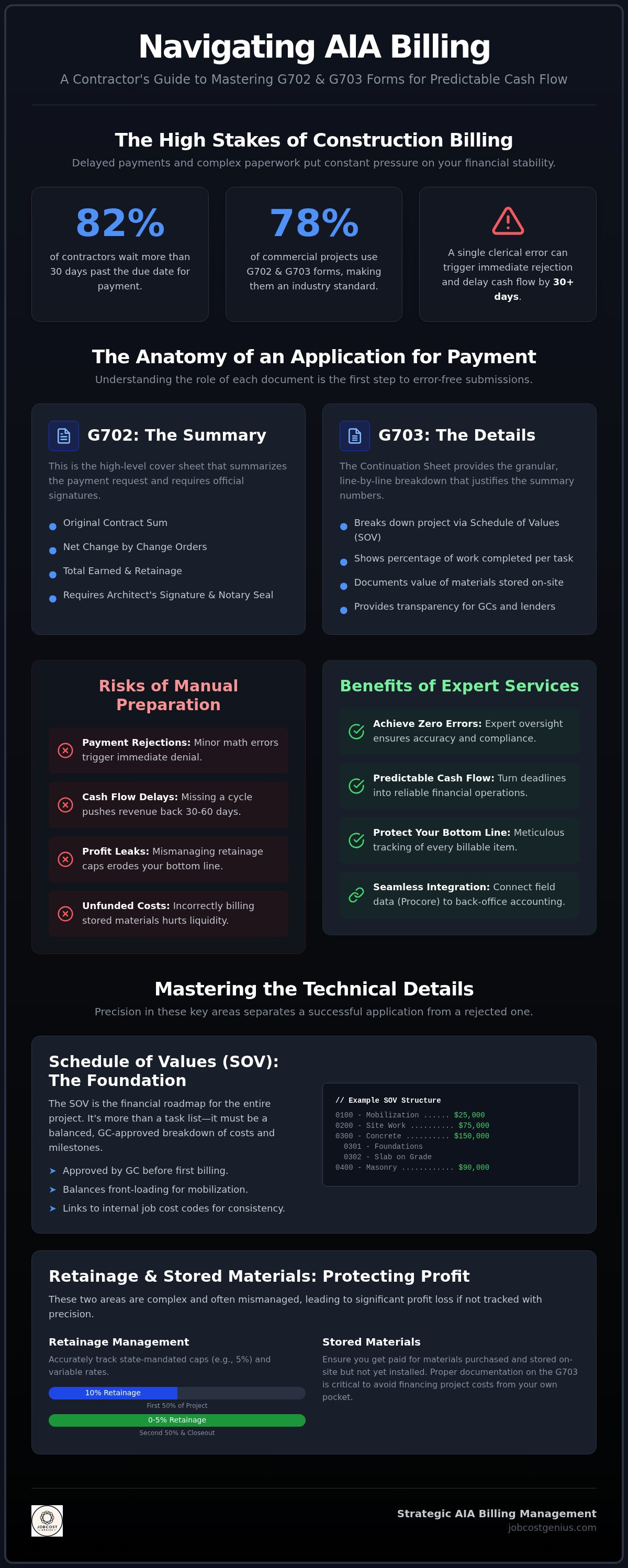
Standardized billing relies on two primary documents: the G702 Application and Certificate for Payment and the G703 Continuation Sheet. The G702 serves as the high-level summary. It details the original contract sum, the net change by change orders, and the total earned to date. It is the document that requires a notary's seal and the architect's signature. It provides the final "bottom line" that triggers your payment.
The G703 provides the granular detail required for transparency. It breaks the project down into a Schedule of Values (SOV), showing the percentage of work completed for every specific task. General contractors and architects insist on these formats because they provide a clear, chronological history of the project's financial health. Without this structure, tracking progress across multi-million dollar contracts becomes nearly impossible for project owners and finance partners like The Federal Group who rely on accurate data for development finance.
Manual preparation is a high-stakes gamble with your company's liquidity. Even a minor mathematical error on a G702 form can trigger an immediate rejection from a GC. When an application is kicked back, you don't just fix a typo; you often miss the entire payment cycle, delaying your cash flow by 30 days or more. These delays are compounding, especially when you have payroll and material vendors to satisfy.
Retainage mismanagement is another significant risk. With many states now capping retainage at 5%, failing to track these percentages accurately leads to profit leaks. Manual systems often struggle to account for materials presently stored on-site but not yet installed. If you don't document these stored materials correctly on the G703, you are essentially financing the project's front-loaded costs out of your own pocket. Professional AIA billing services for contractors eliminate these vulnerabilities by applying industry-specific logic to every calculation.
The Technical Nuances of G702 and G703 Preparation
Successful payment applications aren't built on software alone. They're built on technical precision. The preparation of G702 and G703 documents requires a strategic approach to project accounting that protects your profit margins from the start. Professional AIA billing services for contractors ensure that these technical details are managed with the meticulousness required by commercial project owners and their lenders.
Mastering the Schedule of Values (SOV)
The Schedule of Values is the foundation of your entire billing cycle. It's not merely a list of tasks; it's a financial roadmap that must be approved by the GC before the first application is ever submitted. Effective SOV management involves breaking down project costs into manageable line items that reflect realistic milestones. You must balance front-end loading, which helps with initial mobilization costs, with the GC's requirement for a balanced schedule. Linking these line items directly to your internal job cost codes ensures that your billing remains consistent with your actual project spending, preventing discrepancies during audits.
Retainage and Stored Materials Management
Managing retainage is one of the most complex aspects of AIA billing. While a 10% rate was once the industry standard, 2026 regulations in states like New York and California have capped retainage at 5% for private projects. Your G703 must accurately track these percentages as they fluctuate throughout the project lifecycle. Some contracts utilize variable retainage, holding 10% until the project is 50% complete and then 0% thereafter. Tracking this cumulative total correctly is vital for a smooth final closeout and the timely release of your funds.
Reimbursement for stored materials is another area where contractors often lose time. To get paid for materials not yet installed, you must provide specific backup documentation, including invoices and certificates of insurance. Failure to track 'Work Completed' separately from 'Materials Presently Stored' leads to underbilling or application rejection. If these calculations feel overwhelming, partnering with an expert for professional financial oversight can ensure your applications remain accurate and compliant.
Every approved change order must be integrated into the G703 continuation sheet immediately. Waiting until the end of a project to reconcile change orders creates a massive administrative burden and delays final payment. Every approved change should appear as a new line item, allowing you to bill for that work in the same cycle it was performed. This keeps your billing current and your cash flow predictable.
Software vs. Managed Services: Why Automation Isn't Enough
Many construction firms invest in high-priced software expecting it to solve their billing delays. While automation can generate the physical G702 and G703 documents, it cannot ensure the data behind them is accurate or strategic. Software is a tool, not a solution. It requires a seasoned operator who understands the specific language of your contract and the expectations of your project owner. Without this expertise, you're simply automating the production of errors.
Professional AIA billing services for contractors provide a critical human firewall that software lacks. Automated platforms often fail to account for the subtle nuances of verbal agreements with a General Contractor or the specific requirements of a lender. When your billing is managed by experts, it aligns perfectly with your broader outsourced bookkeeping for construction firms strategy. This ensures that every payment application reflects the true financial state of your company, rather than just a set of disconnected numbers.
The Limits of AIA Billing Software
The "garbage in, garbage out" principle applies heavily to construction billing. If your daily logs are inconsistent or your field team hasn't updated the percentage of completion, the software will generate a flawed application. Basic applications often struggle with complex "split" retainage structures where the rate changes after a project reaches the 50% milestone. They also lack the flexibility to handle non-standard billing cycles or unique material storage requirements. Most importantly, software won't help you defend a disputed line item during a meeting with an architect. It cannot interpret the intent of a contract clause or negotiate on your behalf to get a pay app approved.
The ROI of Specialized AIA Billing Services
The true value of managed AIA billing services for contractors is measured in cash flow. By eliminating the clerical errors that lead to immediate rejections, you significantly reduce your Days Sales Outstanding (DSO). This allows your project managers to stay focused on field operations instead of spending hours wrestling with spreadsheets. Managed services also ensure that all necessary lien waivers are attached and compliant, which is often the final hurdle for getting a check cut. When your billing is handled with technical precision, you move from a state of administrative overwhelm to one of organized, financial clarity.
Integrating AIA Billing with WIP Reporting and Job Costing
AIA billing is often treated as a standalone administrative task. This is a mistake. To understand your company's financial health, your progress billing must align perfectly with your WIP reporting for construction companies. If your G703 shows a project is 60% complete while your job costs indicate only 40% of the work is done, you're significantly overbilled. While overbilling provides temporary cash flow, it creates a cash hole that will inevitably stall future operations. Conversely, persistent underbilling signals to lenders and stakeholders that your project management lacks control. AIA billing is the external face of your internal job costing accuracy.
Utilizing professional AIA billing services for contractors ensures that these two financial worlds remain in sync. Specialized oversight catches discrepancies before they impact your balance sheet. By verifying that billed amounts match actual costs incurred, you protect your firm from the erratic swings of phantom profit. This level of coordination is what separates a growing contractor from one that's simply surviving month to month.
Field-to-Office Data Synchronization
Accuracy starts in the field. Many firms struggle with a communication gap where the office bills for work the field hasn't yet documented. Implementing Procore financials integration services bridges this gap by pulling real-time progress data directly into your billing cycle. Daily logs and field reports serve as the objective evidence for the percentage complete reported on your G703. This synchronization reduces the friction between project managers and the accounting department. It ensures that every line item on your payment application is defensible and grounded in reality.
Protecting Cash Flow through Accurate Reporting
Accurate AIA data is a powerful forecasting tool. When you track billing in excess of costs correctly, you can manage your tax liabilities and cash reserves with precision. This data allows you to forecast upcoming revenue and determine exactly when you'll need to scale labor or material orders. You must also ensure that retention is recognized as an asset on your balance sheet rather than ignored until the project ends. If you're ready to stabilize your project finances, you can explore specialized WIP and billing management to ensure every dollar is accounted for. Proper reporting transforms your AIA documents from simple invoices into strategic assets that support your company's long-term growth.
Strategic AIA Billing Management with JobCost Genius
Generalist bookkeepers often lack the technical depth required for commercial construction. They might understand basic debits and credits, but they don't understand the nuance of a G703 Continuation Sheet or the impact of retainage on your balance sheet. JobCost Genius provides specialized AIA billing services for contractors that bridge the gap between your field operations and your financial statements. We ensure every payment application is audit-ready and fully compliant with your specific contract terms. This meticulous approach serves as the essential foundation for construction cash flow management.
Expert Management of Procore and Sage Integrations
We optimize your existing tech stack to eliminate the administrative friction that leads to billing errors. By leveraging Procore Financials Integration, we pull project data directly into your accounting environment without the need for manual re-entry. Our team categorizes every transaction to match your specific Schedule of Values (SOV). This eliminates duplicate entry between field tools and your accounting software, ensuring that your job costing is as accurate as your billing. We don't just generate forms; we ensure the data integrity of your entire project lifecycle.
Scaling Your Back Office with Confidence
As your commercial contracts grow in size and complexity, your back-office requirements will shift. You might start with our Starter Plan for professional oversight and transition to our Premium Plan as you take on larger, multi-phase projects. This tiered approach allows you to access high-level financial oversight without the overhead cost of a full-time in-house controller. You get the expertise of a seasoned industry veteran who understands your business as well as you do. If you're ready to fix your billing and stabilize your revenue, partner with JobCost Genius today.
Secure Your Company’s Financial Foundation
Mastering the complexities of G702 and G703 forms is not just about paperwork; it's about protecting your company's liquidity. You've seen how a precise Schedule of Values and accurate tracking of stored materials prevent the payment rejections that stall growth. By moving beyond basic automation and integrating your progress billing with real-time WIP reporting, you ensure that every application reflects your firm's true profitability. This technical precision is what allows you to maintain a steady pace on even the most demanding commercial projects.
Professional AIA billing services for contractors provide the specialized oversight needed to navigate shifting retainage laws and complex contract requirements. At JobCost Genius, our Procore Financials certified consultants bring specialized construction expertise to your back office. We implement WIP-integrated billing workflows that transform administrative overwhelm into financial clarity. It's time to stop chasing payments and start building with confidence. You deserve a partner who understands the high-stakes nature of your industry.
Schedule a Financial Clarity Consultation with JobCost Genius to stabilize your cash flow and scale your operations for 2026 and beyond. We are ready to help you build a more resilient and profitable business.
Frequently Asked Questions
What is the difference between AIA billing and progress billing?
AIA billing is a highly structured form of progress billing that utilizes standardized documents developed by the American Institute of Architects. While progress billing is a general term for invoicing based on work completed, AIA billing requires specific formatting, notarization, and a detailed Schedule of Values. This standardized approach provides a level of transparency and consistency that standard progress invoices lack, which is why most commercial lenders and architects mandate its use.
Can JobCost Genius handle AIA billing if we use QuickBooks Online?
Yes, we manage AIA billing for firms using QuickBooks Online by layering specialized project accounting workflows over your existing ledger. While QBO lacks native G702/G703 generation, our team utilizes professional AIA billing services for contractors to bridge this gap. We ensure your transactions are categorized correctly to support the detailed reporting required for commercial pay applications. This allows you to maintain your preferred accounting software while meeting strict contract compliance standards.
How do AIA billing services help with lien waivers?
We synchronize the submission of conditional and unconditional lien waivers with your monthly payment applications to prevent funding delays. Most GCs won't release a check until they have a signed waiver in hand for the current billing period. Our team manages this administrative exchange, ensuring that waivers for both your firm and your subcontractors are accurate and submitted on time. This proactive management protects your legal rights while satisfying the GC’s risk management requirements.
Why do architects reject AIA payment applications so frequently?
Rejections usually stem from minor mathematical errors or a lack of supporting documentation for stored materials. Architects also look for discrepancies between the reported percentage of completion and the actual field progress they observe during site visits. If your G703 doesn't align with the approved Schedule of Values or if you fail to account for previously held retainage correctly, the entire application is returned. Professional oversight eliminates these clerical triggers before the architect ever sees the document.
Do I need special software to do AIA billing, or can you manage it for me?
You don't need to purchase or learn complex software because our team manages the entire billing process for you. While we often utilize Procore Financials Integration to pull data from the field, the primary value we provide is the expert oversight of the calculations. We handle the technical preparation of your G702 and G703 forms as part of our managed service. This allows your team to focus on project delivery rather than wrestling with specialized billing templates.
How does AIA billing impact my company's bonding capacity?
Accurate AIA billing improves your bonding capacity by providing sureties with clear, reliable financial data. Bond agents look for consistency between your billing and your Work in Progress (WIP) reports to verify project profitability. If your billing is erratic or frequently rejected, it signals a lack of internal control, which can lead to lower bonding limits. Maintaining professional, error-free payment applications demonstrates the financial discipline that sureties require for larger, more complex commercial contracts.
What happens if my Schedule of Values doesn't match my job costs?
A mismatch between your Schedule of Values and actual job costs results in significant overbilling or underbilling, which distorts your company's true cash position. If you bill for 50% of a task but have only incurred 20% of the costs, your profit and loss statement will show "phantom profit" that disappears as the project concludes. Our AIA billing services for contractors include regular reconciliations to ensure your billing stays in sync with your internal job costing, protecting you from future shortfalls.
Can you help release retention that has been held up for months?
Yes, we help release stalled funds by performing a comprehensive audit of your cumulative billing and project closeout documentation. Retention is often held up because of minor discrepancies in previous applications or missing final lien waivers. We reconcile the total retainage held against the work completed to date and present a clear, defensible final application to the GC. This structured approach removes the administrative hurdles that typically delay the release of your final project profits.


