

Why does your Profit and Loss statement show a healthy margin while your bank account feels dangerously thin? This disconnect often stems from "phantom profits" created by generalist bookkeepers who don't understand the unique flow of construction cash. You've likely felt the frustration of untracked change orders and inaccurate job costing that makes bidding on new work feel like a gamble. It's a common pain point for firms managing high-volume projects where every unrecorded field change erodes your bottom line.
Choosing specialized bookkeeping services for remodeling contractors is the most effective way to regain control and transform administrative overwhelm into financial clarity. We'll show you how to find a partner that tracks every change order and protects your hard-earned margins. This 2026 guide covers the latest regulatory shifts, including the new $2,000 threshold for 1099 reporting and the increased $32 million gross receipts test. You'll discover how WIP reporting and automated data syncs can provide real-time visibility into project health, ensuring your financial statements are ready for bonding or bank loans whenever you need them.
Key Takeaways
- Understand why standard accounting models fail to capture high-volume change orders and how to avoid the "Remodeling Trap" of using new deposits to pay old bills.
- Identify the essential features of specialized bookkeeping services for remodeling contractors, including industry-specific charts of accounts and real-time job costing.
- Master the mechanics of Work-in-Progress (WIP) reporting to accurately identify overbilling and underbilling before they evolve into a cash flow crisis.
- Evaluate the true ROI of outsourcing by comparing the fully burdened cost of in-house staff against the strategic value of niche construction expertise.
- Discover how to select the right service level for your firm's stage, ranging from foundational accuracy in the Starter Plan to the scaled support of the Growth Plan.
Why General Bookkeeping Fails Remodeling Contractors
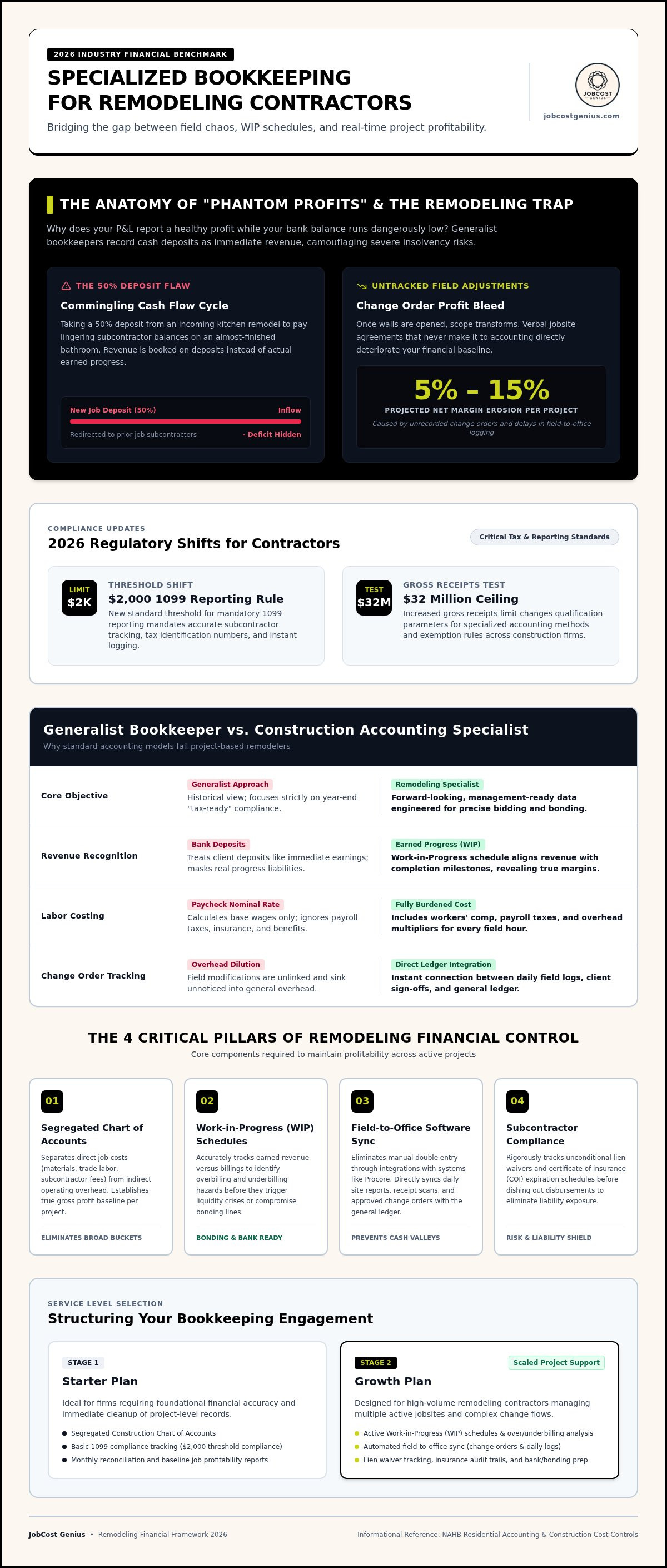
Remodeling isn't like retail or professional services. You don't just buy a widget and sell it at a markup. You manage a complex, shifting web of labor, materials, and subcontractors. Standard bookkeeping services for remodeling contractors must account for the "Remodeling Trap". This occurs when a generalist bookkeeper records revenue based on bank deposits rather than earned progress. Without specialized oversight, you might find yourself commingling funds, using the 50% deposit from a new kitchen project to cover the final subcontractor payments on a finished bathroom. This creates a dangerous cycle that hides insolvency until it's too late.
A generalist often misses the true labor burden. They see a paycheck but ignore the payroll taxes, workers' comp, and benefits that inflate every field hour's cost. While your books might look "tax-ready" at year-end, they lack the management-ready data needed to bid accurately. You need to know if you're making money on the project itself, not just if you have enough cash to satisfy the IRS. Generalists focus on the past; remodeling contractors need to see the future of their cash flow.
The Change Order Chaos
Remodeling is defined by the unknown. Once you open a wall, the scope changes. Untracked verbal agreements are the primary source of profit bleed in this industry. If your bookkeeper doesn't have a system to link field changes to the ledger immediately, those costs disappear into your overhead. In the 2026 remodeling market, unrecorded change orders can represent a 5% to 15% erosion of your projected net margin on every project. Effective bookkeeping services for remodeling contractors bridge the gap between field logs and financial reporting to ensure every extra hour is billed and tracked.
The Myth of the "One-Size-Fits-All" Accountant
Many accountants treat your material draws like simple retail inventory. However, construction accounting principles require a more nuanced approach to revenue recognition and job costing. When you apply for bonding or a line of credit, lenders look for accurate Work-in-Progress (WIP) schedules. A generalist's balance sheet often lacks these, making your firm look riskier than it is. Understanding the difference between a construction bookkeeper vs generalist is critical for your long-term stability. Accurate project data isn't just about compliance; it's the foundation of your bidding strategy and your ability to scale with confidence.
Essential Features of a Remodeling Bookkeeping Service
Relying on generic bookkeeping services for remodeling contractors often results in a Chart of Accounts that is too broad to be useful. For a project-based business, your financial skeleton must isolate direct job costs like materials, labor, and subcontractors from your indirect overhead. This structure is what makes real-time job costing possible. You need the ability to compare estimated costs against actual spend while the project is active, not months after the final punch list is signed. Following established NAHB residential financial management guidance ensures your profit center metrics remain accurate. It transforms your books from a historical record into a strategic tool for future bidding.
Software Integration: Field to Office Sync
Modern bookkeeping services for remodeling contractors must bridge the gap between the construction site and the accounting office. Manual data entry is a relic that invites human error and creates dangerous lags in reporting. High-performing firms utilize Procore financials integration to ensure that every field-approved change order and daily log syncs directly with the general ledger. In 2026, digital compliance standards require secure, cloud-based records that support instant auditing and receipt scanning. This connectivity allows for proactive cash flow forecasting. It helps you anticipate the "cash valleys" that often follow heavy material procurement phases before they become a crisis.
Accounts Payable and Subcontractor Management
Managing subcontractors requires more than just cutting checks. Your bookkeeping partner must track lien waivers and expiration dates for insurance certificates with meticulous care. Missing one expired policy can expose your business to massive liability. In 2026, the mandatory reporting threshold for Form 1099-NEC has increased to $2,000, requiring even tighter tracking of smaller trade partners. Specialized services also manage retention accounting. They ensure these held funds are tracked as liabilities and don't accidentally inflate your perceived profit margins. Efficient vendor invoice processing is equally critical. It maintains supplier relationships and ensures you're capturing early-payment discounts whenever possible. If your current system feels like a patchwork of spreadsheets, it's likely time to transition to a structured Growth Plan that can stabilize your financial infrastructure.
The Critical Role of WIP Reporting in Remodeling
Work-in-Progress (WIP) reporting is the "truth teller" of the construction world. While your bank balance might look high after a milestone deposit, a WIP report reveals how much of that cash is actually yours to keep. Professional bookkeeping services for remodeling contractors use work-in-progress schedule analysis to calculate exactly where a project stands at any given moment. This report compares the total contract value and estimated costs against the actual costs incurred to date. It allows you to recognize revenue based on the percentage of completion rather than just the invoices you've sent out. This level of detail is necessary to avoid the cash flow spikes and valleys that often plague remodeling firms.
Fixing the "Phantom Profit" Problem
A standard Profit and Loss (P&L) statement often misleads remodeling contractors. It shows income when you bill a client and expenses when you pay a vendor; however, this doesn't account for the work performed but not yet invoiced. You need WIP reporting to reconcile these timing differences. This process identifies overbillings (billings in excess of costs) and underbillings (costs in excess of billings). Overbilling can mask a failing project by providing temporary cash flow that obscures a project's actual lack of profitability. Without this insight, you might unknowingly spend "borrowed" money from one job to fund the losses of another.
Management-Ready Reporting
Transitioning from yearly tax compliance to monthly strategic oversight is the hallmark of a mature remodeling business. In 2026, the industry standard demands project-level financial transparency that goes beyond basic ledger entries. Specialized bookkeeping services for remodeling contractors provide the data necessary to adjust bids for future work based on historical WIP performance. If your WIP data shows consistent underestimation of labor on kitchen gut-renovations, you can correct your pricing before the next estimate goes out. JobCost Genius provides this visibility into every project dollar, ensuring you have the administrative calm to focus on production. This management-ready reporting transforms your financial statements into a strategic roadmap for growth rather than just a historical record for the IRS.
Evaluating ROI: Outsourcing vs. In-House Bookkeeping
Hiring an in-house employee often feels like the most direct way to maintain control over your finances. However, the true cost of an internal hire is significantly higher than the base salary. According to Bureau of Labor Statistics data, benefits and payroll taxes average 30.1% of total private compensation. For a specialized construction bookkeeper earning a base salary between $55,000 and $65,000, the fully burdened employer cost ranges from $72,500 to over $85,000 per year. This doesn't include the overhead of recruitment, training, or software licenses. Choosing specialized bookkeeping services for remodeling contractors allows you to bypass these fixed costs while gaining access to high-level expertise.
The "Generalist Discount" is another hidden danger. A cheaper, non-specialized bookkeeper might save you a few hundred dollars a month in service fees but cost you thousands in lost profit. Generalists often fail to identify margin fade or miss the timing on revenue recognition. This leads to "phantom profits" that vanish when the final bills arrive. High-quality outsourced bookkeeping scales with your project volume. You receive the support of a seasoned industry veteran without the management burden of a full-time staff member. This model mitigates the risk of audit failures and ensures your financial statements remain clean for bonding or bank credit.
Cost-Benefit Analysis for Remodelers
For many firms, the financial math is clear. Our Starter Plan provides foundational accuracy for $800 per month, which is a fraction of the $6,000 to $7,000 monthly cost of a burdened part-time employee. You're not just buying data entry; you're investing in 20+ years of industry experience. This expertise transforms your back office from a source of stress into a state of "Admin Calm." You gain the confidence that every project dollar is tracked, allowing you to focus on production and client relationships rather than chasing missing receipts or reconciling messy ledgers.
Payroll and Compliance Savings
Compliance requirements in 2026 have become increasingly complex for remodeling firms. The threshold for mandatory Form 1099-NEC reporting for subcontractors has increased to $2,000, requiring more diligent tracking of even your smallest trade partners. If you work across state lines, managing multi-state labor laws and prevailing wage payroll becomes a massive administrative headache. Specialized bookkeeping services eliminate the hidden cost of payroll errors and tax preparation support. We ensure your firm stays compliant with current IRS regulations, reducing the likelihood of costly penalties. If you're ready to trade administrative overwhelm for professional clarity, explore our specialized construction plans.
Choosing the Right Plan for Your Remodeling Firm
Selecting the right financial infrastructure depends on your current project volume and your 2026 growth targets. Specialized bookkeeping services for remodeling contractors shouldn't be a generic monthly fee; they should align with the specific complexity of your production. We've structured our offerings to provide a steady, logical progression for firms at every stage of their journey. Each tier is designed to transform administrative overwhelm into a state of organized calm.
- Starter Plan: This plan is ideal for new or smaller contractors who need to stop the profit bleed. It provides foundational accuracy and ensures your ledger is structured for construction-specific reporting.
- Growth Plan: Designed for expanding firms, this tier supports contractors scaling their project volume and team. It offers more robust management of subcontractor payments and deeper job costing insights.
- Premium Plan: This is our enterprise-level solution. It includes high-level tech support, deep financial oversight, and advanced reporting for firms managing multi-million dollar remodeling portfolios.
Transitioning from a generalist or a messy internal system to JobCost Genius is a methodical process. We don't just take over your data; we refine your entire financial engine. This ensures that your back office becomes an essential component of your growth rather than a bottleneck.
The Onboarding Process
Most contractors come to us with "messy books" that lack clear project-level data. Our first priority is cleaning up these historical records to establish a clean financial baseline. We then focus on technical alignment, mapping your Procore or Buildertrend data directly to your new ledger. This eliminates the data silos that lead to double-entry errors. Once your tech stack is synced, we set up a monthly reporting rhythm. This schedule ensures you receive the WIP reports and cash flow forecasts needed to stay on track for your 2026 goals.
Strategic Partnership for 2026 and Beyond
Financial clarity is more than just a convenience; it's a strategic asset. When you can present clean, professional financial statements, you gain a significant advantage in securing larger remodeling contracts and better terms for bonding. Specialized bookkeeping services for remodeling contractors prepare you for future scaling by providing a disciplined framework for every project dollar. You gain the professional confidence to bid on more complex work, knowing your margins are protected by expert oversight. It's time to move beyond reactive accounting and start leading with data. Schedule your consultation with JobCost Genius today to stabilize your firm's financial future.
Securing Your Firm's Financial Future in 2026
Remodeling is a high-stakes industry where precision in the back office is just as critical as craftsmanship in the field. You've discovered how generalist accounting often leads to "phantom profits" and why specialized WIP reporting is necessary to reveal your true project health. By integrating your field data from platforms like Procore or Buildertrend directly into your ledger, you eliminate the administrative gaps that erode your margins. This visibility allows you to bid with confidence and scale without the fear of hidden cash flow crises.
With over 20 years of construction industry experience, JobCost Genius provides the disciplined oversight required to thrive in a competitive market. Our specialized bookkeeping services for remodeling contractors include expert WIP reporting and seamless software integration to ensure every project dollar is tracked and protected. It's time to trade administrative overwhelm for the organized calm of professional financial management. Start your journey toward financial clarity with JobCost Genius and build a foundation that supports your long-term vision. You've worked hard to grow your firm; we're here to help you protect it.
Frequently Asked Questions
Do you provide income tax filing services for remodeling contractors?
JobCost Genius does not file income taxes. We provide comprehensive tax preparation support to ensure your CPA or tax professional has clean, accurate, and categorized data ready for filing. This approach minimizes your year-end accounting fees and reduces the risk of errors. For contractors based in the UK, professional accountancy services from Mazuma can handle these final filings and ensure compliance for limited companies and sole traders. Our focus remains on the monthly management and project-level reporting that helps you run a more profitable remodeling business throughout the entire year.
For business owners who require a broader scope of services, such as cloud-based accounting, tax, and corporate secretary support for their small or medium enterprise, you can learn more about Count On Me.
Specialized bookkeeping services for remodeling contractors bridge the gap between field agreements and the general ledger. We establish a workflow where every approved change order is recorded and tracked against the project budget immediately. This prevents profit bleed caused by forgotten verbal agreements or delayed billing. By maintaining a real-time link between production and accounting, you ensure that every extra hour and material cost is accounted for before the final invoice.
Can you integrate with software like Procore or Buildertrend?
JobCost Genius specializes in Procore Financials Integration and similar field-to-office syncs with platforms like Buildertrend. We eliminate the need for manual double-entry by ensuring your project management data flows directly into your accounting software. This connectivity provides real-time visibility into your project health and ensures your tech stack supports 2026 digital standards. Our experts handle the technical mapping so your team can focus on production without worrying about data silos.
What is the difference between your Starter and Growth plans?
The Starter Plan is designed for firms needing foundational financial accuracy and starts at $800 per month. It focuses on transaction categorization and basic monthly statements. The Growth Plan is tailored for expanding firms that require deeper oversight, such as more complex subcontractor management and detailed job costing. While the Starter Plan stabilizes your books, the Growth Plan provides the strategic data needed to scale your project volume and manage a larger team effectively.
How much do specialized bookkeeping services for contractors typically cost?
Our specialized bookkeeping services for remodeling contractors start at $800 per month for the Starter Plan. This flat-fee model provides predictable overhead compared to the fluctuating costs of hourly generalist bookkeepers. We focus on construction-specific reporting that helps you identify margin fade early. This price includes the specialized expertise that generalist firms often lack, ensuring you receive a high return on your investment while maintaining administrative calm in your back office.
Do I need to change my current accounting software to work with you?
You generally don't need to change your accounting software if it already supports project-based tracking. We typically work within your existing QuickBooks Online environment but optimize the setup for construction-specific needs. Our team implements a specialized Chart of Accounts and configures necessary integrations with your field software. If your current system is inadequate for 2026 compliance, we'll guide you through a structured transition. This ensures your financial foundation remains strong and scalable.
How do you handle payroll for remodeling crews and 1099 subs?
We manage the entire payroll lifecycle, including tax withholdings and labor compliance for your employees. For 1099 subcontractors, we track payments against the 2026 mandatory reporting threshold of $2,000. Our system ensures you collect necessary insurance certificates and lien waivers before payments are released. This meticulous approach protects your firm from payroll penalties and ensures you remain compliant with current IRS regulations across all your remodeling projects regardless of their location.
What is WIP reporting and why does my remodeling business need it?
Work-in-Progress (WIP) reporting is a specialized schedule that identifies your true earned revenue based on project completion percentages. It's the only way to accurately see if you're overbilling or underbilling on a job. For remodelers, this is critical because it prevents you from accidentally spending customer deposits on unrelated overhead. WIP reports provide the project-level financial transparency needed to satisfy bonding agents and manage your company's long-term cash flow with confidence.


