

What if your most profitable project is actually draining your cash reserves without you knowing it? For many owners, the gap between money in the bank and earned revenue is a source of constant anxiety. You deserve better than a generalist bookkeeper who struggles with over/underbillings or profit projections that change every time you look at them. Implementing specialized contractor financial reporting packages isn't just about organizing paperwork. It's about building a strategic dashboard that translates field data into real office intelligence.
We understand that the administrative weight of managing job costs can feel overwhelming, especially when you're trying to secure bonding or bank loans. You need financial clarity to make confident decisions. In this guide, you'll discover the essential reports every contractor needs to track job costs, manage cash flow, and ensure long-term profitability. We'll explore how WIP reporting and integrated systems provide the visibility you need to reduce stress and focus on growth. This structured approach transforms your financial statements from a source of confusion into a foundation for professional confidence.
Key Takeaways
- Understand why a standard P&L statement often hides cash flow crises and how specialized contractor financial reporting packages reveal the true health of your projects.
- Identify the four essential pillars of construction accounting to pinpoint exactly where your firm is making or losing money on every job.
- Discover why software integrations like Procore require expert management to produce the bank-ready data needed for bonding and major loans.
- Use our implementation checklist to establish a reporting rhythm that eliminates financial surprises and reduces daily administrative stress.
- Learn how tiered service options like the Starter Plan provide a scalable foundation for firms ready to move beyond basic, generalist bookkeeping.
Beyond the P&L: Why Standard Financial Statements Fail Contractors
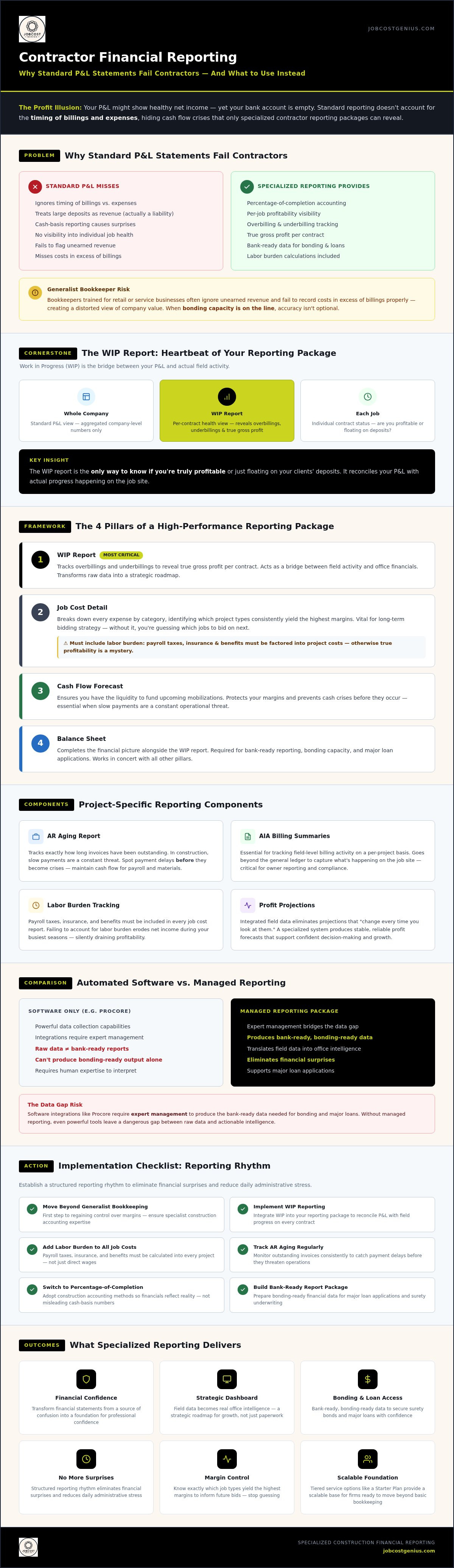
A standard Profit and Loss (P&L) statement tells a story, but for a contractor, it's often a work of fiction. Most businesses rely on generic financial statements to gauge health. However, specialized contractor financial reporting packages are different. These are a tailored set of documents designed to track the unique lifecycle of a construction project from the first mobilization to the final retention payment. Without this specific focus, you're managing your business with half the data.
The "Profit Illusion" is a common trap. Your P&L might show a healthy net income, yet your bank account is empty. This happens because standard reporting doesn't account for the timing of billings and expenses. You might've received a large deposit that looks like revenue but is actually a liability for work you haven't performed yet. Relying on simple cash-basis reporting leads to surprises. Using construction accounting methods like the percentage-of-completion method ensures your financials reflect reality. Establishing this level of financial oversight is a foundational strength that separates growing firms from those that plateau.
The Problem with Generalist Financial Reporting
Many firms hire generalist bookkeepers who handle retail or service businesses. These professionals often struggle with the nuances of job-costing. They might ignore unearned revenue or fail to record costs in excess of billings properly. This lack of precision creates a distorted view of your company's value. Our 2026 construction accounting guide for small firms highlights how moving toward specialized reporting is the first step in regaining control over your margins. Accuracy isn't optional when your bonding capacity is on the line.
The Critical Role of the WIP Report
The Work in Progress (WIP) report is the heartbeat of any high-performance reporting package. It acts as a bridge, reconciling your P&L with the actual progress happening on the job site. While the P&L looks at the whole company, the WIP looks at the health of each individual contract. It's the only way to know if you're truly profitable or just floating on your clients' deposits. The Work in Progress report serves as the mechanism that tracks overbillings and underbillings to reveal true gross profit. By integrating this into your contractor financial reporting packages, you transform raw data into a strategic roadmap for your firm's future.
The Anatomy of a High-Performance Contractor Financial Reporting Package
A high-performance reporting system is built on four critical pillars: the WIP Report, Job Cost Detail, Cash Flow Forecast, and the Balance Sheet. Together, these documents form the core of effective contractor financial reporting packages. Following financial management best practices for small businesses ensures that these reports aren't just collections of numbers but actionable tools for growth. Each pillar serves a distinct purpose in protecting your margins and ensuring you have the liquidity to fund upcoming mobilizations.
The Job Cost Detail report is particularly vital for long-term strategy. It breaks down every expense by category, allowing you to identify which project types consistently yield the highest margins. Without this granularity, you're guessing which jobs to bid on next. Additionally, every job cost report must include labor burden calculations. If you aren't accounting for payroll taxes, insurance, and benefits in your project costs, your true profitability is a mystery. Accurate labor burden tracking prevents the erosion of your net income during the busiest seasons.
Liquidity management relies heavily on the Accounts Receivable (AR) aging report. In construction, slow payments are a constant threat to operations. Tracking exactly how long invoices have been outstanding helps you maintain the cash flow needed to fund current payroll and materials. When your reporting is structured, you can spot payment delays before they become crises, allowing you to stay organized and financially confident.
Project-Specific Reporting Components
Effective reporting goes beyond the general ledger to track field-level activity. AIA Billing summaries are essential for tracking progress against total contract values, ensuring that your billing stays ahead of your costs. Similarly, change order logs protect your bottom line by documenting every scope adjustment and its impact on the contract price. For a deeper look at reconciling these elements, see our WIP reporting for construction guide. These components ensure that no revenue is left on the table at project closeout.
Executive-Level Dashboards and KPIs
Strategic growth requires tracking specific Key Performance Indicators (KPIs). You should monitor Gross Profit Margin per job, Days Sales Outstanding (DSO), and Working Capital. Utilizing comprehensive contractor financial reporting packages allows you to present organized financials to stakeholders, projecting a sense of "organized calm." This level of detail often helps contractors secure higher bonding limits and better terms on bank loans. If you're ready to upgrade your financial visibility, exploring a modern financial reporting solution is a logical next step for your firm.
Automated Software vs. Managed Reporting: Bridging the Data Gap
Many contractors believe buying a high-end ERP or subscribing to QuickBooks will automatically solve their financial visibility issues. It's a common misconception. Software is a tool, not a solution. Pure software solutions provide the necessary infrastructure, but managed contractor financial reporting packages provide the intelligence. Without expert oversight, even the most expensive software can become a repository for inaccurate data that leads to poor decision-making.
Procore and QuickBooks are industry standards for a reason. However, they cannot "fix" inaccurate data entry or poor cost coding from the field. If a project manager misallocates labor hours or a bookkeeper misses a change order, the software simply processes the error. Field-to-office synchronization requires more than just a digital connection; it requires a commitment to data integrity that software alone cannot enforce. You need a system that captures reality, not just transactions.
The Power of Tech Integration
Integrating your field operations with your accounting office is essential for modern job costing. Using Procore financials integration services eliminates the need for manual double entry, which is the primary source of reporting errors. This integration ensures that commitments, change orders, and invoices flow seamlessly between platforms without administrative friction. When your tech stack supports real-time job costing, you move from guessing to knowing. Trustworthy reports are only possible when they are built on a foundation of clean, synchronized data.
Why Human Expertise is the Missing Link
Even with a perfect tech stack, human expertise remains the missing link. A construction-specific expert doesn't just enter data; they review and "scrub" it to ensure it reflects the physical reality of the job site. This is where the "Genius" in JobCost Genius comes into play. We provide the disciplined oversight needed to catch overbillings or missed accruals before they impact your bonding capacity. Managed services allow you to transition from reactive data entry to a proactive financial strategy. You stop worrying about whether the numbers are right and start using them to drive project profitability.
Some smaller firms worry that specialized contractor financial reporting packages are too complex for their current size. In reality, the opposite is true. Smaller firms have less margin for error and fewer cash reserves to absorb surprises. Implementing a structured reporting system early prevents the administrative overwhelm that often stalls growth. It creates an organized calm that allows you to scale with confidence, knowing your foundation is secure.
How to Evaluate and Implement a Reporting Package for Your Firm
Implementing a new financial system is a significant transition that requires more than just a software installation. It's a strategic shift in how your firm captures and interprets data. When evaluating contractor financial reporting packages, you must look for a solution that aligns with your specific volume and project complexity. A system that works for a $1M specialty contractor will likely fail a $20M general contractor due to the increased need for multi-system integration and deeper labor burden analysis.
Start your evaluation by asking potential service providers these critical questions:
- Do you specialize exclusively in the construction industry?
- How do you handle the reconciliation of overbillings and underbillings?
- Can you integrate directly with our existing field management tools?
- What is the typical turnaround time for a monthly WIP package?
- Do you provide proactive analysis or just reactive data entry?
Reporting frequency is another vital consideration. While quarterly reporting might satisfy a tax preparer, it's insufficient for managing project profitability. Monthly reporting is the industry standard for maintaining bank-ready financials. However, high-volume firms often require weekly job cost updates to catch margin fade before it becomes irreversible. If your firm is ready to move beyond basic spreadsheets, you can view our specialized reporting plans to find the right fit for your current volume.
Choosing the Right Level of Support
Your reporting needs evolve as your firm scales. New contractors often start with a focus on basic compliance and simple job tracking to keep the doors open. As you enter the growth stage, the requirements shift toward payroll compliance and sophisticated cash flow forecasting. High-revenue firms reaching the $20M mark require premium financial oversight. This includes multi-system integration and a dedicated expert to ensure every dollar is accounted for across dozens of active job sites. For those ready to scale further, you can explore Fractional and Outsourced Finance Leadership.
The journey toward organized calm begins with standardizing your construction chart of accounts. This structure ensures that every expense is coded correctly from the start, preventing hours of cleanup later. Next, you must train your field team to provide accurate daily logs and time tracking. The quality of your office reports depends entirely on the data coming from the site. The final milestone is reviewing your first comprehensive WIP package with your financial partner. This initial review sets the baseline for your future profitability and establishes the disciplined rhythm your business needs to thrive.
Scaling with Confidence: JobCost Genius Custom Reporting Solutions
Managing a construction firm without specialized data is like navigating a job site in the dark. You might make progress, but the risks of a costly misstep are high. JobCost Genius bridges this gap by providing contractor financial reporting packages that are built specifically for the industry's unique demands. We bring over 20 years of industry experience to every engagement, ensuring your firm has the foundational strength needed to scale. Our goal is to transform your financial statements from a source of administrative overwhelm into a strategic dashboard for growth.
Financial clarity leads to better business decisions. When you understand your true project margins, you can bid more aggressively on profitable work and walk away from jobs that drain your resources. We focus exclusively on outsourced bookkeeping for construction firms, which means we understand the nuances of WIP schedules and labor burden better than any generalist. This specialized focus allows us to act as a reliable guide, positioning our team as an essential component of your company's infrastructure.
Tailored Plans for Every Contractor
Every firm has different needs based on their current stage of growth. We offer three structured plans designed to provide the exact level of support you require:
- Starter Plan: Perfect for firms seeking essential bookkeeping and financial visibility. It includes monthly record keeping and the delivery of accurate financial statements starting at $800 per month.
- Growth Plan: Designed for expanding teams that need enhanced payroll support and more aggressive AP/AR management to protect liquidity.
- Premium Plan: Our enterprise-level solution for firms requiring full-scale financial oversight and deep Procore financials integration across multiple complex projects.
Next Steps to Financial Clarity
The transition from administrative chaos to organized calm begins with a single decision. You don't have to settle for "good enough" reporting that leaves you guessing about your cash position at the end of the month. By implementing professional contractor financial reporting packages, you gain the confidence to present bank-ready financials to any stakeholder. It's time to stop reacting to cash flow surprises and start managing your firm with precision.
We invite you to explore our advanced construction cash flow management strategies to see how structured data protects your bottom line. If you are ready to secure your firm's financial future, schedule a consultation with our team today. We'll help you identify the right plan to ensure your projects remain profitable well into 2026 and beyond.
Build a Foundation for Sustainable Project Growth
Implementing professional contractor financial reporting packages is the most effective way to eliminate cash flow surprises and stop margin fade before it impacts your bottom line. You've seen how standard financial statements often mask the reality of project health. By prioritizing specialized WIP reporting and ensuring your tech stack produces clean data, you transform your office into a center of intelligence. This level of financial oversight allows you to secure higher bonding limits and bid on larger contracts with absolute confidence.
JobCost Genius is a founder-led partner with over 20 years of specialized construction experience. We offer expert WIP management and Procore integration through a flexible, no-contract monthly subscription model. Our team is dedicated to helping you move from administrative overwhelm to a state of organized calm. Ready for financial clarity? Explore our Reporting Packages starting at $800/mo. You have the skills to build great projects; we have the expertise to ensure they stay profitable. Take the first step toward a more secure financial future today.
Frequently Asked Questions
What is included in a standard contractor financial reporting package?
A standard package includes the four pillars of construction accounting: the WIP report, job cost detail, cash flow forecast, and a current balance sheet. We also include Profit and Loss statements and Accounts Receivable aging reports to ensure total liquidity management. These high-performance contractor financial reporting packages translate field data into office intelligence. Every report is designed to meet the specific compliance needs of the construction industry and provide visibility into your margins.
Why is a WIP report more important than a Profit and Loss statement?
A Profit and Loss statement only shows historical transactions, which can create a profit illusion if you've overbilled a client. The WIP report is the heartbeat of your financials because it reconciles billings with actual project progress. It identifies overbillings and underbillings to reveal your true gross profit on every job. Without a WIP, you might think you have a surplus when you actually have a future cash liability to fulfill.
How often should a contractor receive their financial reporting package?
Monthly reporting is the industry standard for maintaining bank-ready financial statements and ensuring bonding compliance. It provides a consistent rhythm for reviewing project performance and adjusting your strategy. However, contractors managing high-volume or fast-moving projects often benefit from weekly job cost updates. This frequency allows you to catch margin fade early. Regular delivery ensures you move from administrative overwhelm to a state of organized calm and financial clarity.
Can I get specialized reporting if I still use QuickBooks?
Yes, you can generate specialized reports while using QuickBooks, but the software alone cannot fix inaccurate data entry. Effective contractor financial reporting packages require an expert to review and scrub the data to ensure it reflects project reality. We work with your existing systems to layer in WIP reporting and job costing. This approach ensures your QuickBooks data produces trustworthy intelligence rather than just a list of categorized transactions.
How does a reporting package help me get a bank loan or bonding?
Banks and bonding companies require high-quality financials to assess your firm's risk and capacity. They specifically look for a Work in Progress schedule that accurately reflects earned revenue and liabilities. Providing a structured reporting package demonstrates that you have professional financial oversight and a disciplined management team. This transparency builds trust with lenders, often leading to higher bonding limits, better terms on commercial bank loans, and access to specialized options like commercial equipment leasing Troy MI for your business.
Labor burden represents the total cost of an employee beyond their hourly wage, including payroll taxes, workers' compensation, health insurance, and retirement benefits. If you only track gross wages, you're underestimating your project costs by a significant margin. Including labor burden in your job cost reports is essential for calculating true project profitability. This accuracy ensures your bids are high enough to cover all overhead and maintain healthy net margins throughout the year.
Do I need to hire a full-time CFO to get these reports?
You don't need a full-time CFO to access high-level financial intelligence. Outsourced bookkeeping services for construction firms provide specialized reporting at a fraction of the cost of a full-time executive hire. Our plans, such as the Starter Plan, provide the essential visibility and job tracking needed for growth. You get the benefit of professionals with over 20 years of industry experience without the overhead of an on-site administrative staff member.
What happens if my reporting shows significant underbillings?
Significant underbillings indicate that you've performed work and incurred costs but haven't yet billed the client for that progress. This situation creates a major cash flow risk because you're essentially financing the project out of your own pocket. When your reporting identifies this trend, it's a signal to review your billing cycle or project management efficiency. Addressing underbillings quickly helps you regain liquidity and ensures your projects remain financially sustainable over the long term.


