

Retention isn't a cost of doing business; it's an interest-free loan you're providing to your customers with no guaranteed return date. You probably feel the weight of that 5% or 10% sitting in a client's bank account for a year or more while you struggle with manual spreadsheets and missed reconciliation deadlines. It's an exhausting cycle that leaves your true profit margins in limbo and places an unnecessary burden on your office staff. You deserve financial clarity that matches the hard work your team puts in on-site every day.
This article explains how professional construction retention tracking services transform that "lost" cash into liquid capital through meticulous accounting and proactive management. We'll explore how specialized AP/AR workflows and Procore financials integration eliminate administrative errors and accelerate the release of your funds. You'll learn how to move beyond the "organized chaos" of field notes and legacy trackers to build a financial foundation that protects your 2026 profit margins. We'll also preview how accurate WIP reporting ensures your financial statements finally reflect your company's true value and operational success.
Key Takeaways
- Understand how "forgotten" retention acts as an interest-free loan to project owners and why active management is essential for protecting your 2026 cash flow.
- Master the technical distinction between Retainage Receivable and Retainage Payable to maintain accurate, GAAP-compliant balance sheets.
- Evaluate the risks of manual tracking versus professional construction retention tracking services that provide expert data integrity and proactive billing.
- Learn negotiation strategies like "Step-Down" retention to reduce withheld percentages as you reach project milestones.
- Discover how integrating your tracking with platforms like Procore or Sage 300 CRE creates a seamless link between project closeout and final payment.
Understanding the Impact of Construction Retention on Your Cash Flow
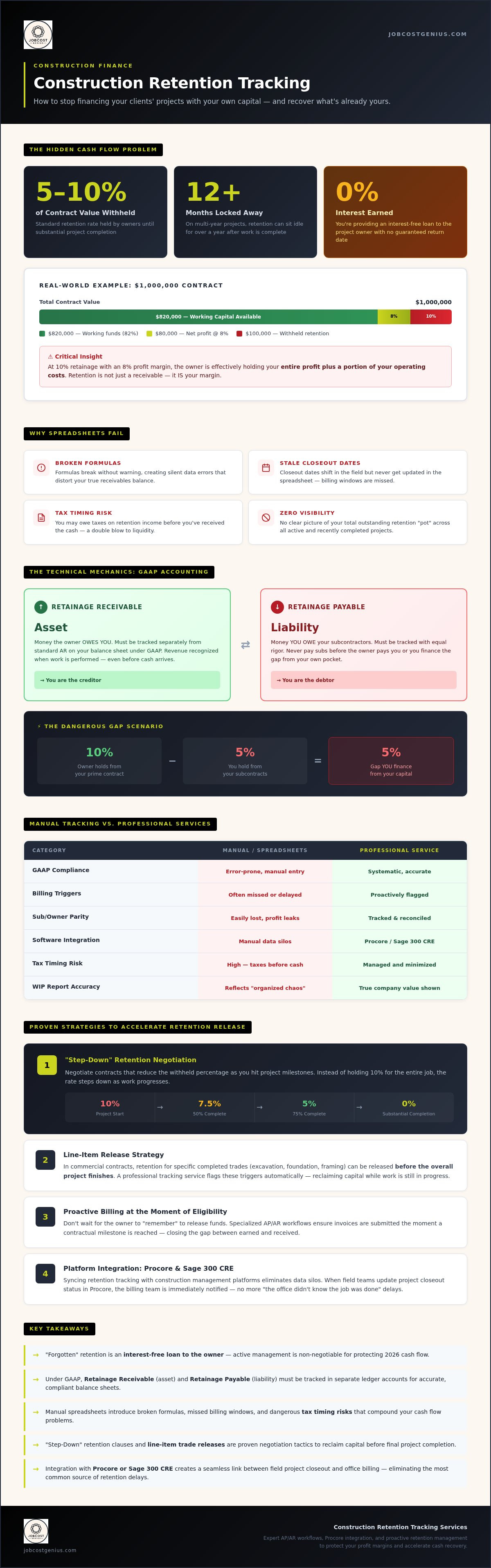
Construction retention is a standard practice where owners withhold 5% to 10% of the total contract value until the project reaches substantial completion. While owners view this as a security measure for performance, for the contractor, it represents earned income that remains out of reach. Essentially, "forgotten" retention acts as an interest-free loan you're providing to the project owner. On multi-year projects, this compounding effect can severely restrict your ability to reinvest in new equipment or hire additional crews. It's capital that belongs to your business but isn't available to fuel your growth.
General bookkeeping often fails to track retention aging with the precision required for construction. Generalists frequently treat these funds as standard receivables, failing to reconcile them with specific project closeout milestones. This creates a dangerous disconnect between your reported revenue and your actual bank balance. Without specialized construction retention tracking services, these funds often sit idle long after they should have been collected.
The Real Cost of 10% Retainage
Consider a $1 million contract. A 10% retainage means $100,000 is held back until the final punch list is signed off. If your net profit margin on that job is 8%, the owner is effectively holding your entire profit plus a portion of your operating costs. Retention is a deferred asset that requires active management. If you don't have a disciplined strategy to recover these funds, you're essentially financing the owner's project with your own working capital. This pressure can stifle your operations and leave you vulnerable during market fluctuations.
Why Spreadsheets Fail for Retention Management
Relying on manual spreadsheets for this complex task is a high-stakes gamble. Formulas break, closeout dates shift without being updated, and visibility into the total "pot" of outstanding retention becomes blurred. One of the most significant risks is the tax implication. Under certain accounting methods, you might end up paying taxes on retention income before you've actually received the cash. This creates a double blow to your liquidity. Professional construction retention tracking services provide the oversight needed to prevent these funds from falling through the cracks. By utilizing specialized accounting workflows and dedicated oversight, you ensure that every dollar is accounted for and billed the moment it becomes eligible for release.
The Technical Mechanics of Professional Retention Accounting
Recording retention requires much more than a simple note on an invoice. Under Generally Accepted Accounting Principles (GAAP), you must recognize revenue when the work is performed, even if a portion of the cash is withheld for a year or longer. This creates a Retainage Receivable asset on your balance sheet that must be tracked independently from standard accounts receivable. Managing these entries manually often leads to data silos where the field team knows a project is finished, but the office team hasn't billed for the released funds. Professional construction retention tracking services bridge this gap by ensuring your ledger accounts stay synchronized with actual project progress and contractual milestones.
One of the most effective ways to improve interim cash flow is through "line-item release" strategies. In many commercial contracts, retention for specific trades, such as excavation or foundation work, can be released once their specific scope is complete rather than waiting for the entire building to be finished. Without a dedicated system to flag these opportunities, contractors often leave this money sitting idle for months. High-quality construction retention tracking services identify these triggers early, allowing you to reclaim capital while the project is still in progress.
Retainage Receivable vs. Retainage Payable
A critical technical challenge is maintaining parity between what you are owed and what you owe your subcontractors. If your prime contract holds 10% retention but your subcontracts only hold 5%, you're effectively financing that 5% gap out of your own pocket. You must track Retainage Payable with the same rigor as your receivables to ensure you aren't overpaying subs before the owner has paid you. Using separate ledger accounts for these categories is essential for clear reconciliation. It prevents the accidental "leakage" of profit that occurs when retention is lumped into general accounts payable or receivable.
Retention and Project Profitability
Inaccurate tracking directly skews your construction job cost tracking services data. If retention isn't correctly integrated into your WIP reporting for construction companies, your overbilling and underbilling calculations will be fundamentally flawed. This can lead to a false sense of financial security or, conversely, unnecessary panic about cash shortages. Expert oversight helps you use retention aging reports to forecast quarterly cash availability with high precision. For contractors looking to stabilize their financial foundation, choosing a tailored bookkeeping plan ensures these technical details are handled with professional precision.
Comparing Retention Management Solutions: Services vs. Software
Choosing the right approach for your retention management often involves a trade-off between administrative control and operational efficiency. Many firms start with an in-house DIY approach, relying on internal staff to update legacy spreadsheets. While this keeps direct costs low, the risk of human error is exceptionally high. On the other hand, automated SaaS platforms offer a more modern alternative by providing alerts for project milestones. However, these tools still require your team to perform the data entry and verify the accuracy of the information. For many growing contractors, specialized construction retention tracking services represent the most balanced solution, combining expert strategic oversight with hands-on data management.
Your choice should depend on your current project volume and the complexity of your contracts. If you're managing multiple high-value projects with tiered subcontractor agreements, the administrative burden of manual tracking quickly becomes unsustainable. You need a system that doesn't just store data but actively works to reclaim your capital.
Why Software Alone Isn’t a Strategy
Software is a tool. It isn't a strategy. The "Garbage In, Garbage Out" principle applies heavily to construction tech stacks. Even the most expensive dashboard is useless if the underlying data is flawed or incomplete. You need a human expert to interpret the nuances of construction vendor invoice processing to ensure retention is recorded accurately from day one. Without this professional verification, errors in subcontractor billing can quickly compound, leading to disputes during project closeout. Effective management requires a seamless field-to-office sync, which is best achieved through Procore financials integration services. This ensures that when a Project Manager marks a milestone in the field, the office team is immediately ready to trigger the corresponding retention release.
The ROI of Outsourced Retention Tracking
The return on investment for professional construction retention tracking services becomes clear when you compare a monthly service fee to the cost of a single missed $50,000 retention claim. It's common for busy firms to lose track of small retention balances that, when totaled across ten or twenty projects, represent a massive hit to the bottom line. Outsourcing this task saves your Project Managers from the "hunt" for retention status, allowing them to focus on project delivery rather than administrative detective work. You also gain the peace of mind that comes with an audit-ready balance sheet. When your financial statements accurately reflect your liquid capital and deferred assets, your bonding capacity improves and your business remains on a firm foundation for future growth.
Proven Strategies to Accelerate Retention Release
Waiting for a project owner to voluntarily release retention is a recipe for cash flow stagnation. You need proactive strategies to move those funds from "pending" to "paid" as quickly as possible. One of the most effective methods is negotiating "Step-Down" retention. In this scenario, you agree that once the project reaches 50% completion, the withheld percentage reduces from 10% to 5%. This immediately injects capital back into your operations mid-project. It's a standard industry practice that savvy contractors use to maintain liquidity during the most intensive phases of construction.
Proactive punch list management also plays a vital role in your financial health. By resolving minor issues as they arise rather than waiting for the final walkthrough, you reach substantial completion faster. This triggers the official release clock earlier. You should also use lien waivers strategically. Providing a conditional waiver upon final payment serves as a professional lever, signaling to the owner that you're ready to close the books once the funds are transferred. Automated triggers for "Notice of Completion" filings ensure you don't miss statutory deadlines that protect your right to payment. Without these triggers, your construction retention tracking services might be monitoring a clock that hasn't even started ticking.
Administrative Discipline for Closeout
Efficient closeout requires more than just finishing the physical work. You need a standardized checklist that links physical milestones to financial triggers. Accurate AIA billing is essential here; it provides the transparency owners need to feel comfortable releasing funds. Many contractors find that the "chase" for final payment is the most draining part of the job. Professional construction retention tracking services handle this persistent follow-up, ensuring your team stays focused on the next project while the office secures the profit from the last one. This discipline prevents the common "closeout fatigue" that leaves thousands of dollars sitting in owner accounts for months on end.
Negotiation and Contractual Levers
Your subcontracts should mirror your prime contract to protect your liquidity. If you're a general contractor, ensure you aren't paying out retention to subs before the owner has released it to you, unless state-specific caps dictate otherwise. You can also negotiate early release for trades that finish long before the building is done, such as excavation or foundation crews. This reduces your Retainage Payable liability and keeps your project partners satisfied. To ensure your contracts and accounting are perfectly aligned, choose a specialized construction bookkeeping plan that prioritizes your profit margins.
How JobCost Genius Streamlines Retention Tracking for Contractors
JobCost Genius doesn't treat retention as an isolated line item. It's woven into our broader strategy for construction cash flow management. This ensures that every dollar held back by an owner is tracked from the moment the contract is signed until the final check clears. By providing construction retention tracking services that integrate directly with Procore, QuickBooks, and Sage 300 CRE, we give you real-time visibility into your deferred assets. You'll no longer have to wonder which projects have outstanding balances. Our team reconciles these accounts every month to ensure your balance sheet remains accurate and your financial statements reflect your true profit.
Customized reporting is a cornerstone of our approach. We understand that a growth-stage subcontractor has different needs than an enterprise-level general contractor. Our specialized formatting for construction-specific billing ensures that your retention data is always presented in a way that owners and lenders respect. We bridge the gap between field operations and office accounting, turning static data into actionable financial strength.
Our Proactive Retention Recovery Process
Our team identifies billable retention before you even have to ask. We monitor project milestones and substantial completion dates within your Procore financials integration to trigger billing the moment a release is eligible. This tight connection between AP/AR management and your bottom line is what sets us apart from generalist bookkeepers. In our experience, firms that implement meticulous tracking often reclaim significant percentages of their cash flow that had previously been stalled by administrative oversight. We handle the technical heavy lifting, from managing Retainage Receivable to ensuring your subcontractors are paid in parity with owner releases. This proactive approach eliminates the stress of the "final chase" for payment.
Ready to Reclaim Your Profit?
Whether you're looking for foundational support or enterprise-level tech integration, we have a structured solution for your business. Our Starter Plan provides essential bookkeeping for smaller operations, while our Growth and Premium plans offer the advanced technical support required for complex, high-volume projects. Every partnership begins with a comprehensive financial health checkup to identify exactly where your current systems might be leaking profit. Our construction retention tracking services are designed to scale with you, providing the stability and meticulousness your business deserves. Schedule your consultation with JobCost Genius today! and start transforming your withheld profit into liquid capital.
Securing Your 2026 Financial Foundation
Retention shouldn't be an administrative afterthought that drains your liquidity. By mastering the technical mechanics of retainage and implementing proactive release strategies like step-down negotiations, you transform deferred assets into active working capital. Professional construction retention tracking services provide the meticulous oversight needed to reconcile accounts and trigger billings the moment milestones are met. This disciplined approach ensures your balance sheet accurately reflects your project success and operational strength.
With over 20 years of industry experience, JobCost Genius specializes in the complex WIP and job costing reporting that keeps contractors profitable. Our seamless Procore financials integration bridges the gap between field progress and office accounting, giving you real-time clarity on every dollar owed. Stop losing profit to the "retention black hole"-let JobCost Genius manage your construction financials. You've done the hard work on-site; it's time to ensure your bank account reflects that effort. We're here to help you build a more stable, liquid, and prosperous future for your firm.
Frequently Asked Questions
What is the difference between retention and retainage in construction?
Retention and retainage are essentially synonymous in the United States construction industry. Both terms refer to the specific portion of a contract price that an owner or general contractor withholds until the work is finished. While "retainage" is the more technical term often found in legal contracts, "retention" is frequently used in daily accounting. Regardless of the word used, the goal is providing financial security for the project owner.
How long can a project owner legally hold retention funds?
Legal timeframes vary significantly by state and the type of contract involved. Generally, funds are released upon "substantial completion" or after the final sign-off of the punch list. Many states have prompt payment laws that mandate the release of these funds within 30 to 60 days after the project is officially accepted. You should review your specific contract and local regulations to determine the exact statutory limits.
Can I bill for retention before the entire project is 100% complete?
Yes, you can bill early if your contract includes "line-item release" or "step-down" retention clauses. For example, an excavation subcontractor might negotiate for their funds once their specific scope is finished. Alternatively, a general contractor might see a reduction from 10% to 5% once the project reaches the 50% completion milestone. These specific milestones must be clearly documented in the prime contract to be enforceable during the billing cycle.
How does retention tracking affect my WIP (Work in Progress) reports?
Retention must be integrated into your WIP reports to accurately reflect your overbilling and underbilling positions. If you don't account for withheld funds, your report might suggest you're underbilled when you've actually earned that revenue. Professional construction retention tracking services ensure these figures are reconciled monthly. This gives you a true view of your project profitability and the remaining contract value without the distortion caused by withheld cash.
What are the risks of not having a dedicated retention tracking service?
The primary risk is the permanent loss of capital through simple administrative oversight. Without a dedicated system, small retention balances often "fall through the cracks" during the chaotic project closeout phase. You also risk paying taxes on income you haven't received yet or failing to meet bonding requirements due to inaccurate financial statements. Utilizing construction retention tracking services prevents these errors and ensures every dollar is eventually reclaimed for your business.
Does JobCost Genius work with my existing construction management software?
We specialize in Procore Financials Integration and work seamlessly with Sage 300 CRE and QuickBooks. Our team ensures that data flows accurately between your field management tools and your accounting software. This eliminates the need for manual double entry and provides your office team with real-time visibility into retention balances. We use the platforms you already use every day to create a more organized and efficient back-office environment.
How much does professional retention tracking typically cost?
Pricing for our services depends on the complexity of your operations and the volume of projects you manage. We offer tiered options including the Starter, Growth, and Premium plans to fit different business sizes. Rather than a standalone fee, retention management is included as a core feature of our comprehensive AP/AR and bookkeeping services. This approach provides a high return on investment by reclaiming stalled capital and reducing your team's administrative burden.


