

Why does your bank account look full while your projects feel like they're losing money? If you've ever felt the cash flow whiplash between mobilization and closeout, you're not alone. Managing a growing firm requires more than just basic math; it requires a specialized approach to construction bookkeeping for non-accountants. You're likely tired of the endless paper trail of receipts and lien waivers that never seem to tell the full story of your profitability. With 2026 shifts like California's 5% retainage cap and reinstated 100% bonus depreciation, staying organized is no longer optional.
We understand that you need financial clarity, not just a list of transactions. This guide will help you master construction-specific financial concepts and move from administrative overwhelm to total project clarity. We'll show you how to leverage Work-in-Progress (WIP) reporting and job costing to ensure your office and field stay in sync. By the end, you'll have the data-driven confidence to make growth decisions that actually protect your bottom line and ensure every project contributes to your long-term success.
Key Takeaways
- Understand why tracking costs by specific project rather than general categories is the only way to avoid the "Invisible Profit" trap that drains your bank account.
- Master the basics of construction bookkeeping for non-accountants by turning complex concepts like Job Costing and WIP reporting into simple, actionable management tools.
- Identify the critical differences between general accounting and construction-specific financials to ensure your P&L statement accurately reflects project health.
- Establish a repeatable field-to-office workflow that uses daily logs and weekly reviews to keep your production and financial teams in total sync.
- Recognize when your manual spreadsheets have reached their "Ceiling of Complexity" and learn how to transition toward professional financial oversight for sustainable growth.
Why Construction Bookkeeping Isn’t Just "Regular" Accounting
Most business owners look at their bank balance to gauge the health of their company. In the trades, this habit is a recipe for disaster. Mastering construction bookkeeping for non-accountants starts with recognizing that your profit isn't found on a standard profit and loss statement. While a traditional business might track expenses by category, like rent or utilities, your success depends on tracking every single dollar to a specific job. If you don't know exactly what a project costs in real time, you're flying blind.
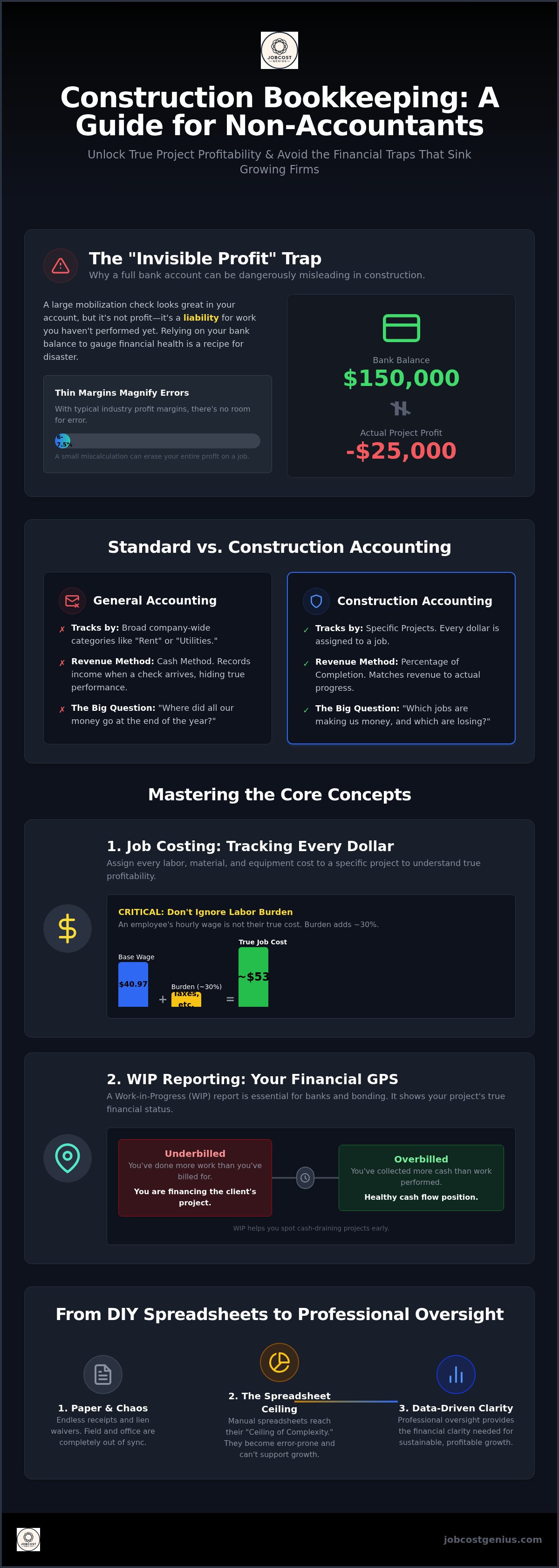
The "Invisible Profit" trap occurs when your bank account looks flush after a large mobilization check. That money isn't yours yet; it's a liability representing work you haven't performed. With net profit margins for most construction segments hovering between 6% and 7.5% in 2026, a small error in tracking can erase your entire gain. You are managing decentralized production where costs happen on the job site, far from the home office. This distance makes it easy for receipts and time cards to vanish, creating a gap between field reality and office records.
The Project-Based Nature of Construction
Every project you take on is effectively its own mini-business with unique risks and costs. In a retail environment, inventory is predictable and static. In construction, your "inventory" is a living project subject to weather delays, material price spikes, and labor shortages. To manage this complexity, you must use job costing. This is the practice of assigning labor, materials, and equipment costs to specific projects. Construction accounting differs from general accounting because it prioritizes these project-level details over broad company-wide totals. Without this granular view, you won't know if a specific job is actually profitable until it's too late to fix it.
Revenue Recognition: When is the Money Actually Yours?
Understanding when to claim income is the biggest hurdle for most contractors. Many firms use the "Cash Method" because it's simple. However, this method can make a failing company look wealthy on paper during a busy month of invoicing. Professional firms prefer the "Percentage of Completion" method. This approach matches your revenue to the actual progress of the work. Revenue recognition in construction is the process of recording income based on the progress of a project rather than when a check is received. Using this method prevents the common shock of reaching project closeout only to realize you've spent more than you earned. It provides the financial clarity needed to make growth decisions based on real data rather than a temporary bank balance.
Mastering the Core Concepts: Job Costing, WIP, and Retainage
Effective construction bookkeeping for non-accountants requires a shift from tracking what you spent to tracking why you spent it. Think of your financials as a system of buckets. Every dollar for labor, materials, or subcontractors must land in the correct project bucket to maintain an accurate view of your profit. When these costs are commingled, you lose the ability to see which jobs are winners and which are draining your resources.
Job Costing: Tracking Every Project Dollar
The biggest mistake contractors make is ignoring labor burden. As of April 2026, average hourly earnings reached $40.97, but the true cost to have that worker on site is often 30% higher when you factor in taxes, workers' comp, and benefits. If you don't account for this burden, your job costing is fundamentally flawed. You should also avoid the "General Supplies" trap. Categorizing everything as a generic expense hides waste and makes it impossible to see if material price spikes, like the 13% increase in steel seen this year, are eating your margins. For a deeper dive into managing these variables, see our WIP Reporting for Construction: The Definitive 2026 Guide.
WIP Reporting: Your Financial GPS
Your Work in Progress (WIP) report is your financial GPS. It identifies if you are overbilled, which means you've collected more cash than work performed, or underbilled, which means you are losing money today by financing the client's project. Banks and bonding companies demand this report because it proves you understand your project's true status. Spotting a project that is bleeding cash early allows you to adjust field operations before the final invoice. If you find your current reports are lagging, a specialized bookkeeping partner can provide the real-time data you need to stay on track.
The Reality of Retainage and Cash Flow
Retainage is a unique hurdle where a portion of your payment is withheld. In 2026, California capped retainage at 5% for private contracts, following a national trend toward lower limits. Even at 5%, this is often a significant portion of your net profit held hostage. You must track these funds separately on your balance sheet to ensure your cash flow projections stay realistic. Retainage is not just a discount but earned income held for quality assurance. Managing the gap between paying vendors today and receiving that final 5% in six months requires disciplined cash management.
Finally, beware of field favors. Change orders that aren't documented in the books destroy your accuracy. A "small favor" in the field without a corresponding budget adjustment makes a profitable job look like a loser on paper. Keeping the field and office in sync is the only way to protect your bottom line.
Standard vs. Construction Bookkeeping: Why Generalists Often Miss the Mark
Hiring a general bookkeeper who understands retail or professional services is a common mistake for growing contractors. While these professionals are skilled at balancing bank statements, they often treat construction like any other business. This leads to the "commingling" problem. Commingling happens when job-related expenses are mixed with general overhead, making it impossible to see your true gross margin. If your bookkeeper can't separate the fuel for your fleet from the fuel for a specific excavator on Job A, your data is already compromised.
The Problem with "Standard" Financial Statements
A standard Profit & Loss statement is often lying to you in the construction industry. It shows you paid for a massive lumber order this month, but it doesn't show that those materials are for a project that won't be billed for another thirty days. This creates a massive, artificial "loss" on paper. Without a specialized Construction Chart of Accounts (COA), your financial data is just noise. A proper COA organizes costs by project phase and type, ensuring your reports reflect reality. For a structured look at how to set this up, review our 2026 Construction Accounting Guide for Small Firms.
Generalists miss the Work in Progress (WIP) report entirely. They focus on reconciling bank statements rather than matching revenue to progress. This lack of specialized oversight is why construction bookkeeping for non-accountants often feels like guesswork instead of a strategic tool. Without WIP, you won't know if you're actually profitable until the job is finished and the money is gone.
Compliance Risks: Certified Payroll and Sales Tax
Regular payroll services are designed for offices, not job sites. They frequently fail when faced with certified payroll or prevailing wage requirements on government contracts. With labor costs in many markets up 15% to 20% in 2026, even small payroll errors can lead to massive compliance penalties. You need a system that tracks these nuances automatically to protect your licenses and your reputation. You can find more detail in our Prevailing Wage Payroll: 2026 Guide for Contractors.
Finally, generalists often stick to "Cash Basis" reporting because it's easier to manage. For a growing firm, this is a dangerous trap. It hides your liabilities and creates a false sense of security when your bank account is full of mobilization checks. Transitioning to accrual-based reporting is essential for anyone looking to scale their business with confidence and accuracy.
The Non-Accountant’s Workflow: Managing Financials from Field to Office
Managing your financials isn't a task that starts and ends at a desk. It's a continuous cycle that begins on the job site and flows through the office. Effective construction bookkeeping for non-accountants relies on a repeatable rhythm that keeps production and accounting in sync. Without a clear workflow, your office team is left guessing about field progress, which leads to billing errors and missed costs.
Your financial management should follow a four step cycle. First, daily logs must be submitted from the field. These logs are the field’s responsibility in the financial chain; they document who was on site and what materials were used. Second, perform a weekly review. This involves matching every vendor invoice to a purchase order before you approve a payment. Third, hold a monthly WIP meeting. This is where you and your bookkeeper review project progress versus actual costs to identify any red flags. Finally, leverage tech integration. Systems like Procore or Buildertrend automate the data flow, ensuring that information captured in the field reaches the books without manual entry errors.
Bridging the Field-Office Data Gap
Shoeboxes of receipts are the enemy of project profitability. When receipts stay in a truck for weeks, your books are perpetually behind, making it impossible to see real time costs. To fix this, you must get your foremen to care about coding their time and materials correctly. Explain that accurate coding protects the company’s ability to bid future work and secure bonuses. For firms using advanced project management tools, our Procore Financials Integration Services can bridge this gap by syncing field data directly with your accounting software.
Setting Up a "Paper Trail" That Works
A purchase order (PO) acts as a contract between you and your vendor. It ensures that the price you agreed upon is the price you actually pay, preventing vendor overbilling. Encourage your team to use mobile apps to capture job site expenses in real time. Before clicking "pay" on any invoice, use this simple checklist: Verify the quantities match the delivery ticket, confirm the price matches the PO, and ensure the cost is coded to the correct job. This disciplined approach eliminates the administrative overwhelm that often plagues growing firms. To streamline your data flow and eliminate office-field friction, consider a professional bookkeeping partnership that handles the heavy lifting for you.
Scaling Your Back Office: From DIY Spreadsheets to Professional Oversight
Every growing contractor eventually hits the "Ceiling of Complexity." This is the point where manual spreadsheets begin to break, and the time you spend wrestling with data exceeds the time you spend on the job site. When you rely on construction bookkeeping for non-accountants that you've managed yourself, you risk making major business decisions based on outdated information. Spreadsheets don't scale; they hide errors that can cost you thousands in missed billing or unrecovered expenses.
When to Stop Doing the Books Yourself
Recognizing the warning signs is the first step toward professional stability. If you're dealing with late invoices, mystery bank balances, or the stress of missed tax deadlines, your current system has reached its limit. The opportunity cost is massive. Every hour you spend stuck in QuickBooks is an hour you aren't building relationships, bidding new work, or managing your crews. Transitioning to a specialized service allows you to reclaim your time and focus on your core strengths. For a detailed look at making this shift, see our Outsourced Bookkeeping for Construction: 2026 Guide.
Many firms consider hiring a full-time office manager, but a generalist often lacks the technical depth required for the trades. A part-time specialist who understands the nuances of the industry is consistently more effective than a full-time generalist. You don't need someone to just enter data; you need a strategic partner who ensures your WIP and job costing are accurate.
The JobCost Genius Approach: Partnership, Not Just Entry
JobCost Genius transforms your raw data into a strategic "CEO Dashboard." Our monthly subscriptions, including our Starter, Growth, and Premium plans, provide the ongoing financial oversight you need to grow with confidence. We act as your "Construction Veteran," bringing over 20 years of industry experience to your back office. We focus on finding the 2-5% of profit that often disappears into the cracks of poorly managed project financials. Whether it's specialized WIP reporting or Procore Financials Integration, we provide the tools to move you from administrative overwhelm to total project clarity.
The transition from a "builder who does books" to a "construction CEO" requires professional financial infrastructure. By offloading the burden of construction bookkeeping for non-accountants to experts, you gain the data-driven confidence to make growth decisions that protect your bottom line. It's time to build a business that is as solid as the structures you create.
Building Your Financial Foundation for 2026
Building a profitable construction firm requires moving beyond simple bank balance management. True financial clarity comes from mastering job costing and WIP reporting to see the real story behind your numbers. By establishing a disciplined field-to-office workflow, you ensure that every material receipt and labor hour is captured accurately. These specialized practices are what separate a builder who does books from a strategic construction CEO.
Mastering construction bookkeeping for non-accountants doesn't mean you have to become a CPA yourself. It means implementing the right systems and choosing the right partners to protect your margins. Generalist bookkeepers often miss the nuances of retainage and prevailing wage, but a specialized guide ensures nothing falls through the cracks. With over 20 years of industry experience and national expertise in WIP and Procore integration, we help you transform administrative chaos into organized data.
Stop guessing your project profits—get the JobCost Genius Starter Plan today.
You've built the structures; now it's time to build the financial infrastructure that supports your next level of growth. We're here to help you navigate the complexities of 2026 and beyond with total confidence.
Frequently Asked Questions
What is the difference between job costing and general accounting?
General accounting tracks your company's total income and expenses, while job costing tracks every dollar to a specific project. Effective construction bookkeeping for non-accountants depends on this distinction. Generalists often focus on balancing the checkbook, but you need to know exactly where every material and labor dollar went. This project-first approach ensures that you aren't using profit from one job to cover the hidden losses of another.
Why do I need a WIP report if I already have a Profit and Loss statement?
A Profit and Loss statement tells you how the company did last month, but a WIP report tells you how your projects are doing right now. It identifies overbilling and underbilling, which are often invisible on a standard P&L. Without this report, a large deposit can make a failing company look healthy. It's the only way to see the true financial health of your ongoing work.
What is retainage and how do I track it in my books?
Retainage is a percentage of your payment held back by the owner to ensure the project is finished correctly. In 2026, many states have moved toward a 5% cap on these funds for private contracts. You should track this as a separate line item on your balance sheet. This prevents you from overestimating your available cash and ensures you have a clear record of earned income that is still pending.
Can I use regular QuickBooks for construction bookkeeping?
You can use QuickBooks, but it's often insufficient for complex project tracking without significant modifications. Most contractors need a specialized chart of accounts and integrations like Procore Financials Integration to capture field data accurately. While the software provides a foundation, it requires a construction-specific setup to produce meaningful WIP reports and job costing data that actually helps you manage your business with confidence.
How often should I review my construction financial statements?
You should review your financial statements at least once a month, but your job costs should be monitored weekly. A monthly cadence allows you to catch billing errors and labor overages before they spiral out of control. Consistent reviews transform your bookkeeping from a historical record into a strategic tool. This practice builds the financial confidence you need to bid larger projects and scale your operations safely.
What is labor burden and why does it matter for my job costs?
Labor burden is the total cost of an employee including taxes, benefits, and insurance. It's much higher than just the hourly rate. With average hourly earnings reaching $40.97 in April 2026, failing to track this burden accurately leads to underbidding. Proper construction bookkeeping for non-accountants must include these hidden costs to reflect the true expense of having a crew on a job site during every phase.
What are the risks of underbilling on a construction project?
Underbilling happens when you've done the work but haven't invoiced for it yet. This effectively means you're acting as a bank for your client. It drains your cash reserves and can lead to a crisis when you need to pay vendors or payroll. It also hides project losses, making it difficult to see if a job is actually failing until the very end of the project.
When should a construction company outsource its bookkeeping?
You should outsource when your DIY spreadsheets become unmanageable or when you can no longer tell if a specific job is profitable. If you're spending your evenings in QuickBooks instead of growing your business, you've reached the ceiling of complexity. A specialized partner provides the ongoing financial oversight you need to move from being a builder who does books to a construction CEO with total project clarity.


