

Why does a construction firm with a record-breaking backlog still struggle to meet payroll on a Friday afternoon? It's a common paradox in an industry where high revenue often masks deep-seated cash flow gaps and inaccurate project cost estimates. You've likely felt the administrative overwhelm of tracking dozens of moving parts across multiple jobsites while searching for the key financial kpis for construction companies that actually matter. You aren't alone in wanting your net profit to finally reflect the hard work your team puts in every day.
Monitoring these specific metrics is the only way to move from reactive firefighting to proactive management. By focusing on the data that drives project profitability, you can secure better bonding capacity through accurate reporting and finally achieve predictable cash flow cycles. This 2026 strategy guide provides the roadmap you need to build a more resilient financial foundation. We'll examine how to leverage specialized WIP reporting and Procore Financials integrations to gain clear visibility into job profitability, ensuring your business is built for sustainable growth rather than just temporary spikes in volume.
Key Takeaways
- Adopt a project-first mindset to move beyond period-based accounting and gain clear visibility into individual job profitability.
- Utilize Work in Progress (WIP) reporting as your financial GPS to track actual costs against budgets as they occur.
- Monitor the key financial kpis for construction companies that expose your true labor burden and help manage cash flow cycles.
- Integrate modern software stacks to bridge the field-to-office data gap, ensuring project managers and owners work from a single source of truth.
- Leverage specialized financial reporting to improve your bonding capacity and establish the foundational strength required for scaling.
Beyond the P&L: Why Construction KPIs Require a Project-First Mindset
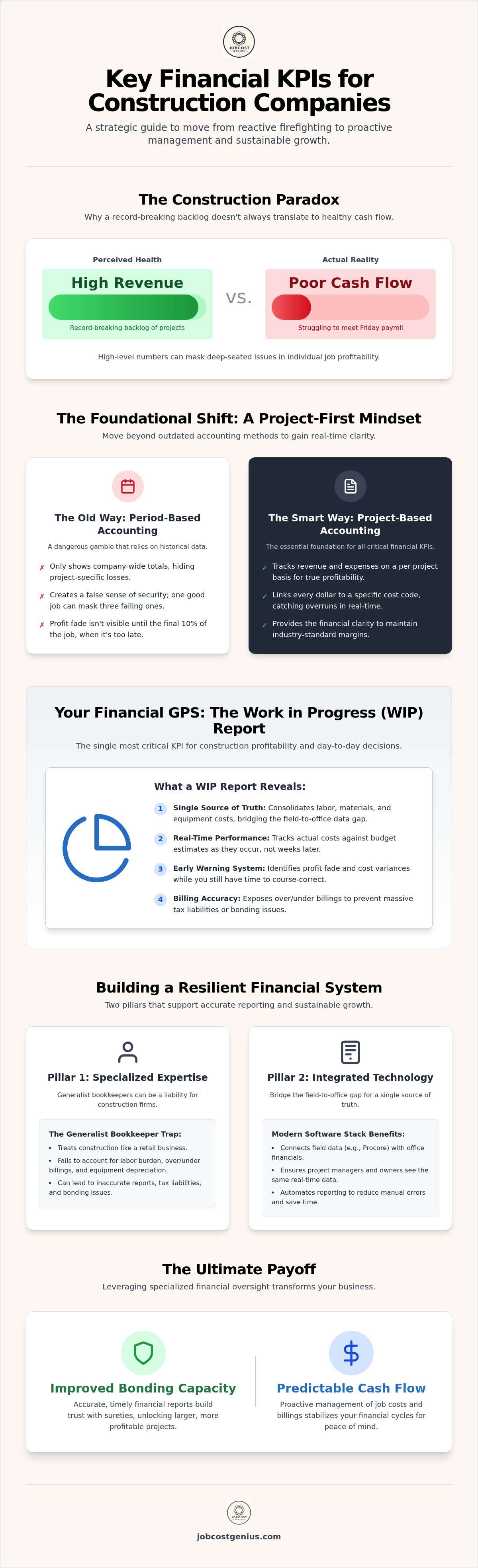
A standard Profit and Loss (P&L) statement tells you how the company performed last month, but it rarely tells you how your projects are performing right now. In construction, relying solely on period-based accounting is a dangerous gamble. Because projects often span several months or even years, a profitable month on paper might actually be the result of front-loaded billing on a job that's currently hemorrhaging cash. To maintain a healthy firm, you must shift your focus toward Key Performance Indicator (KPI) tracking that prioritizes the project lifecycle over the calendar month.
Inaccurate data structures are the primary driver of profit fade. This occurs when your project costs begin to outpace your estimates, but the issue isn't visible until the final 10% of the job. Identifying the key financial kpis for construction companies requires a system that links every dollar spent directly to a specific task or cost code. This granularity ensures that project overruns are caught in real-time. It provides the financial clarity needed to maintain industry-standard margins even as material costs fluctuate throughout 2026.
Project-Based vs. Period-Based Accounting
When you only look at company-wide monthly totals, you can't see the specific leaks in your production. One high-performing project might be subsidizing three failing ones, creating a false sense of security that vanishes when the next big contract ends. Job costing serves as the essential foundation for all financial KPIs. It allows you to see which specific activities are driving or draining your resources. Project-based accounting is a specialized financial method where all revenue and expenses are tracked and reported on a per-project basis to determine the exact profitability of individual contracts.
The Generalist Bookkeeper Trap
Many firms fall into the trap of hiring generalist bookkeepers who treat construction like a retail business. These professionals often fail to account for labor burden, equipment depreciation, or complex 2026 labor compliance standards for federal job reporting. Generalists often miss the nuances of over and under billings, which can lead to massive tax liabilities or bonding issues. They might record a large deposit as pure revenue, failing to recognize the associated future costs that will inevitably hit the bank account.
Your chart of accounts must be built specifically for builders to ensure every expense is categorized correctly for WIP reporting. If your current setup feels disorganized, consult our 2026 Construction Accounting Guide for Small Firms to learn how to restructure your data for better clarity. Implementing these key financial kpis for construction companies ensures your administrative team supports your growth rather than hindering it. Specialized oversight transforms your financial data from a historical record into a strategic tool for project success.
Master the WIP: The Most Critical KPI for Construction Profitability
Work in Progress (WIP) reporting acts as the financial GPS for your projects. It moves beyond static historical numbers to provide a dynamic, real-time view of performance. Unlike a standard P&L, a WIP report consolidates labor, materials, and equipment into a single source of truth. This allows you to identify profit fade while you still have time to course-correct. It is widely considered one of the essential construction finance KPIs because it bridges the gap between the field and the office. Among the key financial kpis for construction companies, none provide more immediate value for day-to-day decision making than a well-structured WIP report.
Integrating your field data into these reports ensures that project managers and owners see the same reality. When actual costs are tracked against estimated budgets in real-time, you can spot variances before they become disasters. This level of meticulousness transforms your financial data from a simple compliance requirement into a powerful strategic tool. If you find yourself struggling to pull this data manually, our specialized WIP reporting services can automate the process, providing you with the organized calm needed to scale.
The Anatomy of a WIP Report
A functional WIP report breaks down three primary components: the total contract price, the total estimated costs at completion, and the actual costs incurred to date. For 2026 standards, the percentage of completion method remains the gold standard for revenue recognition. This calculation ensures that the revenue you report on your financial statements aligns with the actual physical progress on-site. Consistently tracking these key financial kpis for construction companies allows you to see exactly how much profit you've earned versus how much you've simply billed. For a deeper dive into the mechanics, read our WIP Reporting for Construction: The Definitive 2026 Guide.
Identifying Overbilling and Underbilling
Understanding the difference between overbilling and underbilling is vital for maintaining a healthy balance sheet. Overbilling occurs when you've billed the owner for more work than you've actually performed. While this provides a temporary cash cushion, it's a liability, not extra profit. You're essentially borrowing money from the future of the project. Conversely, underbilling is a hidden danger that signals profit gaps. It means you're using your own capital to finance the owner's project, which can lead to severe cash flow shortages. Correcting your billing cycles to reflect true project health ensures your cash position remains stable throughout the project lifecycle.
Liquidity and Efficiency: Tracking Cash Flow and Labor Burden
A construction company can be profitable on paper while still facing insolvency due to poor liquidity. Managing the "gap" between when you pay your vendors and when you receive payment from customers is a constant challenge. This is especially true for complex commercial projects where AIA billing standards and retention clauses are the norm. Tracking these metrics is essential because they represent the key financial kpis for construction companies that determine whether you have the cash to fund your next mobilization.
Retention often acts as a silent profit killer. If you don't track it diligently, you might find that your final profit margin is entirely tied up in a check that won't arrive for months after substantial completion. Implementing a structured system to monitor these funds ensures that your hard-earned margins are actually captured and not lost in administrative delays. Organized tracking transforms your accounts receivable from a list of hopes into a predictable stream of capital.
Calculating Your True Labor Costs
Your hourly wage is only a fraction of what a worker actually costs your firm. To calculate true labor burden, you must include payroll taxes, workers' compensation insurance, health benefits, and union dues where applicable. Labor burden is the total cost a company incurs for an employee over and above their gross wages, including all mandatory and voluntary benefits and taxes. Failing to account for these costs leads to inaccurate project estimates and razor-thin margins that can't withstand 2026 labor market shifts.
When your burden calculation is off by even a few percentage points, every bid you submit is fundamentally flawed. This inaccuracy ripples through your entire financial structure, making it impossible to rely on your project-level reporting. Professionals with decades of experience know that precise labor tracking is what separates sustainable firms from those that struggle to survive their own growth. It's the difference between guessing your costs and knowing your worth.
Optimizing the Accounts Receivable Cycle
Setting standard billing schedules for every national project is a non-negotiable requirement for healthy cash flow. You cannot afford to be casual about invoicing when your material suppliers expect payment within thirty days. Effective change order management also plays a critical role here. If you perform work before a change order is signed and billed, you're essentially providing an interest-free loan to the owner. This practice quickly drains your reserves and creates unnecessary risk for the firm.
To build a more resilient operation, you need a strategy that prioritizes the speed and accuracy of your collections. For more detailed insights on this topic, explore our guide on Construction Cash Flow Management: Strategies for Sustainable Growth in 2026. By refining your AR cycle and monitoring the key financial kpis for construction companies, you transform your financial department into an engine for growth rather than a source of stress.
Modernizing Your Financial Workflows with Tech Integration
Modernizing workflows isn't just about speed; it's about accuracy. Manual data entry is the enemy of reliable reporting. When field supervisors use paper logs or disconnected apps, the office remains blind to daily cost variances. Bridging this gap is essential to capture key financial kpis for construction companies without the typical two-week lag. Real-time data sync empowers project managers to make informed decisions on-site. If a crew hits a rock ledge and equipment hours spike, that information should hit the budget immediately. This visibility prevents the "surprise" loss at the end of a job. It transforms your financial department from a historical record keeper into a proactive strategic partner.
Procore Financials and QuickBooks Integration
Many firms use Procore for project management and QuickBooks for accounting, but keeping them separate creates a massive administrative burden. Integrating these platforms allows field data to flow directly into your financial statements. This synchronization ensures that your WIP reports and key financial kpis for construction companies are always based on the most current field information. Our Procore Financials Integration Services specialize in creating this seamless link, eliminating double entry and reducing human error. Ready to eliminate the data gap? Explore our Procore Financials Integration to streamline your workflows.
Selecting the Right Tech for Your Growth Stage
Moving from spreadsheets to dedicated accounting software is a pivotal moment for any growing firm. While Excel is flexible, it lacks the audit trails and automated compliance features required for 2026 tax prep and payroll standards. Mid-market firms often evaluate specialized stacks like Buildertrend or Sage. These tools provide the robust infrastructure needed to handle complex labor burden and national reporting requirements.
Your tech stack should grow with you. A firm managing five projects has different needs than one managing fifty. Ensure your software supports 2026 labor compliance standards for federal job reporting, especially if you handle government contracts. The right technology doesn't just store data; it organizes it into the actionable insights required for sustainable growth. Accurate financial data becomes the foundation of your bonding capacity and banking relationships.
Scaling Your Business with Specialized Financial Oversight
Scaling a construction firm requires more than just winning larger contracts. It demands a fundamental shift in how you manage the back office. Many owners start by handling their own books, but this DIY approach eventually hits a ceiling. When you spend more time on spreadsheets than on the jobsite, your growth stalls. Transitioning to professional oversight ensures that your key financial kpis for construction companies remain accurate and actionable as you take on more complex work. It's the only way to move from administrative overwhelm to a state of organized calm.
Accurate financial reporting offers a high return on investment through improved bonding capacity and more favorable bank terms. Lenders and sureties don't just look at your revenue; they look at the quality of your data. If your WIP reports are inconsistent or your labor burden is guessed, you appear as a high-risk partner. Meticulous record-keeping builds the foundational strength needed to secure the capital required for large-scale national projects. It transforms your financial statements into a strategic asset that proves your firm's stability to external partners.
The Benefits of Outsourced Construction Bookkeeping
Outsourcing provides access to high-level industry expertise without the overhead of a full-time CFO. A specialist understands the nuances of 2026 labor compliance standards for federal job reporting. This ensures you stay compliant across multiple national jurisdictions without having to track changing regulations yourself. They act as an essential component of your infrastructure, providing the financial clarity needed to make high-stakes decisions. This partnership allows you to focus on project execution while experts handle the technical details of your reporting. For a complete breakdown of how this works, see our Outsourced Bookkeeping for Construction: 2026 Guide.
Building Your Financial Roadmap for 2026
As you prepare for the upcoming fiscal year, setting clear financial benchmarks is vital. You should establish targets for gross margin, current ratio, and days sales outstanding (DSO). Regular financial health checkups allow you to compare your performance against these benchmarks in real-time. This disciplined approach ensures that your key financial kpis for construction companies guide your strategic decisions rather than just documenting past mistakes. It provides the predictability you need to invest in new equipment or hire additional crews with confidence.
Predictable growth is the result of organized systems and expert guidance. By moving away from reactive bookkeeping, you position your firm as a leader in the industry. It's time to stop guessing and start growing with confidence. Ready to transform your financial workflows? Schedule a consultation with JobCost Genius today to build your roadmap for sustainable success.
Building Your Financial Foundation for 2026 and Beyond
Achieving sustainable growth in the construction industry requires more than just a full pipeline of work. It demands a shift toward project-first accounting and a commitment to tracking the key financial kpis for construction companies that reveal your true profitability. By mastering WIP reporting and integrating your field data with your office financials, you eliminate the guesswork that leads to profit fade. These systems provide the foundational strength needed to increase your bonding capacity and navigate the complexities of 2026 labor compliance with confidence.
You don't have to manage this transition alone. Specialized support transforms administrative overwhelm into organized clarity, allowing you to focus on what you do best: building. Get the financial clarity your construction business deserves with JobCost Genius. Our team brings over 20 years of industry experience, specialized WIP reporting expertise, and seamless Procore Financials integration support to your firm. Your path to a more profitable and predictable future starts with better data.
Frequently Asked Questions
How is construction accounting different from regular accounting?
Construction accounting prioritizes project lifecycles over standard monthly periods. Unlike retail or service businesses, contractors must track costs and revenue across long-term contracts using the percentage of completion method. This specialized approach ensures that your financial statements reflect the physical progress on-site. It requires a deep understanding of job costing and the key financial kpis for construction companies that drive long-term stability and accurate bonding reports.
What is a WIP report and why do I need one?
A WIP report is a financial management tool that tracks the progress of every active project. You need one to identify whether you are overbilled or underbilled relative to your actual costs. Without a WIP report, it's impossible to see profit fade before a job ends. It acts as an early warning system, allowing you to make course corrections while there is still time to protect your margins.
Can I use QuickBooks for construction company finances?
You can use QuickBooks, but it often requires specialized configuration to handle construction-specific needs. While it excels at basic bookkeeping, it needs a carefully structured chart of accounts to track job costs accurately. Many growing firms integrate QuickBooks with Procore Financials to bridge the gap between field operations and office accounting. This setup ensures your 2026 financial reporting remains compliant and provides the granular data required for scaling.
How do I calculate labor burden for my construction crew?
To calculate true labor burden, you must sum all costs associated with an employee beyond their base hourly wage. This includes payroll taxes, workers' compensation insurance, health benefits, and any retirement contributions or union dues. Once you have the total annual cost, divide it by the number of billable hours. Using an inaccurate burden rate is one of the most common ways contractors lose money on project estimates.
What is the best way to manage cash flow in a construction business?
Managing cash flow effectively requires a disciplined approach to billing and collections. Use AIA billing standards for commercial work and track your retention closely to ensure final payments don't get lost in administrative delays. You must also manage the time gap between paying material suppliers and receiving customer payments. Establishing a clear change order process prevents you from self-funding extra work that hasn't been officially approved or billed.
How often should I review my construction financial statements?
You should review your high-level financial statements at least once a month to track overall company health. However, project-level data like WIP reports and accounts receivable should be monitored weekly. Real-time review is even better if you use integrated software stacks that sync field costs immediately. Regular checkups allow you to spot key financial kpis for construction companies that are trending downward before they impact your total liquidity.
What are common financial mistakes construction companies make?
One of the most frequent mistakes is relying on a generalist bookkeeper who doesn't understand construction-specific revenue recognition. Many firms also treat overbillings as available cash rather than a future liability on the balance sheet. Other errors include failing to update labor burden rates for 2026 or neglecting to track change orders in real-time. These oversights lead to inaccurate project cost estimates and unexpected cash flow gaps that can stall your growth.


