

If your final profit margin at project closeout looks nothing like your initial estimate, you aren't just experiencing bad luck; you're likely a victim of "death by a thousand unbilled changes." It's a frustrating reality when field crews perform extra work to stay on schedule while the back office struggles to track the mounting costs. With material prices rising 6.4 percent year-over-year as of September 2026, even a small lapse in construction change order management can instantly turn a profitable job into a financial liability.
We understand the administrative friction that occurs when field operations and accounting aren't in sync. You shouldn't have to wait for a month-end WIP report to discover that unapproved work has eroded your fee. This article provides a roadmap to master the financial workflows of change order management, helping you eliminate profit fade and ensure every scope increase is documented, billed, and collected. We will examine how to build a standardized tracking system that offers real-time visibility into your project's health and accelerates your payment cycles for every extra hour worked.
Key Takeaways
- Understand the mechanics of profit fade and why undocumented field work is the primary driver of margin erosion in 2026.
- Master a standardized workflow for construction change order management by using sub-ledgers to isolate extra revenue from the original contract.
- Learn how to sync AIA G701 forms with your Schedule of Values to ensure every scope increase is accurately reflected in your pay applications.
- Establish strict field-to-office notification rules and signature policies to eliminate administrative friction and secure faster payments for extra work.
- Leverage Procore financials integration and expert WIP reporting to gain real-time visibility into how changes impact your project's final profitability.
Why Change Orders Are the Silent Killer of Construction Profit Margins
In its simplest form, a construction change order is a formal amendment to the original contract scope. While it sounds straightforward, poor construction change order management is often the primary reason a project's final profitability doesn't match its estimate. Many contractors view what a change order is as a mere paperwork hurdle. In reality, it's a critical financial control. When field teams perform work based on verbal "handshake" agreements without formal documentation, they trigger a phenomenon known as profit fade.
Profit fade occurs when project costs continue to climb while the contract value remains stagnant. In 2026, with material prices for steel and copper remaining elevated, there's no room for error. Every hour of unbilled labor or every pound of extra material used on an unapproved change directly subtracts from your bottom line. This disconnect creates massive administrative overwhelm; the field team thinks they're being helpful by keeping the job moving, while the back office is left blind to the actual financial health of the project.
The Financial Anatomy of Scope Creep
It's vital to distinguish between minor "extra work" and true contractual changes. A change order is a financial instrument that resets project benchmarks. Generalist bookkeepers often fail here because they don't account for the hidden labor burden associated with change orders. They might track the raw hourly rate but miss the insurance, taxes, and overhead costs that scale with every new task. Effective construction change order management requires identifying these costs immediately to prevent them from becoming "ghost expenses" that haunt your year-end financials.
Change Orders and Your Bonding Capacity
Your ability to secure new work depends heavily on how surety companies view your balance sheet. When you perform work before a change order is officially signed, you're essentially lending the owner money interest-free. This creates a state of underbilling; your costs are recognized on the ledger, but your revenue hasn't been approved. Sureties see this as a high-risk indicator. They worry about your cash flow and your ability to collect on these "soft" receivables.
To protect your bonding capacity, you must ensure your WIP reporting for construction accurately reflects these pending changes. If your WIP report shows massive cost overruns without corresponding revenue increases, your aggregate bonding limit may be slashed. Proactive tracking ensures that your financial statements tell a story of growth and control, rather than one of unmanaged risk and administrative chaos.
The Documentation Trail: AIA Forms and Schedule of Values
Effective construction change order management relies on a paper trail that is both audit-ready and legally defensible. In 2026, the Schedule of Values (SOV) acts as the foundation for this trail. It isn't just a breakdown of the initial contract; it's the baseline against which every deviation is measured. If your SOV isn't structured to accommodate growth, you'll face administrative friction during every billing cycle. Documentation is your only defense against claims that extra work was part of the original scope.
The industry standard for formalizing these shifts is the AIA G701 Change Order form, which serves as the official amendment to the contract sum and time. This document doesn't exist in a vacuum. It directly feeds the G702 Application and Certificate for Payment and the G703 Continuation Sheet. Without a signed G701, your pay applications will likely be rejected by the owner or architect, leading to stalled cash flow and increased project risk.
Integrating Changes into AIA G702/G703
When a change is approved, it must be integrated into the G703 Continuation Sheet as a distinct line item. Don't simply roll the extra costs into an existing category. This transparency is crucial for tracking retainage on change order work, which may have different release terms than the main contract. For those navigating these complexities, our 2026 Construction Accounting Guide for Small Firms offers a deeper look at managing tiered billing structures. Keeping these items separate ensures that your billing remains clear and your collections stay on schedule.
The Role of the Change Order Request (COR)
The transition from a field-requested Change Order Request (COR) to a signed Change Order is a critical accounting trigger point. A COR represents a potential financial shift, while a signed CO is a confirmed one. You should never enter "verbal approvals" into your accounting software. Doing so inflates your projected revenue with money you don't legally own yet. Standardizing your COR format is the best way to ensure all indirect costs, such as labor burden, insurance, and overhead, are captured before the work begins.
Maintaining a "Pending Change Order" log allows for preliminary financial oversight. This log identifies common documentation gaps, such as missing field reports or uncaptured labor burden, before they lead to denied claims at close-out. If you find the documentation trail overwhelming, professional bookkeeping support can help you maintain an audit-ready change order log that protects your margins.
Accounting Best Practices: Tracking Change Orders in Your Ledger and WIP Reports
Precise accounting entries are the only way to transform field changes into bankable revenue. To maintain this clarity, you must establish a "Change Order" sub-ledger. This accounting structure separates your original contract revenue from extras, preventing your baseline data from becoming skewed. Without this separation, your financial reports won't show which parts of the project are truly profitable versus which are merely growing in volume.
Scope changes often carry a heavier labor burden than the original estimate. When you add a new task mid-project, you aren't just paying for hours; you're paying for mobilization, specialized equipment allocation, and the disruption of existing workflows. Reconciling your Estimate at Completion (EAC) every time a scope change is signed ensures your projected margins remain grounded in reality. This level of detail is the cornerstone of professional construction change order management.
WIP Integration: Avoiding Over/Under Billing Messes
Managing WIP reporting for construction companies requires real-time adjustments to your "Total Estimated Costs." If you recognize costs for a change without updating the estimated revenue, your WIP report will trigger a false underbilling signal. This makes your company look like it's failing to bill for work performed when, in fact, the contract value simply hasn't caught up to the field reality. Adjusting your "Total Estimated Costs" to reflect the new scope immediately prevents these accounting distortions. Change orders must be reconciled monthly to protect cash flow.
Ledger Setup for Multi-Phase Projects
Multi-phase projects demand granular tracking through phase-specific cost codes. This allows you to identify exactly where scope creep is occurring. If you lump these costs into general categories, you lose the ability to analyze project performance or identify patterns in scope increases. Additionally, you must track vendor-specific change orders to prevent AP discrepancies. Generalist bookkeepers often "lump" these costs together, which destroys the integrity of your project data and makes it impossible to hold subcontractors accountable for their specific portions of the extra work. High-level construction change order management ensures that every vendor invoice is mapped to a specific, approved change, keeping your accounts payable clean and predictable.
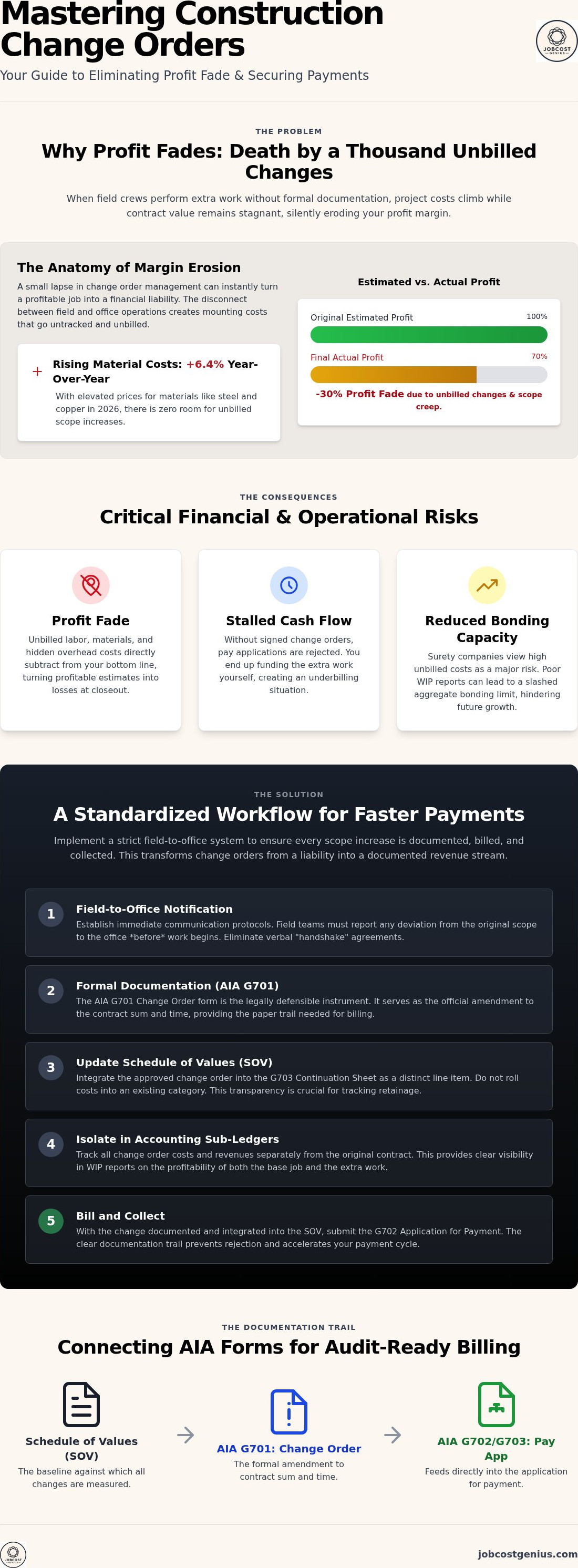
Streamlining the Approval Workflow: 5 Steps to Faster Payments
Speed is the primary factor in successful construction change order management. When field teams wait until the end of the week to report a scope change, the office is already three steps behind the billing cycle. You should implement a strict 24-hour rule for field-to-office change order notification. This ensures that the estimating and bookkeeping teams can begin documenting the cost impact before the work is even completed. Immediate notification is the only way to prevent administrative backlogs that delay your monthly pay applications.
A "No Signature, No Work" policy is essential for maintaining financial health. While it's tempting to keep the project moving to stay on schedule, performing work without a signed agreement is essentially an interest-free loan to the owner. You're assuming all the risk with no guarantee of payment. To move payments through faster, utilize conditional lien waivers specifically for the change order amount. This provides the owner with the security they need to release funds while ensuring your cash flow remains steady. Additionally, schedule monthly reconciliation meetings between project managers and the bookkeeping team to ensure the change order log matches the reality on the ground.
The 5-Step Financial Approval Workflow
- Step 1: Identify the scope change and estimate the total cost. You must include the full labor burden and any specialized equipment costs, not just raw wages.
- Step 2: Submit a formal Change Order Request (COR) with supporting documentation, such as field reports or site photos.
- Step 3: Update the "Pending" log in your accounting system to flag potential revenue and anticipated costs.
- Step 4: Secure the signed AIA G701 form and officially update your Schedule of Values.
- Step 5: Bill the change on your next formal pay application to ensure prompt collection.
Negotiating Change Order Terms
You can improve your margins by including administrative fees for change order processing directly in your prime contract. Processing these documents consumes significant office resources; you should be compensated for that time. It's also vital to set clear timelines for owner approval, such as a seven-day window, to prevent project stalls. These proactive measures are key components of effective Construction Cash Flow Management. If you find that your current approval process is causing payment delays, you can optimize your change order workflow with our specialized bookkeeping support.
Modernizing Change Order Management with JobCost Genius and Procore
Modernizing your approach to construction change order management requires more than just a digital subscription. It demands a seamless connection between the dust of the job site and the precision of your ledger. For many firms, administrative overwhelm stems from a lack of real-time visibility into how field decisions impact the bottom line. By leveraging Procore financials integration services, you can ensure that field data flows directly into your accounting environment without the delays of manual entry. This digital bridge transforms your change order log from a historical record into a proactive management tool that protects your margins as the project evolves.
JobCost Genius acts as the dedicated financial controller for this entire process. We don't just record transactions; we verify that every project remains audit-ready and bonding-compliant through meticulous record-keeping. In the high-stakes environment of 2026, where material costs remain volatile, this level of oversight is essential. When your books are organized and your change orders are reconciled daily, you move from a state of constant catch-up to one of absolute financial clarity. This discipline ensures that your bonding capacity is protected and your cash flow remains predictable even during complex scope shifts.
Field-to-Office Sync: Real-Time Data Flow
Integrating field daily logs with change order financial tracking eliminates the traditional friction between project managers and accounting staff. When a project manager records extra work or site delays in the field, that data must immediately inform the financial side of the project. This real-time flow ensures that labor burden and equipment costs are accurately captured on every scope increase. With the latest September 2026 updates to Procore's mobile data controls, capturing this information is more efficient than ever. You no longer have to wait for weekly meetings to understand how a field directive has changed your financial position.
The JobCost Genius Advantage
Choosing outsourced bookkeeping for construction firms provides deeper insights than a generalist bookkeeper can offer. We focus exclusively on the construction industry, meaning we understand the nuances of AIA billing and WIP reporting. Our commitment to protecting your profit goes beyond simple data entry; we provide proactive financial oversight that identifies margin erosion before it becomes a project-ending loss. We act as your strategic partner, ensuring your back office is as strong as your field operations. If you're ready for more accurate books and a professional approach to your project financials, see our pricing plans to find the right level of support for your firm.
Securing Your Financial Foundation for 2026
Mastering construction change order management is no longer just about paperwork; it's a vital strategy for survival in a volatile market. By moving from verbal field directives to a disciplined documentation trail, you eliminate the "ghost expenses" that erode your bottom line. Accurate WIP reporting and real-time ledger updates ensure that your bonding capacity remains strong and your cash flow stays predictable through project closeout. You've worked hard to build your reputation in the field. Don't let administrative friction compromise your operational success.
You don't have to manage these complex financial workflows alone. With over 20 years of industry-specific experience, our team provides specialized WIP and AIA billing support to keep your projects profitable. We offer national support for Procore and Sage 300 CRE users, ensuring your back office operates with the same precision as your field crews. Protect your project margins; explore JobCost Genius bookkeeping plans today. Achieving financial clarity is the first step toward sustainable growth in 2026. We are here to help you turn administrative overwhelm into an organized, profitable future.
Frequently Asked Questions
What is the most common reason change orders are denied in 2026?
The primary reason for denial is a lack of contemporaneous documentation and a failure to meet strict notice requirements. In 2026, owners and architects are increasingly scrutinizing field directives. If a contractor doesn't provide site photos, daily labor logs, or a formal Change Order Request within the contractually mandated window, the claim is often rejected. Maintaining a clean audit trail is the only way to ensure these costs remain recoverable.
How do I account for a change order that has been performed but not yet signed?
You must track these costs as "Pending" or "Unapproved" changes in a separate sub-ledger. Recognizing the expenses is mandatory for accurate bookkeeping, but you shouldn't recognize the revenue until a signed G701 is in hand. This practice prevents your financial statements from showing inflated profits that haven't been legally secured. This separation is a core component of professional construction change order management.
Should I include overhead and profit on every construction change order?
Yes, you should always include a percentage for overhead and profit to cover the indirect costs of managing scope changes. Every change order consumes administrative time, increases insurance exposure, and disrupts existing project workflows. Most prime contracts allow for a specific markup, often ranging from 10 to 15 percent. This ensures the contractor is compensated for the additional risk and management burden associated with the new work.
How does a change order affect my Work in Progress (WIP) report?
A change order increases both your total estimated costs and your total contract value. If you recognize the costs for extra work without updating the contract revenue on your WIP report, it creates a false underbilling signal. This makes your project look less profitable than it actually is. Real-time WIP reporting ensures that your margins remain accurate and your financial statements reflect the true scope of the project.
Can I bill for a change order before it is formally signed by the owner?
Generally, you cannot bill for a change order on a formal AIA pay application until the owner or architect has signed the G701. Billing for unapproved work often leads to the rejection of the entire pay application, which stalls your cash flow. However, you can use a Construction Change Directive if the contract allows. This mechanism permits work and billing to proceed while the final price is being negotiated.
What is the difference between a Change Order and a Construction Change Directive?
A Change Order is a mutual agreement on scope, price, and time; whereas a Construction Change Directive (CCD) is an order from the owner to perform work before a price is settled. CCDs prevent project delays when parties cannot agree on costs immediately. While a CCD allows you to proceed, it requires meticulous cost tracking to ensure you are eventually paid for the actual labor and materials used.
How often should the project manager and bookkeeper reconcile the change order log?
Project managers and bookkeepers should reconcile the change order log at least once a month. This meeting ensures that the "Pending" log in the accounting software matches the reality of the field operations. Regular reconciliation prevents administrative overwhelm at project closeout. It also ensures that all potential revenue is captured in your monthly financial statements and WIP reports, providing a clear picture of project health.
How do change orders impact my company's bonding capacity?
Change orders impact bonding capacity by altering your net worth and cash flow position on the balance sheet. If you have significant unapproved change orders where costs are recognized but revenue is unrecorded, sureties view this as a high-risk underbilling situation. Proactive construction change order management ensures that your books remain clean. This proves to sureties that you are effectively managing project risks and maintaining a stable financial foundation.


