

Why does your balance sheet show a healthy profit while your bank account struggles to cover next week's payroll? It's a frustrating reality for many contractors who find themselves fronting massive material costs and labor weeks before a single payment application is processed. You likely know the stress of tracking retention across multiple projects or facing a sudden cash crunch because your reports didn't reflect the actual state of the field. Maintaining a comprehensive construction financial health checklist is no longer just a back-office task; it's the engine that drives your firm's stability.
In this 2026 guide, you'll learn how to master the specialized financial metrics and reporting frameworks required to maintain liquidity and ensure your firm stays profitable while you scale. We'll move beyond basic bookkeeping to focus on predictive reporting and real-time visibility into project health. We will cover everything from accurate WIP reporting to specialized integration strategies, giving you the tools to create predictable cash flow cycles and faster payment turnarounds. By the end of this article, you'll have a clear roadmap to transform administrative overwhelm into organized financial clarity.
Key Takeaways
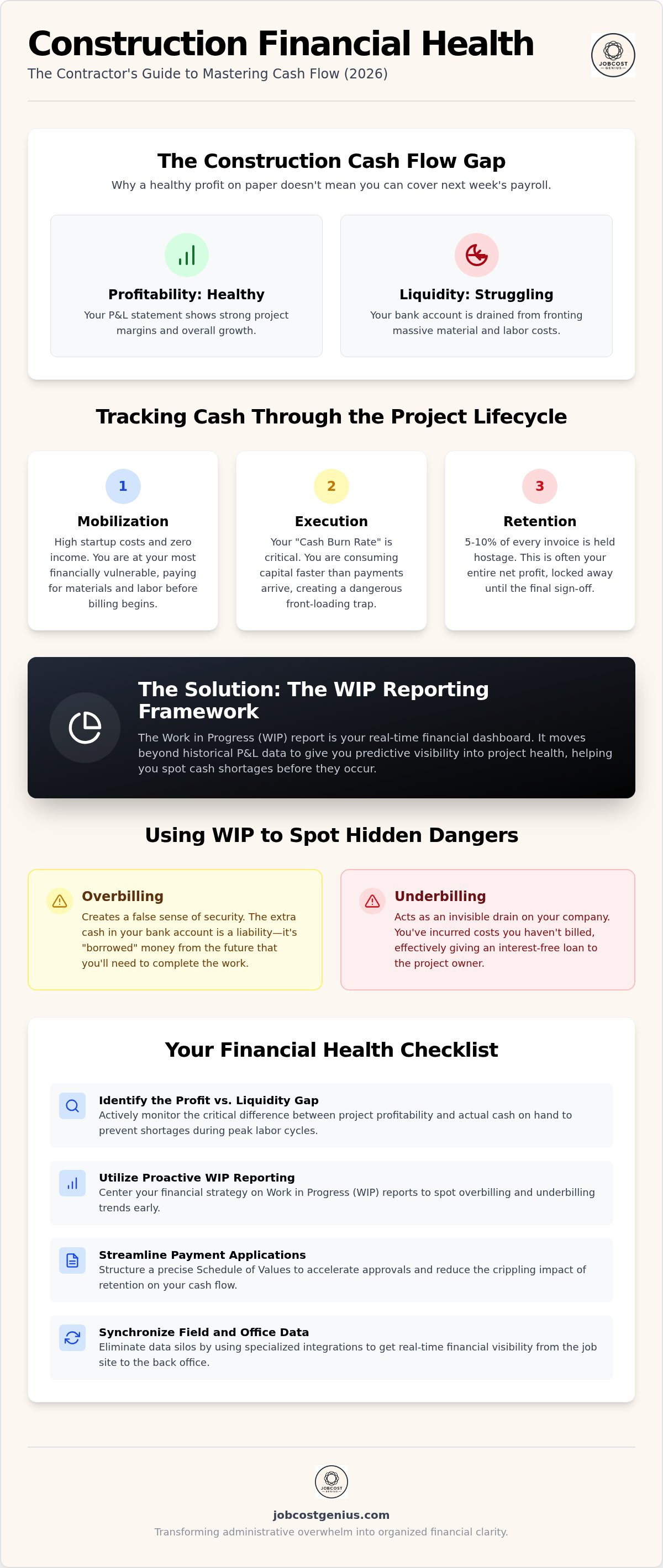
- Identify the critical gap between project profitability and actual liquidity to prevent cash shortages during peak labor cycles.
- Utilize a proactive construction financial health checklist centered on Work in Progress (WIP) reporting to spot overbilling and underbilling trends early.
- Streamline your payment applications by structuring a precise Schedule of Values that accelerates approvals and reduces the impact of retention.
- Eliminate data silos by synchronizing field data with office financials through specialized integrations like Procore Financials.
- Scale your infrastructure with specialized construction bookkeeping that manages the unique nuances of industry-specific reporting and compliance.
The Construction Cash Flow Gap: Why Profit Does Not Equal Liquidity
Profitability is an accounting concept, but liquidity is a survival metric. In the construction industry, the "Cash Flow Gap" represents the timeframe between paying for labor and materials and actually receiving payment from the owner. This delay creates a precarious environment where a firm can technically show a profit on paper while simultaneously running out of cash to meet its obligations. Without a structured construction financial health checklist, many contractors fail to realize that a booming P&L statement can actually be a leading indicator of bankruptcy if the underlying cash isn't managed with precision.
Successful Construction management requires tracking cash through three distinct phases: Mobilization, Execution, and Retention. During mobilization, you're at your most vulnerable, as startup costs are high and income is non-existent. As you move into execution, your "Cash Burn Rate" becomes the most important number to monitor. This is the rate at which you consume capital before reaching project milestones. For growing firms taking on larger projects, a high burn rate can quickly deplete reserves before the first significant payment application is even approved.
The Front-Loading Trap in Project Execution
Payroll doesn't wait for a 60-day billing cycle. While your vendors might offer 30-day terms, your field crew expects payment every week. This creates a front-loading trap where your cash outflows move significantly faster than your inflows. In 2026, increased labor burden and material price volatility have shortened the fuse on this trap. You can't afford to "rob Peter to pay Paul" by using cash from an ongoing Project B to fund the startup costs of Project A. This cycle masks systemic liquidity issues and creates a house of cards that collapses the moment a single project experiences a delay.
Retention: The Hidden Profit Leak
Retention is often the most misunderstood element of construction finance. When an owner holds 5% to 10% of every invoice, they're essentially holding your entire net profit margin hostage until the project is fully completed and signed off. For a firm operating on a 10% margin, a 10% retention rate means you haven't actually earned a cent of spendable profit until the final punch list is cleared. The cumulative impact of retention on a firm's total working capital is massive. It represents the final tier of project liquidity that, if not tracked as part of your construction financial health checklist, can lead to surprise shortages even when jobs seem to be going well.
The WIP Reporting Framework: Predicting Cash Shortages Before They Occur
While the P&L tells you what happened last month, the Work in Progress (WIP) report tells you what's happening right now. It is the most critical component of any construction financial health checklist. By using the Percentage of Completion (POC) method, you align your recognized revenue with actual job costs incurred to date. This prevents the distortion of financial results that occurs when billing cycles don't match the pace of production. Professionals at the Construction Financial Management Association emphasize that accurate WIP reporting is the foundation of construction risk management. Without it, you're essentially flying blind.
Fixing Overbilling and Underbilling
Overbilling often creates a dangerous false sense of security. When you bill ahead of your costs, your bank balance looks healthy, but that extra cash is actually a liability. It's "borrowed" money from the future that you'll need to complete the work. Conversely, underbilling acts as an invisible drain on your firm. It signals that you've incurred costs you haven't yet billed to the client, effectively acting as an interest-free loan to the project owner. If you want to master these nuances, our guide on WIP reporting for construction companies breaks down how to balance these figures for optimal liquidity.
Predictive Cash Flow Analysis via WIP
A well-maintained WIP report serves as a predictive dashboard rather than a historical record. It identifies:
- Projected cash needs for 30, 60, and 90-day windows.
- Early indicators of profit fade before they become irreversible.
- Discrepancies between field progress and office billing.
This level of WIP reporting for contractors provides a CEO-level view of every job's trajectory. Identifying profit fade early allows you to adjust project management tactics before the profit disappears entirely. Maintaining this real-time accuracy requires specialized bookkeeping that understands the specific triggers of construction finance. Integrating these reports into your regular construction financial health checklist ensures you stay ahead of potential shortages. To gain this level of visibility, consider implementing specialized WIP reporting tailored to your specific project volume.
Strategic Billing and Retention: Mastering Payment Applications for Faster Cash
Billing in construction is not a simple matter of sending an invoice. It is a technical submission process where a single error can delay payment by weeks. For firms aiming to maintain a robust construction financial health checklist, the choice between standard progress billing and AIA Document G702/G703 is critical. While standard billing may work for smaller residential jobs, AIA forms provide a standardized language that commercial owners and lenders trust. This standardization reduces the back-and-forth that often plagues the approval process.
A well-structured Schedule of Values (SOV) is the backbone of your payment application. It breaks the project down into manageable line items, allowing you to bill for work as it is completed. Mastering Construction Accounting and Financial Management requires understanding how to allocate costs within the SOV to cover mobilization and early-stage expenses legally. This ensures your cash position remains positive from the start of the job rather than playing catch-up in the final phases.
AIA Billing and Progress Payment Optimization
Invoice rejections are a primary cause of cash flow bottlenecks. Utilizing specialized construction accounting for small firms ensures that every payment application meets the strict documentation requirements of general contractors and owners. Beyond the SOV, you must manage conditional and unconditional lien waivers with precision. Providing a signed conditional waiver with your invoice signals to the owner that you are ready to release your lien rights once paid, which often accelerates the check-cutting process. This proactive approach is a cornerstone of a functional construction financial health checklist.
Retention Recovery Strategies
Retention is a significant asset that often sits forgotten on the balance sheet. In 2026, savvy contractors are negotiating "step-down" retention terms in their contracts. Instead of a flat 10% throughout the project, you might negotiate a reduction to 5% once the project reaches 50% completion. This releases vital working capital back into your business months earlier than usual. Effective AR management also requires tracking retention as a distinct line item so it doesn't get lost in your standard aging reports. Establishing a formal escalation policy for overdue accounts is essential. If a payment is 15 days late, a professional reminder should be triggered; at 30 days, a more formal demand is necessary to protect your lien rights and project liquidity.
Field-to-Office Synchronization: Leveraging Tech for Real-Time Financial Visibility
The disconnect between site operations and the back office is a primary hurdle for scaling firms. Project managers often track budgets in isolated spreadsheets that don't communicate with the primary accounting software. This creates a "Data Silo" where the office reviews historical data while the field deals with real-time costs. To maintain an effective construction financial health checklist, you must bridge this gap with integrated technology. Without synchronization, your financial reports remain reactive rather than proactive, leaving you vulnerable to surprise cash shortages.
Procore and QuickBooks: The Power of a Synced Tech Stack
Eliminating manual double entry is the first step toward operational clarity. By utilizing Procore financials integration services, you ensure that commitments, change orders, and job costs flow directly into your accounting system. This real-time field data drastically improves the accuracy of your WIP reports. When the office sees what the field spends the moment it happens, the financial lag is often reduced by up to 15 days. This increased visibility allows you to make critical adjustments before a project's liquidity is compromised. It transforms your bookkeeping from a compliance burden into a strategic asset.
Automated AP Workflows for Better Vendor Relations
Accounts Payable (AP) management is a frequent bottleneck in the construction cycle. Field expenses often get lost in trucks or buried in email inboxes, leading to late fees and strained vendor relationships. Modern software solutions now allow your team to capture and categorize field expenses instantly via mobile devices. This automation ensures that your ledger reflects your actual liabilities at all times. You can't manage what you can't see, and automated workflows provide that necessary oversight.
Managing vendor terms is equally vital for maintaining a healthy cash position. You should aim to align vendor payment cycles with your own client payment cycles. If you're on a 45-day cycle with an owner, paying a vendor in 15 days creates a cash vacuum that can stall project momentum. Leveraging technology to track material lead times also helps you predict exactly when large cash outlays will occur. This level of foresight is what separates a stable, growing firm from one that is constantly chasing its own tail. To eliminate the manual data entry that slows down your growth, our team can help you implement a Procore Financials Integration that connects your field and office seamlessly.
Scaling Your Financial Infrastructure: The Case for Specialized Construction Bookkeeping
Scaling a construction business requires more than just winning bigger bids. It demands a financial foundation capable of handling the technical complexity of multiple project lifecycles simultaneously. Many contractors reach a ceiling where their back-office setup can't keep up with the technical demands of 2026 reporting standards. Finalizing your construction financial health checklist means moving beyond simple data entry toward strategic oversight that protects your margins as you grow. Without this infrastructure, scaling often leads to increased risk rather than increased reward. To further protect your business from the unexpected risks of growth, you may learn more about SI Insurance.
Generalist bookkeepers often treat construction like any other service industry. This approach leads to critical errors in WIP reporting and payroll compliance. A generalist might fail to account for labor burden nuances, such as the specific insurance and tax allocations required for accurate job costing. They often overlook prevailing wage requirements that can trigger costly audits. Our comparison between specialist and generalist bookkeepers details why industry-specific knowledge is non-negotiable for firms managing complex commercial contracts. Specialists ensure that your financial reports reflect the reality of the field, not just the movement of cash.
Taking the Next Step Toward Financial Stability
Transitioning from administrative overwhelm to organized calm is the most significant leap a contractor can make. It requires shifting the burden of financial tracking to experts who understand the "profit-but-no-cash" trap. The cost-benefit analysis of outsourced bookkeeping for construction firms shows that specialized support often pays for itself by preventing overbilling liabilities and identifying profit fade before it becomes terminal. Monthly recurring oversight ensures that your project profitability remains a constant focus rather than a year-end surprise.
Specialized oversight provides the audit readiness and peace of mind necessary to focus on field execution. JobCost Genius offers tiered support to match your firm's current size and future goals. Whether you need the foundational support of a Starter Plan, the expanded capacity of a Growth Plan, or the comprehensive visibility of a Premium Plan, our services ensure your construction financial health checklist remains current and accurate. Moving to a specialized model allows you to scale with confidence, knowing your infrastructure is as solid as your builds. Discover how JobCost Genius transforms your back office-View our Plans.
Building a Foundation for Sustainable Growth
Scaling your firm in 2026 requires a shift from reactive accounting to predictive financial management. By closing the gap between project profitability and actual liquidity, you ensure your business remains resilient through every mobilization and execution phase. Mastering your WIP reports and optimizing your payment applications are not just administrative tasks; they are strategic moves that protect your hard-earned margins. Implementing a robust construction financial health checklist allows you to identify profit fade early and maintain the organized calm necessary for long-term stability.
You don't have to manage these complexities alone. JobCost Genius provides the specialized expertise you need to navigate the technical nuances of the industry. From expert WIP reporting for real-time project oversight to certified Procore Financials Integration support and specialized construction payroll and compliance management, we ensure your back office is a consistent driver of growth. Stop guessing your project health and start scaling with JobCost Genius specialized bookkeeping. With the right financial infrastructure in place, you can focus on what you do best: building the future with confidence.
Frequently Asked Questions
What is the most common cause of cash flow problems for construction companies?
The most common cause is the construction cash flow gap, which represents the delay between paying for labor and materials and receiving project payments. Contractors often front these costs for 30 to 60 days before an owner approves a payment application. This mismatch forces firms to rely on cash reserves or lines of credit to sustain operations. Without proactive management, even profitable firms face sudden liquidity crises during high-growth periods.
How does a WIP report help improve my company’s financial health?
A WIP report identifies overbilling and underbilling by comparing actual costs to project progress. It serves as a predictive dashboard that shows if you are borrowing from future work or funding an owner's project with your own capital. Integrating this report into your construction financial health checklist ensures that your recognized revenue matches the actual work completed. This clarity prevents year-end profit fade and those sudden, unexpected cash shortages.
Should I use overbilling as a strategy to fund my construction projects?
Overbilling should be managed carefully rather than used as a primary funding strategy. While it provides immediate cash, those funds represent a liability for work you haven't yet performed. Spending overbilled cash on other projects can lead to a cash vacuum later in the project lifecycle. It is better to focus on accurate billing cycles and maintaining a healthy working capital reserve to fund mobilization costs safely without risking your long-term project liquidity.
What is the difference between profit and cash flow in construction accounting?
Profit is a theoretical accounting figure showing revenue minus expenses on your P&L statement. Cash flow is the actual movement of money into and out of your bank account. In construction, you can be profitable on paper while having zero liquidity because your cash is tied up in retention or unpaid invoices. Understanding this distinction is vital for long-term survival. Cash, not profit, is what pays your weekly payroll, keeps your vendors satisfied, and covers tax liabilities. To better manage your business's cash requirements and filing dates, visit Coombs Chartered Accountants.
Recovering retention faster starts with negotiating favorable terms during the contract phase. You can request step-down retention, where the percentage drops from 10% to 5% once you reach half completion. Additionally, ensuring your final punch list and closeout documentation are submitted immediately prevents administrative delays. Tracking these amounts as a distinct asset on your balance sheet ensures they don't get lost in your standard accounts receivable reports, keeping your working capital accessible.
Is Procore integration worth the investment for a small construction firm?
Procore integration is often worth the investment because it eliminates manual data entry and reduces financial lag. By syncing field data with your accounting software, you gain real-time visibility into project costs. JobCost Genius offers a specialized Procore Financials Integration that bridges the gap between project managers and the back office. This setup allows even small firms to scale their operations without hiring additional administrative staff. It turns your field data into actionable financial intelligence.
How often should a construction company perform a cash flow analysis?
You should perform a cash flow analysis at least once a month, though weekly reviews are recommended during peak execution phases. Regular analysis helps you anticipate upcoming material outlays and payroll requirements before they become urgent. Including a cash flow review in your construction financial health checklist allows you to adjust your billing strategy or negotiate vendor terms proactively. This consistency builds a predictable financial rhythm that supports sustainable growth and prevents administrative overwhelm.
Can a specialized construction bookkeeper really help me scale my business?
Specialized bookkeepers understand industry-specific nuances like labor burden, prevailing wage, and WIP reporting that generalists often overlook. They provide the technical oversight needed to maintain compliance and protect your profit margins as you take on larger contracts. JobCost Genius offers tiered plans, including Starter, Growth, and Premium options, to help firms scale their financial infrastructure. This specialized support transforms administrative chaos into organized calm, ensuring you are always ready for an audit or expansion.


