

What if the software that anchored your firm for a decade is now the primary obstacle to your growth? With Trimble mandating cloud migrations and disabling classic logins, many contractors find themselves at a crossroads. You've likely noticed that searching for Viewpoint Vista alternatives has become less about simple software shopping and more about reclaiming operational control. It's exhausting to manage high maintenance fees and specialized IT infrastructure while struggling to find staff proficient in legacy systems.
We recognize that your accounting system should be a foundation, not a bottleneck. You need a setup that provides real-time project profitability and clean WIP reports without the administrative overwhelm of an outdated ERP. This article identifies the top construction accounting platforms and managed service models available in 2026 to help you modernize your project financials. We'll preview 15 alternatives that automate field-to-office data sync and provide a scalable infrastructure that doesn't require a full-time IT department to maintain.
Key Takeaways
- Understand why mandatory cloud migrations and rising infrastructure costs make evaluating Viewpoint Vista alternatives a strategic priority for growing contractors in 2026.
- Categorize potential platforms by project complexity to ensure your new financial system matches your firm's specific operational scale and reporting needs.
- Explore the managed service model as a way to achieve financial clarity without the burden of hiring specialized ERP staff or a full-time IT administrator.
- Identify non-negotiable features like automated WIP reporting and real-time field data sync that bridge the communication gap between the job site and the back office.
- Implement a structured migration strategy that prioritizes a comprehensive data audit to prevent legacy errors from polluting your new, scalable financial stack.
Evaluating Viewpoint Vista: Why Contractors Seek Modern Alternatives in 2026
Viewpoint Vista is a legacy construction accounting ERP that excels in compliance but often lags in modern user experience and field connectivity. It remains a powerhouse for heavy civil and large-scale contractors who require deep audit trails. However, the software often feels like a black box for non-accountants. Project managers and owners frequently struggle to pull simple reports without assistance from a specialized power user. This lack of transparency is a primary reason firms now investigate Viewpoint Vista alternatives to regain visibility into their financials.
The shift toward cloud-native, user-friendly interfaces is driving many firms to seek more agile solutions. In 2026, the industry has reached a tipping point. Trimble's mandate for cloud migration and the disabling of classic logins have forced many contractors to re-evaluate their tech stack. High seat costs and annual maintenance fees for on-premise infrastructure are no longer sustainable for growing businesses. Many teams find they're paying for enterprise-level power they don't use while missing out on modern mobile field tools.
The Complexity vs. Capability Trade-off
Powerful software leads to dirty data when field staff find the interface too difficult to navigate. If a site supervisor can't easily enter daily logs or equipment hours, the office receives delayed or inaccurate information. This friction compromises the integrity of your construction accounting and leads to reactive decision-making. There's also a significant hidden cost in training new office staff. Finding personnel proficient in specialized legacy ERPs is increasingly difficult. Modern technology has finally bridged the gap between ease of use and deep reporting. It's now possible to have both a friendly UI and robust financial controls.
Modern Integration Needs: Beyond Core Accounting
The demand for a seamless sync between project management tools and the general ledger has never been higher. All-in-one legacy systems are losing ground to best-of-breed integrated stacks. Contractors now prefer connecting specialized field tools to a streamlined accounting core. This field-first data entry approach ensures the office sees project health in real time. When data flows automatically from the site to the books, it eliminates the manual entry errors that plague older systems. Transitioning to Viewpoint Vista alternatives often allows firms to maintain a scalable infrastructure without the need for a full-time IT administrator to manage complex server environments.
Top Construction Accounting Software Tiers for 2026
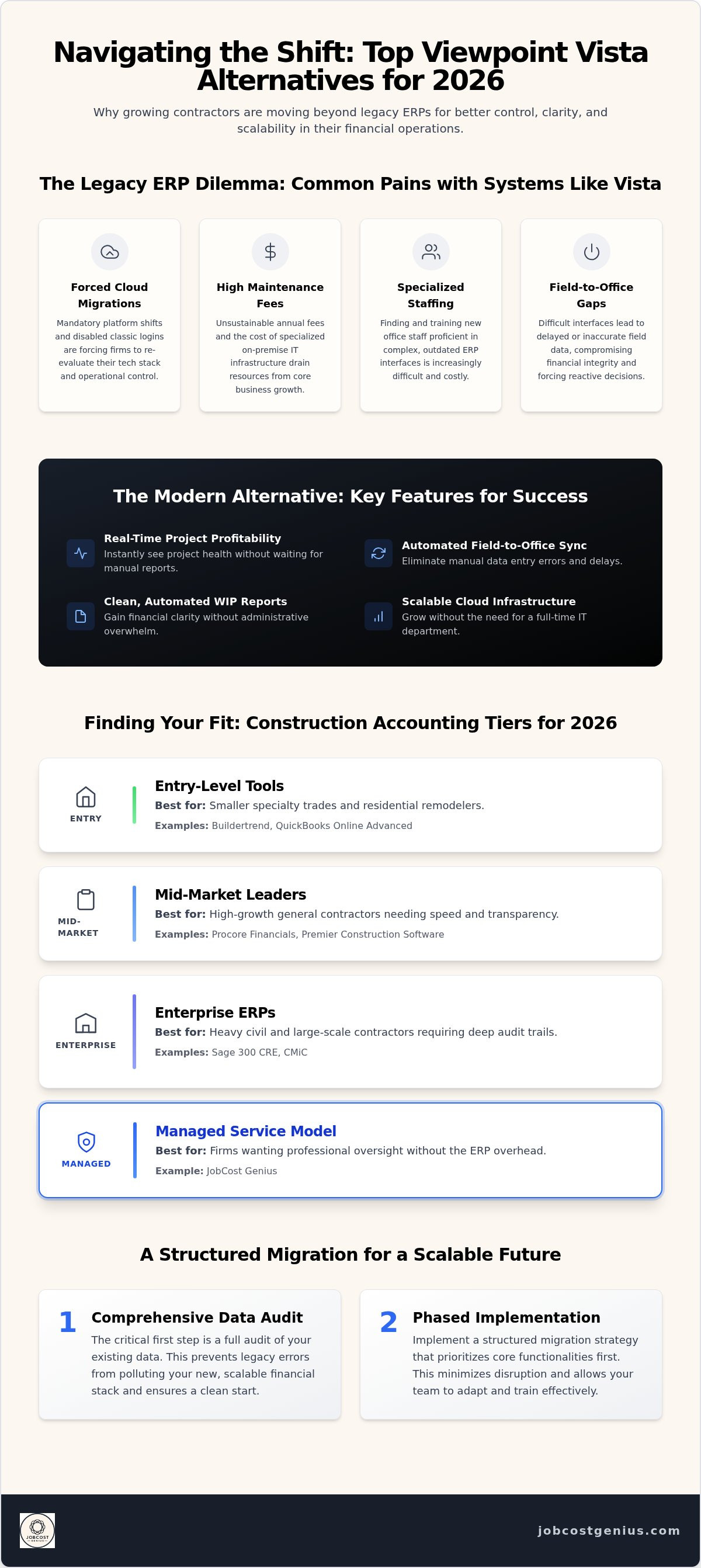
Selecting Viewpoint Vista alternatives isn't a one-size-fits-all process. You must categorize options by firm size and project complexity to ensure a successful migration. The construction accounting software market offers diverse solutions ranging from lean, cloud-native apps to massive enterprise resource planning (ERP) systems. By 2026, the distinction between these tiers has become clearer as software providers specialize in specific niches to meet the demand for better field connectivity.
For firms handling massive, multi-state projects, Enterprise ERPs like Sage 300 CRE and CMiC remain the primary choice. These platforms offer the depth required for complex compliance and high-volume data. High-growth general contractors often find Mid-Market Leaders like Procore and Premier Construction Software more aligned with their need for speed and transparency. Smaller specialty trades or residential remodelers usually find success with Entry-Level tools like Buildertrend or QuickBooks Online Advanced. Finally, firms that want professional oversight without the overhead of a large ERP often turn to managed service providers like JobCost Genius to handle their back-office infrastructure.
The Best-of-Breed Approach: Procore and QuickBooks
Pairing a field-focused tool like Procore with a standard ledger like QuickBooks Online creates a flexible, modern system. This stack allows your field team to use a high-quality interface they actually like, while the office maintains a clean general ledger. Many firms find this combination more scalable and cost-effective than a single, monolithic ERP. To keep your numbers accurate, using Procore financials integration services is essential. It prevents data silos and ensures that every field-entered dollar reflects correctly in your financial statements. This approach reduces the need for a full-time IT admin and allows you to add specific modules as your project volume grows.
Heavyweight Alternatives: Sage and CMiC
When considering heavyweight Viewpoint Vista alternatives, Sage and CMiC are the top contenders for enterprise stability. Sometimes your firm genuinely needs the deep audit trails and complex payroll capabilities of a legacy powerhouse. This is when your firm actually needs the power of Sage 300 CRE bookkeeping. These systems handle union payroll, multi-state compliance, and intricate intercompany transfers with ease. CMiC, for instance, provides a single-database architecture that ensures data consistency across all modules. However, these systems require professional management to prevent system bloat. Without a disciplined expert to oversee the setup, these powerful tools can become just as messy as the system you're trying to replace.
If you're unsure which tier fits your current growth trajectory, our team can help you evaluate your construction tech stack to find the right balance between power and usability.
The Managed Service Alternative: Why Better Software Isn’t Always the Answer
Contractors often mistake software problems for process or people problems. If your data is messy in your current ERP, migrating to a new platform will likely result in a faster way to generate the same inaccurate reports. Many firms searching for Viewpoint Vista alternatives assume that a modern interface will automatically fix deep-seated job costing errors. However, the software is only a tool. The real value lies in the expertise of the people managing the data. This realization has led to the rise of the "Third Option": keeping a functional tool but outsourcing the oversight to specialized professionals.
Current market trends in construction accounting show a clear move toward specialized support services that complement software. By choosing outsourced bookkeeping for construction firms, you remove the need for expensive, recurring software training. You stop worrying about which logo is at the top of your screen and start focusing on the results. A perfect WIP report is more valuable than a shiny new dashboard that contains faulty math. This shift allows owners to reclaim their time and focus on project execution.
Reducing the Labor Burden of Construction Accounting
Finding a proficient construction controller is difficult and expensive. The annual salary for a seasoned professional often exceeds the cost of a specialized bookkeeping subscription. JobCost Genius transforms administrative overwhelm into organized calm by providing a team of experts for a fraction of that cost. This model also eliminates the risk of key person dependency. If your only Vista expert leaves the firm, your operations shouldn't stop. Our tiered plans provide a scalable infrastructure that grows with you.
Expert Oversight for WIP and Job Costing
Software alone cannot fix overbilling issues. These are logic problems that require an industry veteran to identify. When it comes to WIP reporting for construction companies, having a human in the loop is essential to catch errors. We ensure compliance with certified payroll and AIA billing without requiring you to click 50 buttons yourself. This professional oversight provides the financial clarity needed for data-driven decisions on the job site.
Ultimately, the best Viewpoint Vista alternatives aren't always different software packages. They're better ways to manage the software you already have. By focusing on the quality of your financial output rather than the features of your input tool, you build a foundation for long-term stability. This approach ensures your project financials are accurate, compliant, and ready for your next big contract.
Critical Features Your Viewpoint Vista Alternative Must Support
Any software replacing a legacy ERP must go beyond basic debits and credits. It has to speak the language of the job site. When evaluating Viewpoint Vista alternatives, the most critical requirement is the ability to handle the unique math that generic accounting platforms miss. You can't rely on a system that treats a multi-million dollar project like a simple retail transaction. Your new platform needs to understand the complexities of long-term contracts and heavy equipment management.
Automated WIP reporting is the heartbeat of a profitable construction firm. A modern system must track percent-complete and earned revenue in real-time. This prevents the profit fade that occurs when project managers realize too late that expenses have outpaced billings. Additionally, managing prevailing wage payroll processing for contractors is a massive hurdle in generic software. Your alternative must calculate true labor burden, including taxes, benefits, and insurance, to give you an accurate picture of your job costs. Finally, AIA G702/G703 invoicing should be a standard feature. Generating these documents manually in spreadsheets is a recipe for billing delays and administrative errors.
Job Costing and Retention Tracking
Tracking retention, or holdback, is essential for protecting your final profit margins. Many Viewpoint Vista alternatives fall short here by failing to separate these funds from standard accounts receivable. You need a system that automates the release of retention process once project milestones are met. This level of detail ensures every project dollar is categorized correctly for construction cash flow management. Without it, your cash position looks stronger on paper than it is in reality. This often leads to overextending your resources on new bids before you've actually collected the cash from previous jobs.
Field-to-Office Data Flow
Mobile time-tracking is non-negotiable for accurate job costing in 2026. You shouldn't have office staff chasing paper timecards or deciphering messy handwriting. By letting field data flow directly into the accounting system, you reduce double-entry and minimize the risk of human error. Daily logs also play a vital role in protecting your firm during financial audits. When every hour and every equipment use is timestamped and linked to a cost code, you build a bulletproof record of project activity. This transparency is what transforms a chaotic back office into a disciplined financial engine. It provides the clarity needed to bid more accurately on future work.
If your current system lacks these specialized features, you can schedule a tech stack audit with our experts to identify the gaps in your financial infrastructure.
Transitioning from Legacy ERP: A Strategy for Successful Migration
Moving away from a legacy ERP is often the most stressful decision a contractor makes. However, a structured approach mitigates the risk of financial disruption. Your first step is a comprehensive data audit. You shouldn't move years of legacy mess into your new system. Clean up your Chart of Accounts and reconcile all outstanding retention before the migration begins. Next, you must define your tech stack. Decide if you need a single ERP or a field-to-office integration that connects your project management tools to a clean general ledger. This choice dictates the complexity of your implementation and the future scalability of your firm.
Once you've selected from the available Viewpoint Vista alternatives, you must commit to parallel running. Operate your new system alongside Vista for at least one full month or one complete billing cycle. This allows you to verify that your AIA billings and WIP reports match across both platforms. Finally, invest in professional implementation. A generalist IT firm doesn't understand construction-specific labor burden or equipment costing. You need a partner who understands the nuances of the industry to ensure your data remains compliant and accurate from day one.
Minimizing Downtime During Software Migration
Many firms believe January 1st is the only time to switch. In reality, a mid-year transition can be smoother because your team isn't also dealing with year-end tax prep. For open projects, you'll need to enter beginning balances that reflect current costs and billings to date. Focus your team's training on their specific daily tasks rather than the entire system. A project manager only needs to know how to approve a sub-invoice or enter a daily log, not how to reconcile the bank account or manage the general ledger.
The Role of JobCost Genius in Your Migration
We specialize in guiding firms through this transition. Our team helps you move from complex legacy environments to modern, managed bookkeeping plans that provide immediate clarity. Our Premium Plan offers dedicated support for enterprise-level tech stacks and complex integrations, ensuring your financials remain organized and scalable. We handle the heavy lifting of job costing and payroll compliance so you can focus on building. If you're ready to stop struggling with outdated software, you can schedule a strategy session to find your perfect Viewpoint Vista alternative.
Modernizing Your Construction Financial Infrastructure
The transition away from legacy systems is an opportunity to rebuild your firm on a foundation of accuracy and financial clarity. You've seen that the best Viewpoint Vista alternatives aren't always just new software packages. Often, the most effective solution is a best-of-breed tech stack paired with expert oversight. By prioritizing real-time WIP reporting and seamless field-to-office integrations, you eliminate the administrative bottlenecks that stall growth. It's about moving from a reactive state to a proactive financial strategy that supports long-term stability.
You don't have to manage this complex migration or daily data entry alone. Our team of specialized WIP and job costing experts serves as your strategic guide, ensuring your data remains compliant and your reports stay clean. We're Procore and Sage integration specialists who handle the heavy lifting of payroll and financials for you. With dedicated construction bookkeeping starting at $800/mo, you can finally reclaim your time and focus on project execution. Get a Professional Financial Oversight Plan for Your Construction Firm. Your project financials are the heartbeat of your business, and it's time to give them the expert attention they deserve.
Frequently Asked Questions
Is QuickBooks Online a good alternative to Viewpoint Vista for construction?
QuickBooks Online is a viable component of Viewpoint Vista alternatives for firms that prefer a best-of-breed tech stack. While it lacks native construction-specific features like automated WIP or retention tracking, it serves as an excellent general ledger when integrated with a field tool like Procore. This combination provides a modern, user-friendly interface for the office while maintaining the financial controls required for job costing. It's often more cost-effective than a monolithic legacy ERP.
What is the most user-friendly construction accounting software in 2026?
Procore is frequently cited as the most user-friendly platform for construction financials in 2026. Its interface is designed for field use, which ensures that site staff actually enter the data needed for accurate job costing. For smaller firms, Buildertrend offers a highly intuitive experience. The key is finding a tool that your team will use consistently. Without high adoption rates, even the most powerful software will result in dirty data and inaccurate financial reports.
Can I integrate Procore with my current accounting software to avoid switching?
You can certainly integrate Procore with your current accounting software to improve visibility without a full system replacement. Procore offers robust integrations for Sage 300 CRE, Viewpoint Vista, and QuickBooks Online. This approach allows you to keep your existing general ledger while benefiting from a modern, field-first project management interface. It bridges the data gap between the job site and the back office, ensuring that commitments and change orders sync automatically to your books.
How much does it cost to migrate away from Viewpoint Vista?
Migration costs vary significantly based on the complexity of your data and the software you choose. Implementation fees for enterprise-level ERPs often range from $50,000 to over $150,000. In contrast, transitioning to a managed service model with JobCost Genius allows you to avoid massive upfront software fees. Our tiered plans start at $800 per month. This provides professional financial oversight and specialized reporting without the heavy capital investment required for a new legacy system deployment.
Does Viewpoint Vista still offer a desktop version in 2026?
Trimble is actively phasing out on-premise configurations in favor of a mandatory cloud environment. Starting in early 2025, cloud customers were moved to Trimble ID authentication, and classic desktop logins began to be disabled in waves. By 2026, Viewpoint Vista Web requires Trimble ID exclusively. This forced migration is a primary reason many contractors are currently evaluating Viewpoint Vista alternatives that offer more flexibility or a different service-based management model.
What is the difference between a construction ERP and a general ledger?
A construction ERP is an all-in-one system that manages everything from project schedules and HR to the general ledger. A general ledger is a specialized accounting tool that focuses strictly on financial transactions. Many modern firms are moving away from monolithic ERPs in favor of connecting a specialized field tool to a streamlined general ledger. This strategy often provides better visibility and ease of use than a single, complex system that attempts to handle every operational task.
How does JobCost Genius help if I already have construction software?
JobCost Genius provides the professional oversight needed to make your existing software effective. We don't just sell you a tool; we handle the transaction categorization, bank reconciliations, and specialized WIP reporting that software alone cannot fix. Whether you use Procore, Sage, or QuickBooks, our team ensures your data is accurate and compliant. We act as a disciplined, expert guide that transforms administrative overwhelm into organized calm, allowing you to focus on building rather than bookkeeping.
Which software is best for certified payroll and prevailing wage jobs?
Sage 300 CRE and CMiC remain strong contenders for firms with heavy certified payroll requirements. Modern Viewpoint Vista alternatives often involve using a general ledger integrated with a specialized payroll management service. This ensures compliance with complex labor burden calculations and AIA billing requirements. The best approach is to choose a system that automates these calculations to prevent the manual entry errors that lead to costly audits or payroll delays.


